Blaise Agüera y Arcas and Michael Levin: The Computational Foundations of Life and Intelligence

Blaise Agüera y Arcas and Michael Levin: The Computational Foundations of Life and Intelligence

Author: Helen and Dave Edwards March 12, 2025 Duration: 1:10:14

In this remarkable conversation, Michael Levin (Tufts University) and Blaise Agüera y Arcas (Google) examine what happens when biology and computation collide at their foundations. Their recent papers—arriving simultaneously yet from distinct intellectual traditions—illuminate how simple rules generate complex behaviors that challenge our understanding of life, intelligence, and agency.

Michael’s "Self-Sorting Algorithm" reveals how minimal computational models demonstrate unexpected problem-solving abilities resembling basal intelligence—where just six lines of deterministic code exhibit dynamic adaptability we typically associate with living systems. Meanwhile, Blaise's "Computational Life" investigates how self-replicating programs emerge spontaneously from random interactions in digital environments, evolving complexity without explicit design or guidance.

Their parallel explorations suggest a common thread: information processing underlies both biological and computational systems, forming an endless cycle where information → computation → agency → intelligence → information. This cyclical relationship transcends the traditional boundaries between natural and artificial systems.

The conversation unfolds around several interwoven questions:

- How does genuine agency emerge from simple rule-following components?

- Why might intelligence be more fundamental than life itself?

- How do we recognize cognition in systems that operate unlike human intelligence?

- What constitutes the difference between patterns and the physical substrates expressing them?

- How might symbiosis between humans and synthetic intelligence reshape both?

Perhaps most striking is their shared insight that we may already be surrounded by forms of intelligence we're fundamentally blind to—our inherent biases limiting our ability to recognize cognition that doesn't mirror our own. As Michael notes, "We have a lot of mind blindness based on our evolutionary firmware."

The timing of their complementary work isn't mere coincidence but reflects a cultural inflection point where our understanding of intelligence is expanding beyond anthropocentric models. Their dialogue offers a conceptual framework for navigating a future where the boundaries between biological and synthetic intelligence continue to dissolve, not as opposing forces but as variations on a universal principle of information processing across different substrates.

For anyone interested in the philosophical and practical implications of emergent intelligence—whether in cells, code, or consciousness—this conversation provides intellectual tools for understanding the transformed relationship between humans and technology that lies ahead.

Links:

------

Do you enjoy our conversations like this one? Then subscribe on your favorite platform, subscribe to our emails (free) at Artificiality.world, and check out the Artificiality Summit—our mind-expanding retreat in Bend, Oregon at Artificiality.world/summit.

Thanks again to Jonathan Coulton for our music.
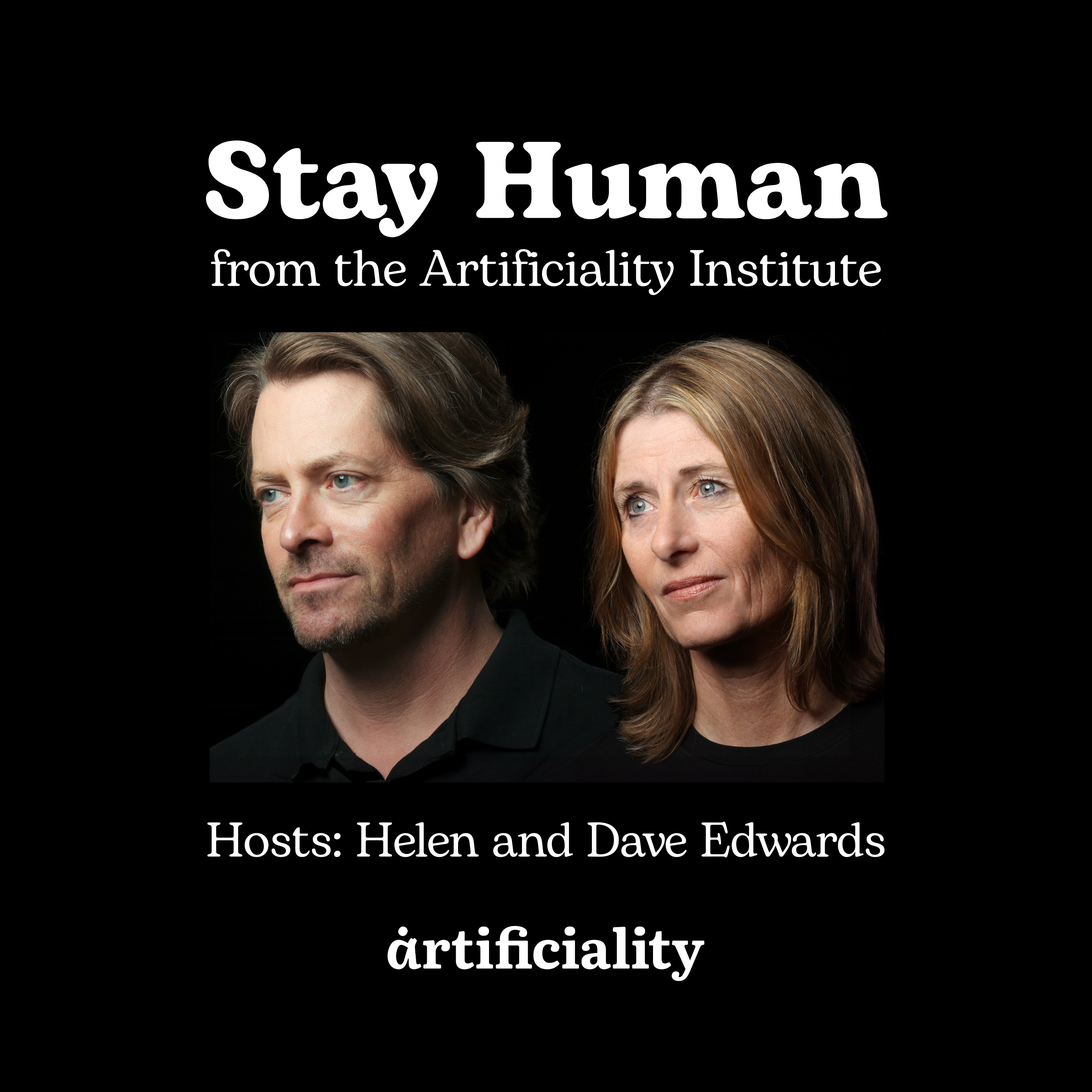

Hosted by Helen and Dave Edwards, Stay Human, from the Artificiality Institute is a conversation that lives in the messy, human space between our tools and our selves. Each episode digs into the subtle ways artificial intelligence is reshaping our daily decisions, our creative impulses, and even our sense of identity. This isn't a technical manual or a series of futuristic predictions; it's a grounded exploration of how we maintain our agency in a world increasingly mediated by algorithms. The podcast operates from a core belief: that our engagement with AI should be about more than just safety or efficiency-it needs to be meaningful and worthwhile. You'll hear discussions rooted in story-based research, where complex ideas about cognition and ethics are unpacked through relatable narratives and real-world examples. The goal is to provide a framework for thoughtful choice, helping each of us consciously design the relationship we want with the machines in our lives. Tuning in offers a chance to step back from the hype and consider how we can actively remain the authors of our own minds, preserving what makes us uniquely human even as the technology evolves. It's an essential listen for anyone curious about the personal and philosophical dimensions of our digital age.
Author: Language: en-us Episodes: 100

Stay Human, from the Artificiality Institute
Podcast Episodes
Julia Rhodes Davis: Advancing Racial Equity [not-audio_url] [/not-audio_url]

Duration: 47:39
In this episode, we speak with Julia Rhodes Davis, a Senior Advisor at Data & Society, about her recent report "Advancing Racial Equity Through Technology Policy" published by the AI Now Institute. This comprehensive rep…
Alicia Juarrero: Context Changes Everything [not-audio_url] [/not-audio_url]

Duration: 1:04:50
Grounding her work in the problem of causation, Alicia Juarrero challenges previously held beliefs that only forceful impacts are causes. Constraints, she claims, bring about effects as well, and they enable the emergenc…
Jai Vipra: Computational Power and AI [not-audio_url] [/not-audio_url]

Duration: 41:17
Jai Vipra is a research fellow at the AI Now Institute where she focuses on competition issues in frontier AI models. She recently published the report Computational Power and AI which focuses on compute as a core depend…
Wendy Wong: We, the Data, and Human Rights [not-audio_url] [/not-audio_url]

Duration: 58:40
Wendy Wong is a professor of political science and principal’s research chair at the University of British Columbia where she researches and teaches about the governance of emerging technologies, human rights, and civil…
Chris Summerfield: Natural General Intelligence [not-audio_url] [/not-audio_url]

Duration: 56:53
Chris Summerfield is a Professor of Cognitive Science at the University of Oxford. His work is concerned with understanding how humans learn and make decisions. He is interested in how humans acquire new concepts or patt…
Michael Bungay Stanier: How to Work with (Almost) Anyone [not-audio_url] [/not-audio_url]

Duration: 58:02
Michael Bungay Stanier has an extraordinary talent for distilling the complexity of human relationships into easy to remember and follow frameworks—doing so with just the right amount of Australian humor and plenty of vu…
Synthesis & Generative AI [not-audio_url] [/not-audio_url]

Duration: 33:21
An exploration of how we might conceptualize the design of AGI within the context of human left and right brains. The tension between AI and human functioning highlights unique cooperation. AI uses language, abstraction,…
Jonathan Coulton: Generative AI, songwriting, and creativity [not-audio_url] [/not-audio_url]

Duration: 1:01:37
If you’ve read our show notes, you’ll know that our music was written and performed by Jonathan Coulton. I’ve known Jonathan for more than 30 years, dating back to when we sang together in college. But that’s a story for…
Is it possible for AI to be meaningful? [not-audio_url] [/not-audio_url]

Duration: 36:30
An exploration of the intersection of AI, meaning, and human relationships. In this episode, we dive deep into the role of AI in our lives and how it can influence our perception of meaning. We explore how AI, and specif…
Existential risk of AI [not-audio_url] [/not-audio_url]

Duration: 32:37
ChatGPT, Dall-e, Midjourney, Bard, and Bing are here. Many others are coming. At every dinner conversation, classroom lesson, and business meeting people are talking about AI. There are some big questions that now everyo…
