De Kai: Raising AI

De Kai: Raising AI

Author: Helen and Dave Edwards September 21, 2025 Duration: 54:57

In this conversation, we explore how humans can better navigate the AI era with De Kai, pioneering researcher who built the web's first machine translation systems and whose work spawned Google Translate. Drawing on four decades of AI research experience, De Kai offers a different framework for understanding our relationship with artificial intelligence—moving beyond outdated metaphors toward more constructive approaches.

De Kai's perspective was shaped by observing how AI technologies are being deployed in ways that increase rather than decrease human understanding. While AI has tremendous potential to help people communicate across cultural and linguistic differences—as his translation work demonstrated—current implementations often amplify polarization and misunderstanding instead.

Key themes we explore:

  • Beyond Machine Metaphors: Why thinking of AI as "tools" or "machines" is dangerously outdated—AI systems are fundamentally artificial psychological entities that learn, adapt, and influence human behavior in ways no coffee maker ever could
  • The Parenting Framework: De Kai's central insight that we're all currently "parenting" roughly 100 artificial intelligences daily through our smartphones, tablets, and devices—AIs that are watching, learning, and imitating our attitudes, behaviors, and belief systems
  • System One vs. System Two Intelligence: How current large language models operate primarily through "artificial autism"—brilliant pattern matching without the reflective, critical thinking capacities that characterize mature human intelligence
  • Translation as Understanding: Moving beyond simple language translation toward what De Kai calls a "translation mindset"—using AI to help humans understand different cultural framings and perspectives rather than enforcing singular universal truths
  • The Reframing Superpower: How AI's capacity for rapid perspective-shifting and metaphorical reasoning represents one of humanity's best hopes for breaking out of polarized narratives and finding common ground
  • Social Fabric Transformation: Understanding how 800 billion artificial minds embedded in our social networks are already reshaping how cultures and civilizations evolve—often in ways that increase rather than decrease mutual understanding


Drawing on insights from developmental psychology and complex systems, De Kai's "Raising AI" framework emphasizes conscious human responsibility in shaping how these artificial minds develop. Rather than viewing this as an overwhelming burden, he frames it as an opportunity for humans to become more intentional about the values and behaviors they model—both for AI systems and for each other.

About De Kai: De Kai is Professor of Computer Science and Engineering at HKUST and Distinguished Research Scholar at Berkeley’s International Computer Science Institute. He is Independent Director of AI ethics think tank The Future Society, and was one of eight inaugural members of Google’s AI ethics council. De Kai invented and built the world’s first global-scale online language translator that spawned Google Translate, Yahoo Translate, and Microsoft Bing Translator. For his pioneering contributions in AI, natural language processing, and machine learning, De Kai was honored by the Association for Computational Linguistics as one of only seventeen Founding Fellows and by Debrett’s as one of the 100 most influential figures of Hong Kong.
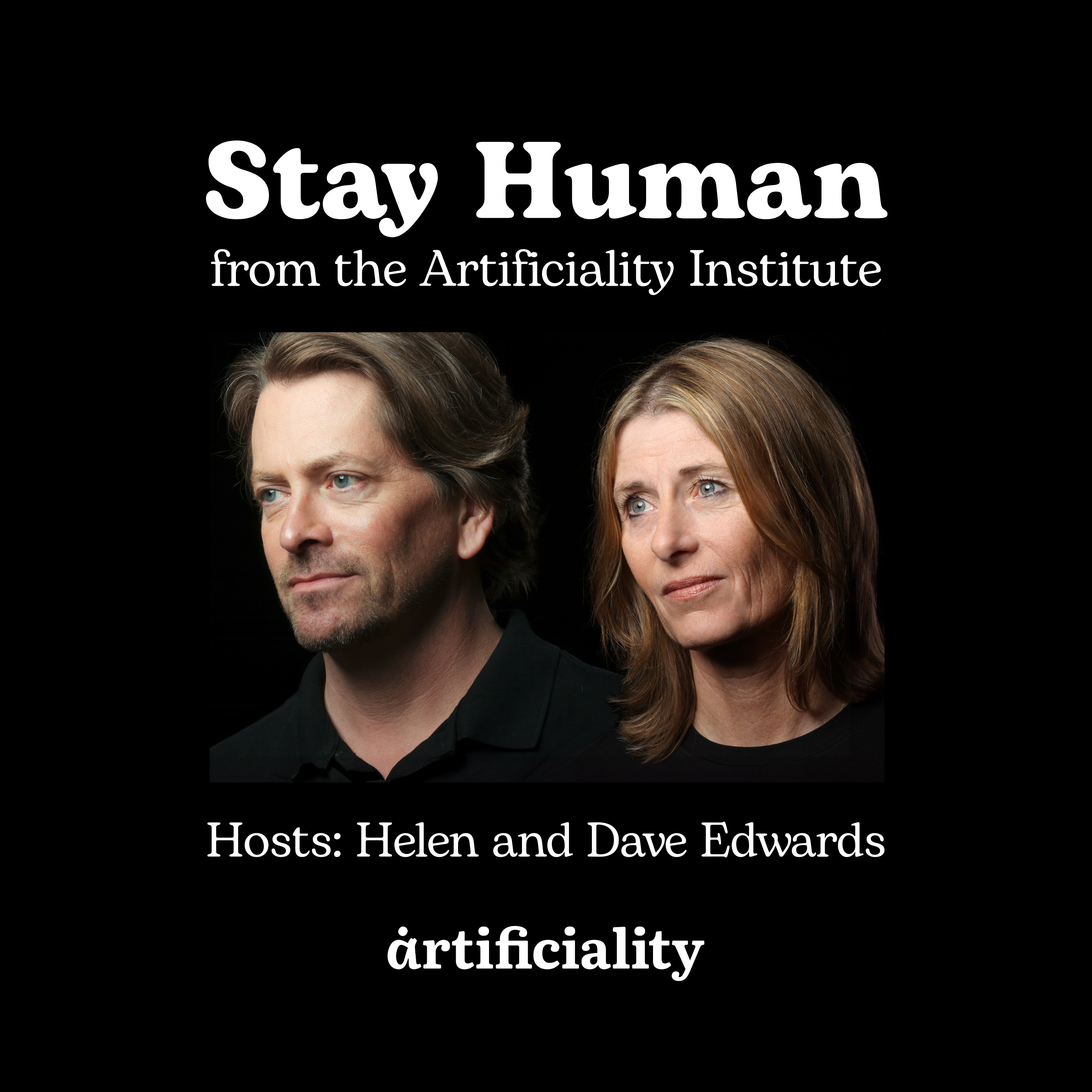

Hosted by Helen and Dave Edwards, Stay Human, from the Artificiality Institute is a conversation that lives in the messy, human space between our tools and our selves. Each episode digs into the subtle ways artificial intelligence is reshaping our daily decisions, our creative impulses, and even our sense of identity. This isn't a technical manual or a series of futuristic predictions; it's a grounded exploration of how we maintain our agency in a world increasingly mediated by algorithms. The podcast operates from a core belief: that our engagement with AI should be about more than just safety or efficiency-it needs to be meaningful and worthwhile. You'll hear discussions rooted in story-based research, where complex ideas about cognition and ethics are unpacked through relatable narratives and real-world examples. The goal is to provide a framework for thoughtful choice, helping each of us consciously design the relationship we want with the machines in our lives. Tuning in offers a chance to step back from the hype and consider how we can actively remain the authors of our own minds, preserving what makes us uniquely human even as the technology evolves. It's an essential listen for anyone curious about the personal and philosophical dimensions of our digital age.
Author: Language: en-us Episodes: 100

Stay Human, from the Artificiality Institute
Podcast Episodes
Values & Generative AI [not-audio_url] [/not-audio_url]

Duration: 25:05
As Silicon Valley lunges towards creating AI that is considered superior to humans (at times called Artificial General Intelligence or Super-intelligent AI), it does so with the premise that it is possible to encode valu…
Culture & Generative AI [not-audio_url] [/not-audio_url]

Duration: 32:29
Culture plays a vital role in connecting individuals and communities, enabling us to leverage our unique talents, share knowledge, and solve problems together. However, the rise of an intelligentsia of machine soothsayer…
Mind for our Minds: Introduction [not-audio_url] [/not-audio_url]

Duration: 26:28
This episode is the first in our summer series based on our thesis for designing AI to be a Mind for our Minds. We recently presented this idea for the first time at our favorite event of the year hosted by The House of…
C. Thi Nguyen: Metrification [not-audio_url] [/not-audio_url]

Duration: 1:07:38
AI is based on data. And data is frequently collected with the intent to be quantified, understood, and used across context. That’s why we have things like grade point averages that translate across subject matters and e…
Harpreet Sareen: Cyborg Botany [not-audio_url] [/not-audio_url]

Duration: 48:44
We are deeply interested in the intersection of the digital and material worlds, both living and not living. Most of our interviews are focused on the intersection of humans and machines—how does the digital world affect…
Arvind Jain: Glean, Enterprise Search, and Generative AI [not-audio_url] [/not-audio_url]

Duration: 48:03
Anyone working in a large organization has likely asked this question: Why is it that I can seemingly find anything on the internet but I can’t seem to find anything inside my organization? It is counter-intuitive that i…
Lukas Egger: Generative AI, a view from SAP [not-audio_url] [/not-audio_url]

Duration: 46:35
The world has been upended by the introduction of generative AI. We think this could be the largest advance in technology—ever. All of our clients are trying to figure out what to do, how to de-risk the introduction of t…
Katie Davis: Technology's Child [not-audio_url] [/not-audio_url]

Duration: 52:32
Is technology good or bad for children? How should parents think about technology in their children’s lives? Are there different answers depending on the age of the child and their stage of development? What can we apply…
Andrew Blum: The Weather Machine [not-audio_url] [/not-audio_url]

Duration: 52:58
Weather forecasting is fascinating. It involves making predictions in the complex, natural world, using a global infrastructure for people who have varying needs and desires. Some just want to know if we should carry an…
Juan Noguera: Generative AI in Industrial Design [not-audio_url] [/not-audio_url]

Duration: 39:26
We’ve heard a lot about how generative AI may negatively impact careers in design. But we wonder how might generative AI have a positive impact on designers? How might generative AI be used as a tool that helps designers…