Emily M. Bender: AI, Linguistics, Parrots, and more!

Emily M. Bender: AI, Linguistics, Parrots, and more!

Author: Helen and Dave Edwards August 2, 2024 Duration: 57:18

We're excited to welcome to the podcast Emily M. Bender, professor of computational linguistics at the University of Washington.

As our listeners know, we enjoy tapping expertise in fields adjacent to the intersection of humans and AI. We find Emily’s expertise in linguistics to be particularly important when understanding the capabilities and limitations of large language models—and that’s why we were eager to talk with her.

Emily is perhaps best known in the AI community for coining the term "stochastic parrots" to describe these models, highlighting their ability to mimic human language without true understanding. In her paper "On the Dangers of Stochastic Parrots," Emily and her co-authors raised crucial questions about the environmental, financial, and social costs of developing ever-larger language models. Emily has been a vocal critic of AI hype and her work has been pivotal in sparking critical discussions about the direction of AI research and development.

In this conversation, we explore the issues of current AI systems with a particular focus on Emily’s view as a computational linguist. We also discuss Emily's recent research on the challenges of using AI in search engines and information retrieval systems, and her description of large language models as synthetic text extruding machines.

Let's dive into our conversation with Emily Bender.

----------------------

If you enjoy our podcasts, please subscribe and leave a positive rating or comment. Sharing your positive feedback helps us reach more people and connect them with the world’s great minds.

Subscribe to get Artificiality delivered to your email

Learn about our book Make Better Decisions and buy it on Amazon

Thanks to Jonathan Coulton for our music


#artificiality #ai #artificialintelligence #generativeai #airesearch #complexity #intimacyeconomy #spaciality #consciousness #knowledge #mindforourminds


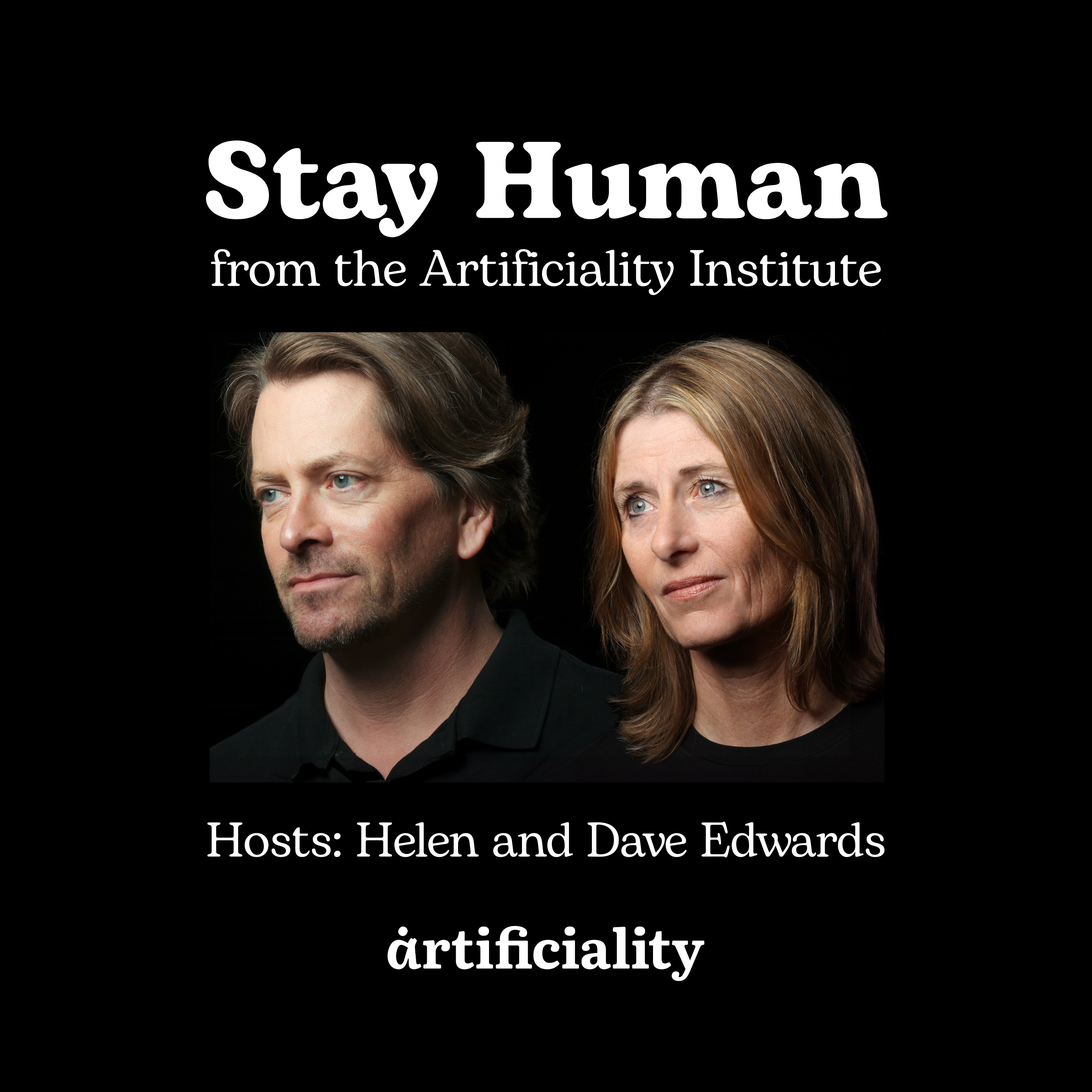
Hosted by Helen and Dave Edwards, Stay Human, from the Artificiality Institute is a conversation that lives in the messy, human space between our tools and our selves. Each episode digs into the subtle ways artificial intelligence is reshaping our daily decisions, our creative impulses, and even our sense of identity. This isn't a technical manual or a series of futuristic predictions; it's a grounded exploration of how we maintain our agency in a world increasingly mediated by algorithms. The podcast operates from a core belief: that our engagement with AI should be about more than just safety or efficiency-it needs to be meaningful and worthwhile. You'll hear discussions rooted in story-based research, where complex ideas about cognition and ethics are unpacked through relatable narratives and real-world examples. The goal is to provide a framework for thoughtful choice, helping each of us consciously design the relationship we want with the machines in our lives. Tuning in offers a chance to step back from the hype and consider how we can actively remain the authors of our own minds, preserving what makes us uniquely human even as the technology evolves. It's an essential listen for anyone curious about the personal and philosophical dimensions of our digital age.
Author: Language: en-us Episodes: 100

Stay Human, from the Artificiality Institute
Podcast Episodes
Megan Brown: Data Literacy [not-audio_url] [/not-audio_url]

Duration: 59:38
All major companies are working to increase the value of data science. Setting a goal may be easy but implementation often raises challenging questions. How should companies think about the role of data scientists, the c…
Peter Sterling: Decision Evolution [not-audio_url] [/not-audio_url]

Duration: 1:13:41
This week we talk with Peter Sterling, the author of What is Health. Peter has had a long career in medicine and neuroscience. He has recently published in Jama Psychiatry, with Michael Platt, on Why Deaths of Despair Ar…
Stephen Fleming: Metacognition [not-audio_url] [/not-audio_url]

Duration: 1:01:40
It’s human to know oneself. We are able to self-monitor, understand our cognition, and recognize gaps in our knowledge. This is called metacognition—we think about how we think. We can think of it as self-awareness or th…
Jevin West: Making Sense of Data [not-audio_url] [/not-audio_url]

Duration: 51:57
Have you ever wondered what it means to be data literate in a world of big data and AI? Now that so many decisions rely on information that is only readable by machine and our statistical intuitions, which were bad befor…
Michael Bungay Stanier: Staying Curious [not-audio_url] [/not-audio_url]

Duration: 43:25
Have you wondered what makes people different from machines? Well one thing is curiosity—curiosity is something that drives humans but as yet not machines. And one person that knows humans and curiosity is Michael Bungay…
Mollie Pettit: Visualizing Data [not-audio_url] [/not-audio_url]

Duration: 41:01
Making decisions with data requires some form of communication with data. But how do we communicate with numbers and characters and binary bits? The best way today is through data visualization. Visualizing data has come…
Josh Lovejoy: Designing AI [not-audio_url] [/not-audio_url]

Duration: 1:27:39
Have you ever wondered about what it takes to design AI that doesn’t do more harm than good? We speak with Josh Lovejoy who is perhaps the most experienced out there in the field of human-centered AI design. At the time…
Kate O'Neill: Humanizing Tech [not-audio_url] [/not-audio_url]

Duration: 43:52
Have you ever wondered what it means to be a humanist in the age of technology? How can we put human values into a machine? How can we even know what those human values are? We asked Kate O’Neill, founder of KO Insights…
Tania Lombrozo: Intuition and data [not-audio_url] [/not-audio_url]

Duration: 49:20
Have you ever wondered why we humans love to use our intuition even when we are surrounded by data and we also know that even simple algorithms can be more accurate than human judgment? We put that exact question to Tani…

«1...678910