John Pasmore: Inclusive AI

John Pasmore: Inclusive AI

Author: Helen and Dave Edwards October 12, 2025 Duration: 34:31

In this conversation, we explore the challenges of building more inclusive AI systems with John Pasmore, founder and CEO of Latimer AI and advisor to the Artificiality Institute. Latimer represents a fundamentally different approach to large language models—one built from the ground up to address the systematic gaps in how AI systems represent Black and Brown cultures, histories, and perspectives that have been largely absent from mainstream training data.

John brings a practical founder's perspective to questions that often remain abstract in AI discourse. With over 400 educational institutions now using Latimer, he's witnessing firsthand how students, faculty, and administrators are navigating the integration of AI into learning—from universities licensing 40+ different LLMs to schools still grappling with whether AI represents a cheating risk or a pedagogical opportunity.

Key themes we explore:

  • The Data Gap: Why mainstream LLMs reflect a narrow "Western culture bias" and what's missing when AI claims to "know everything"—from 15 million unscanned pages in Howard University's library to oral traditions across thousands of indigenous tribes.
  • Critical Thinking vs. Convenience: How universities are struggling to preserve deep learning and intellectual rigor when AI makes it trivially easy to get instant answers, and whether requiring students to bring their prompts to class represents a viable path forward.
  • The GPS Analogy: John's insight that AI's effect on cognitive skills mirrors what happened with navigation—we've gained efficiency but lost the embodied knowledge that comes from building mental maps through direct experience.
  • Multiple Models, Multiple Perspectives: Why the future likely involves domain-specific and culturally-situated LLMs rather than a single "universal" system, and how this parallels the reality that different cultures tell different stories about the same events.
  • Excavating Hidden Knowledge: Latimer's ambitious project to digitize and make accessible vast archives of cultural material—from church records to small museum collections—that never made it onto the internet and therefore don't exist in mainstream AI systems.
  • An eBay for Data: John's vision for creating a marketplace where content owners can license their data to AI companies, establishing both proper compensation and a mechanism for filling the systematic gaps in training corpora.

The conversation shows that AI bias goes beyond removing offensive outputs. We need to rethink which data sources we treat as authoritative and whose perspectives shape these influential systems. When AI presents itself as an oracle that has "read everything on the internet," it claims omniscience while excluding vast amounts of human knowledge and experience.

The discussion raises questions about expertise and process in an era of instant answers—in debugging code, navigating cities, or writing essays. John notes that we may be "working against evolution" by preserving slower, more effortful learning when our brains naturally seek efficiency. But what do we lose when we eliminate the struggle that builds deeper understanding?

About John Pasmore: John Pasmore is founder and CEO of Latimer AI, a large language model built to provide accurate historical information and bias-free interaction for Black and Brown audiences and anyone who values precision in their data. Previously a partner at TRS Capital and Movita Organics, John serves on the Board of Directors of Outward Bound USA and holds degrees in Business Administration from SUNY and Computer Science from Columbia University. He is also an advisor to the Artificiality Institute.
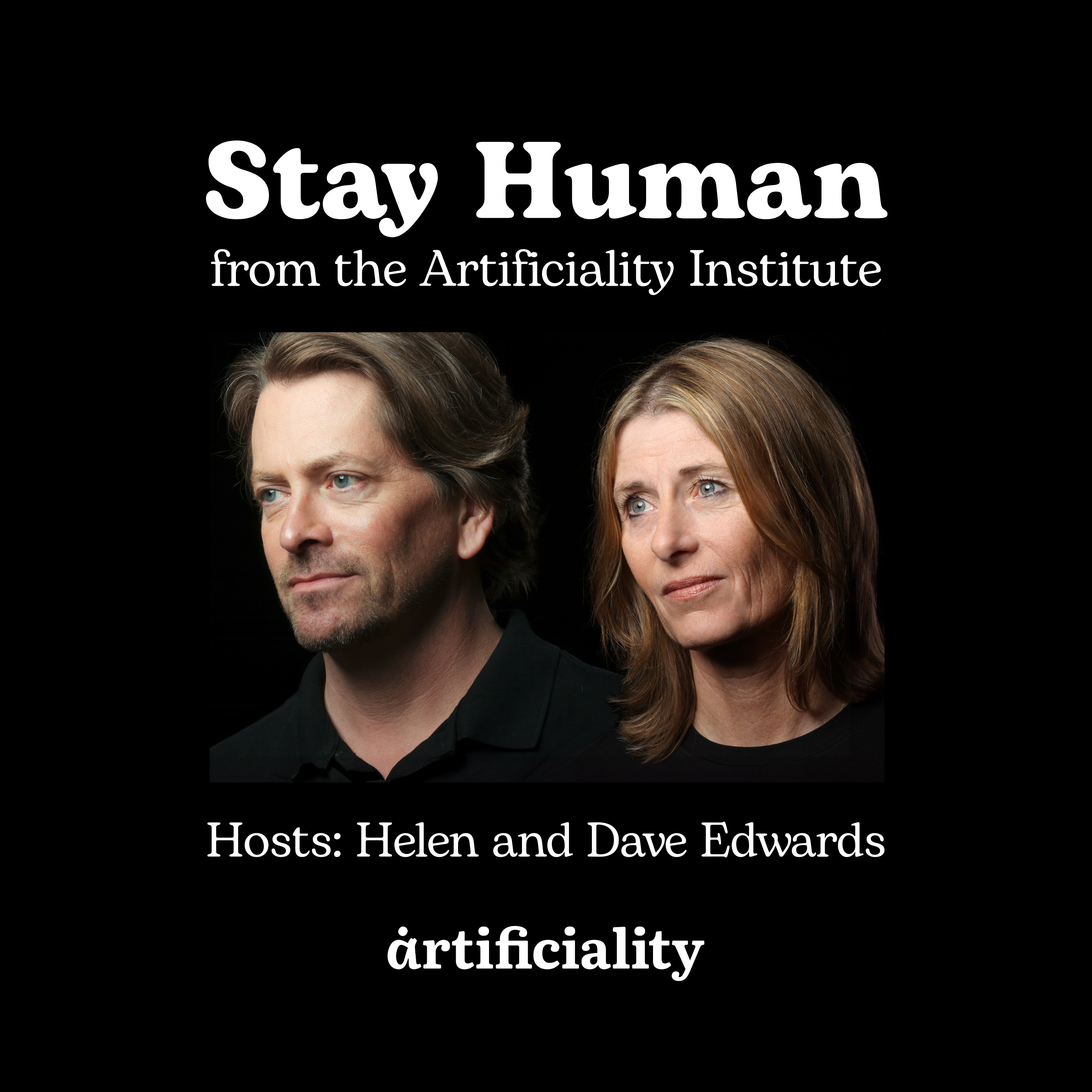

Hosted by Helen and Dave Edwards, Stay Human, from the Artificiality Institute is a conversation that lives in the messy, human space between our tools and our selves. Each episode digs into the subtle ways artificial intelligence is reshaping our daily decisions, our creative impulses, and even our sense of identity. This isn't a technical manual or a series of futuristic predictions; it's a grounded exploration of how we maintain our agency in a world increasingly mediated by algorithms. The podcast operates from a core belief: that our engagement with AI should be about more than just safety or efficiency-it needs to be meaningful and worthwhile. You'll hear discussions rooted in story-based research, where complex ideas about cognition and ethics are unpacked through relatable narratives and real-world examples. The goal is to provide a framework for thoughtful choice, helping each of us consciously design the relationship we want with the machines in our lives. Tuning in offers a chance to step back from the hype and consider how we can actively remain the authors of our own minds, preserving what makes us uniquely human even as the technology evolves. It's an essential listen for anyone curious about the personal and philosophical dimensions of our digital age.
Author: Language: en-us Episodes: 100

Stay Human, from the Artificiality Institute
Podcast Episodes
Values & Generative AI [not-audio_url] [/not-audio_url]

Duration: 25:05
As Silicon Valley lunges towards creating AI that is considered superior to humans (at times called Artificial General Intelligence or Super-intelligent AI), it does so with the premise that it is possible to encode valu…
Culture & Generative AI [not-audio_url] [/not-audio_url]

Duration: 32:29
Culture plays a vital role in connecting individuals and communities, enabling us to leverage our unique talents, share knowledge, and solve problems together. However, the rise of an intelligentsia of machine soothsayer…
Mind for our Minds: Introduction [not-audio_url] [/not-audio_url]

Duration: 26:28
This episode is the first in our summer series based on our thesis for designing AI to be a Mind for our Minds. We recently presented this idea for the first time at our favorite event of the year hosted by The House of…
C. Thi Nguyen: Metrification [not-audio_url] [/not-audio_url]

Duration: 1:07:38
AI is based on data. And data is frequently collected with the intent to be quantified, understood, and used across context. That’s why we have things like grade point averages that translate across subject matters and e…
Harpreet Sareen: Cyborg Botany [not-audio_url] [/not-audio_url]

Duration: 48:44
We are deeply interested in the intersection of the digital and material worlds, both living and not living. Most of our interviews are focused on the intersection of humans and machines—how does the digital world affect…
Arvind Jain: Glean, Enterprise Search, and Generative AI [not-audio_url] [/not-audio_url]

Duration: 48:03
Anyone working in a large organization has likely asked this question: Why is it that I can seemingly find anything on the internet but I can’t seem to find anything inside my organization? It is counter-intuitive that i…
Lukas Egger: Generative AI, a view from SAP [not-audio_url] [/not-audio_url]

Duration: 46:35
The world has been upended by the introduction of generative AI. We think this could be the largest advance in technology—ever. All of our clients are trying to figure out what to do, how to de-risk the introduction of t…
Katie Davis: Technology's Child [not-audio_url] [/not-audio_url]

Duration: 52:32
Is technology good or bad for children? How should parents think about technology in their children’s lives? Are there different answers depending on the age of the child and their stage of development? What can we apply…
Andrew Blum: The Weather Machine [not-audio_url] [/not-audio_url]

Duration: 52:58
Weather forecasting is fascinating. It involves making predictions in the complex, natural world, using a global infrastructure for people who have varying needs and desires. Some just want to know if we should carry an…
Juan Noguera: Generative AI in Industrial Design [not-audio_url] [/not-audio_url]

Duration: 39:26
We’ve heard a lot about how generative AI may negatively impact careers in design. But we wonder how might generative AI have a positive impact on designers? How might generative AI be used as a tool that helps designers…