No-duhs and some surprises

No-duhs and some surprises

Author: Helen and Dave Edwards December 2, 2022 Duration: 26:37

The latest Big Ideas report from MIT Sloan and BCG makes for an interesting read but contains flaws, obvious conclusions, and raises more questions than it answers.

We discuss this report and make some suggestions about how to think about AI based on the survey’s conclusions:

* trust matters (no-duh). The data suggests if people trust AI they will use it twice as much.

* ability to override the AI matters (no-duh). The data suggests if people can override the AI they will use it twice as much.

* people describe an AI as a co-worker but the majority of people don’t even know they are using it. Huh?

Another surprise is that people like AI that means they don’t have to talk to their boss. Who would have anticipated that?

Nudges of the week

Helen: Synthesize Later. Integrate argument and counter-argument into a decision. Good decisions involve reconciling subjective judgments and resolving clashing causal forces. The best way to do this is to be deliberate and conscious of the need to synthesize. Schedule a meeting titled “synthesis” and set expectations that now is the moment to step slowly through each point of view, iterate, and nudge each side. Have each side make a list of the things that would bring them toward each other. Failing to do this contributes to a sense that the decision is stuck.

Dave: Be Less Wrong. Let go of perfectionism and feel the relief of knowing that by striving to be less wrong, you’ll probably end up being more right.

What We’re Learning

Helen: The Neuroscience of You by Chantel Prat. Delivers on the promise of showing you how your brain is different. Really fun and engaging book to read and do all the tests.

Dave: Learning from Helen! He’s been reading the first draft of our next book Solve Better Problems: How to Solve Complex Problems in the Digital Age. Complexity really is a different animal and it’s mind opening to understand why.

If you enjoy our podcasts, please subscribe on Substack or your favorite podcast platform. And please leave a positive rating or comment—haring your positive feedback helps us reach more people and connect them with the world's great minds. Seriously, a review on Apple podcasts is a big deal!

And if you like how we think then contact us about our speaking and workshops, and human-centered product design. You can learn more about us at getsonder.com and you can contact us at hello@getsonder.com.

You can learn more about making better decisions in our book, Make Better Decisions: How to Improve Your Decision-Making in the Digital Age. The book is an essential guide to practicing the cognitive skills needed for making better decisions in the age of data, algorithms, and AI. Please check it out at MBD.zone and purchase it from Amazon, Bookshop.org, or your favorite local bookstore.


This is a public episode. If you would like to discuss this with other subscribers or get access to bonus episodes, visit www.artificiality.world

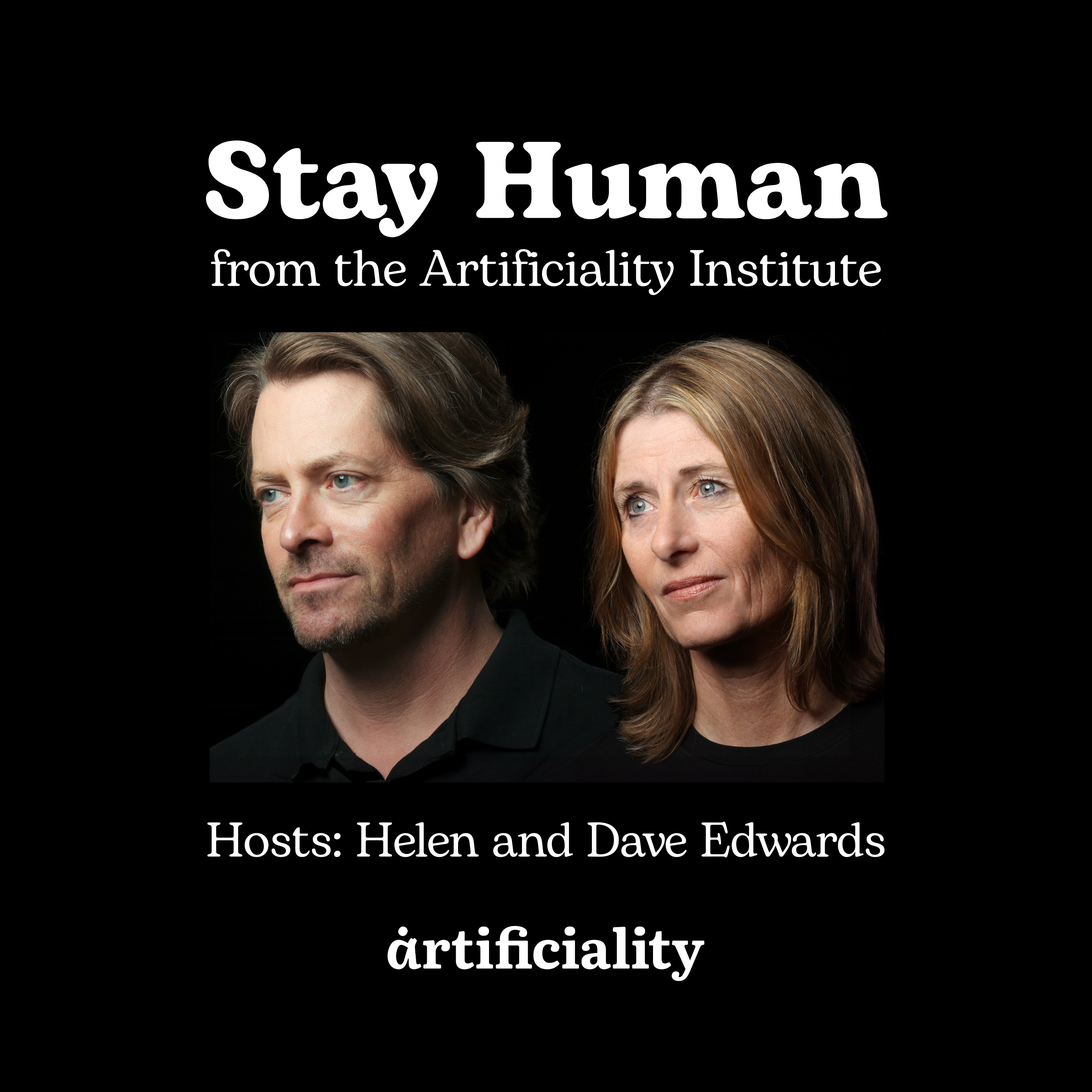
Hosted by Helen and Dave Edwards, Stay Human, from the Artificiality Institute is a conversation that lives in the messy, human space between our tools and our selves. Each episode digs into the subtle ways artificial intelligence is reshaping our daily decisions, our creative impulses, and even our sense of identity. This isn't a technical manual or a series of futuristic predictions; it's a grounded exploration of how we maintain our agency in a world increasingly mediated by algorithms. The podcast operates from a core belief: that our engagement with AI should be about more than just safety or efficiency-it needs to be meaningful and worthwhile. You'll hear discussions rooted in story-based research, where complex ideas about cognition and ethics are unpacked through relatable narratives and real-world examples. The goal is to provide a framework for thoughtful choice, helping each of us consciously design the relationship we want with the machines in our lives. Tuning in offers a chance to step back from the hype and consider how we can actively remain the authors of our own minds, preserving what makes us uniquely human even as the technology evolves. It's an essential listen for anyone curious about the personal and philosophical dimensions of our digital age.
Author: Language: en-us Episodes: 100

Stay Human, from the Artificiality Institute
Podcast Episodes
Steven Sloman: LLMs and Deliberative Reasoning [not-audio_url] [/not-audio_url]

Duration: 1:01:06
If you’ve used a large language model, you’ve likely had one or more moments of amazement as the tool immediately responded with impressive content from its massive data cosmos training set. But you’ve likely also had mo…
Julia Rhodes Davis: Advancing Racial Equity [not-audio_url] [/not-audio_url]

Duration: 47:39
In this episode, we speak with Julia Rhodes Davis, a Senior Advisor at Data & Society, about her recent report "Advancing Racial Equity Through Technology Policy" published by the AI Now Institute. This comprehensive rep…
Alicia Juarrero: Context Changes Everything [not-audio_url] [/not-audio_url]

Duration: 1:04:50
Grounding her work in the problem of causation, Alicia Juarrero challenges previously held beliefs that only forceful impacts are causes. Constraints, she claims, bring about effects as well, and they enable the emergenc…
Jai Vipra: Computational Power and AI [not-audio_url] [/not-audio_url]

Duration: 41:17
Jai Vipra is a research fellow at the AI Now Institute where she focuses on competition issues in frontier AI models. She recently published the report Computational Power and AI which focuses on compute as a core depend…
Wendy Wong: We, the Data, and Human Rights [not-audio_url] [/not-audio_url]

Duration: 58:40
Wendy Wong is a professor of political science and principal’s research chair at the University of British Columbia where she researches and teaches about the governance of emerging technologies, human rights, and civil…
Chris Summerfield: Natural General Intelligence [not-audio_url] [/not-audio_url]

Duration: 56:53
Chris Summerfield is a Professor of Cognitive Science at the University of Oxford. His work is concerned with understanding how humans learn and make decisions. He is interested in how humans acquire new concepts or patt…
Michael Bungay Stanier: How to Work with (Almost) Anyone [not-audio_url] [/not-audio_url]

Duration: 58:02
Michael Bungay Stanier has an extraordinary talent for distilling the complexity of human relationships into easy to remember and follow frameworks—doing so with just the right amount of Australian humor and plenty of vu…
Synthesis & Generative AI [not-audio_url] [/not-audio_url]

Duration: 33:21
An exploration of how we might conceptualize the design of AGI within the context of human left and right brains. The tension between AI and human functioning highlights unique cooperation. AI uses language, abstraction,…
Jonathan Coulton: Generative AI, songwriting, and creativity [not-audio_url] [/not-audio_url]

Duration: 1:01:37
If you’ve read our show notes, you’ll know that our music was written and performed by Jonathan Coulton. I’ve known Jonathan for more than 30 years, dating back to when we sang together in college. But that’s a story for…
Is it possible for AI to be meaningful? [not-audio_url] [/not-audio_url]

Duration: 36:30
An exploration of the intersection of AI, meaning, and human relationships. In this episode, we dive deep into the role of AI in our lives and how it can influence our perception of meaning. We explore how AI, and specif…