Steven Sloman: The Cost of Conviction

Steven Sloman: The Cost of Conviction

Author: Helen and Dave Edwards February 15, 2026 Duration: 52:46

In this conversation, we explore the psychology of conviction with Steve Sloman, Professor of Cognitive, Linguistic, and Psychological Sciences at Brown University and advisor to the Artificiality Institute. Returning to the podcast for a third time, Steve discusses his new book "The Cost of Conviction," which examines a fundamental tension in how humans make decisions—between carefully weighing consequences versus following deeply held sacred values that demand certain actions regardless of outcomes.

Steve's work challenges the dominant assumption in decision research that people primarily act as consequentialists, calculating costs and benefits to maximize utility. Instead, he reveals how many of our most important decisions bypass consequence entirely, guided by sacred values—rules about appropriate action handed down through families and communities that define who we are and signal membership in our social groups. These aren't carefully derived from first principles like philosophical deontology suggests, but rather adopted beliefs about right and wrong that make us members in good standing of our communities.

Key themes we explore:

  • Sacred Values as Uber Heuristics: Why treating certain actions as absolutely right or wrong, independent of consequences, represents perhaps the most powerful shortcut for decision-making—simpler even than most heuristics because it allows us to ignore outcomes entirely
  • Conviction Without Compromise: How framing issues through sacred values makes them feel less tractable, generates more outrage when violated, and increases willingness to take action—producing the absolutist convictions that drive both heroic stands and intractable conflicts
  • Dynamic Sacred Values: How values that define communities aren't fixed but emerge and shift based on what distinguishes groups from each other—explaining why tariffs or transgender rights suddenly become hotly contested "sacred" issues that weren't previously central
  • AI's Polarization Problem: The observation that attitudes toward AI have taken on sacred value characteristics, with absolutist believers that it will save the world racing against those convinced it represents fundamental evil—both positions simpler than engaging with genuine complexity and uncertainty

The conversation reveals Steve's core thesis: we rely on sacred values too much when we should be more consequentialist. Sacred values simplify decisions in ways that produce conviction and community cohesion, but at the cost of making us intransigent, uncompromising, and absolutist. When we shift to genuinely considering consequences, we become more humble about our knowledge limitations and hopefully more open to alternative perspectives.

Yet the discussion also surfaces important nuances. Sacred values serve crucial functions—they may have consequentialist origins in cultural experience even if individuals apply them without consequence calculation. They provide the kind of universal moral stance that makes someone trustworthy in ways that preferences over specific outcomes cannot. And expressing certainty about complex issues where genuine experts admit uncertainty often signals ignorance rather than knowledge.

About Steve Sloman: Steve Sloman is Professor of Cognitive, Linguistic, and Psychological Sciences at Brown University, where his research examines reasoning, decision-making, and the cognitive foundations of community. Author of "The Knowledge Illusion" (with Philip Fernbach) and now "The Cost of Conviction," Steve's work explores how our reliance on others' knowledge shapes everything from individual decisions to political polarization. As an advisor to the Artificiality Institute, he helps bridge cognitive science insights with questions about human-AI collaboration and co-evolution.
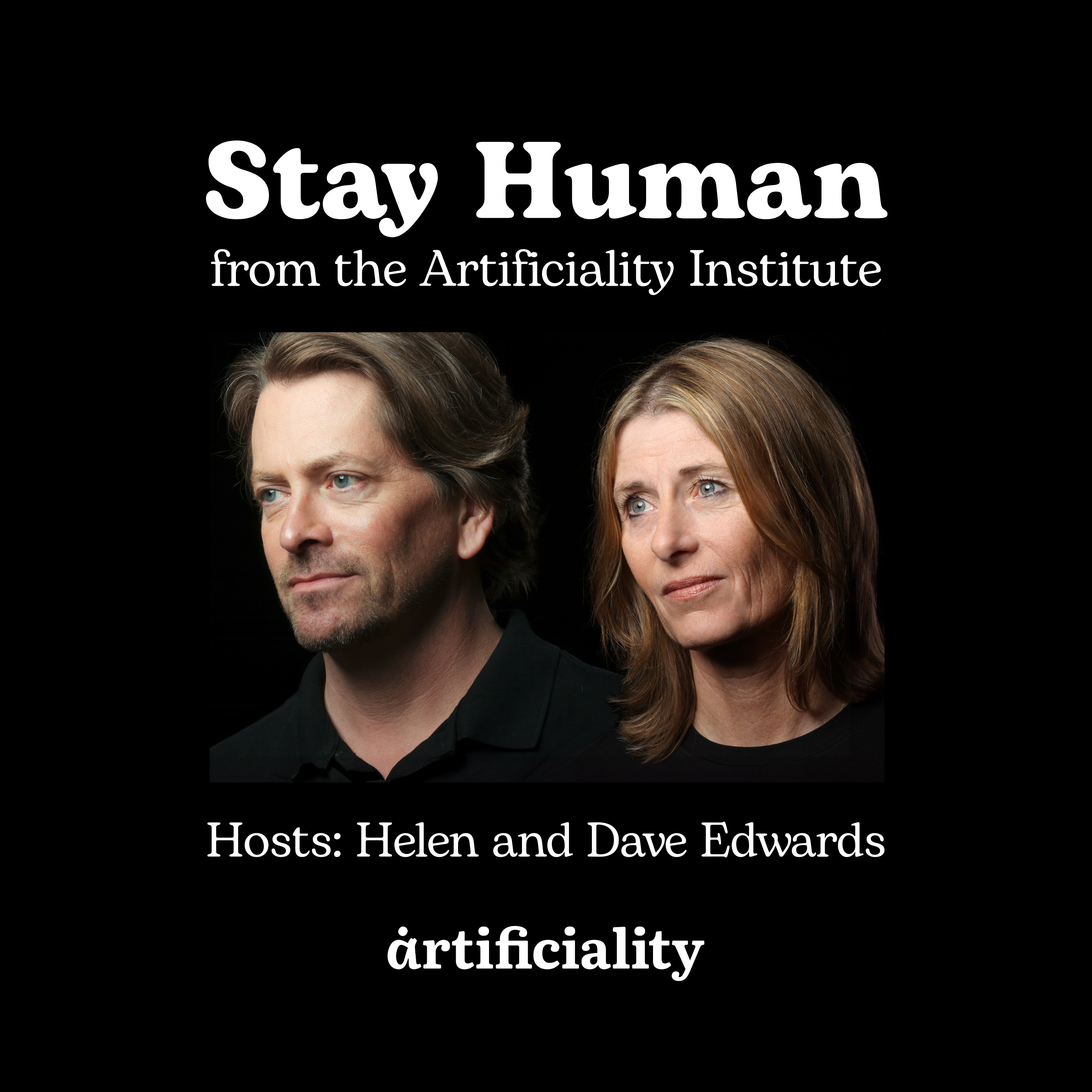

Hosted by Helen and Dave Edwards, Stay Human, from the Artificiality Institute is a conversation that lives in the messy, human space between our tools and our selves. Each episode digs into the subtle ways artificial intelligence is reshaping our daily decisions, our creative impulses, and even our sense of identity. This isn't a technical manual or a series of futuristic predictions; it's a grounded exploration of how we maintain our agency in a world increasingly mediated by algorithms. The podcast operates from a core belief: that our engagement with AI should be about more than just safety or efficiency-it needs to be meaningful and worthwhile. You'll hear discussions rooted in story-based research, where complex ideas about cognition and ethics are unpacked through relatable narratives and real-world examples. The goal is to provide a framework for thoughtful choice, helping each of us consciously design the relationship we want with the machines in our lives. Tuning in offers a chance to step back from the hype and consider how we can actively remain the authors of our own minds, preserving what makes us uniquely human even as the technology evolves. It's an essential listen for anyone curious about the personal and philosophical dimensions of our digital age.
Author: Language: en-us Episodes: 100

Stay Human, from the Artificiality Institute
Podcast Episodes
Values & Generative AI [not-audio_url] [/not-audio_url]

Duration: 25:05
As Silicon Valley lunges towards creating AI that is considered superior to humans (at times called Artificial General Intelligence or Super-intelligent AI), it does so with the premise that it is possible to encode valu…
Culture & Generative AI [not-audio_url] [/not-audio_url]

Duration: 32:29
Culture plays a vital role in connecting individuals and communities, enabling us to leverage our unique talents, share knowledge, and solve problems together. However, the rise of an intelligentsia of machine soothsayer…
Mind for our Minds: Introduction [not-audio_url] [/not-audio_url]

Duration: 26:28
This episode is the first in our summer series based on our thesis for designing AI to be a Mind for our Minds. We recently presented this idea for the first time at our favorite event of the year hosted by The House of…
C. Thi Nguyen: Metrification [not-audio_url] [/not-audio_url]

Duration: 1:07:38
AI is based on data. And data is frequently collected with the intent to be quantified, understood, and used across context. That’s why we have things like grade point averages that translate across subject matters and e…
Harpreet Sareen: Cyborg Botany [not-audio_url] [/not-audio_url]

Duration: 48:44
We are deeply interested in the intersection of the digital and material worlds, both living and not living. Most of our interviews are focused on the intersection of humans and machines—how does the digital world affect…
Arvind Jain: Glean, Enterprise Search, and Generative AI [not-audio_url] [/not-audio_url]

Duration: 48:03
Anyone working in a large organization has likely asked this question: Why is it that I can seemingly find anything on the internet but I can’t seem to find anything inside my organization? It is counter-intuitive that i…
Lukas Egger: Generative AI, a view from SAP [not-audio_url] [/not-audio_url]

Duration: 46:35
The world has been upended by the introduction of generative AI. We think this could be the largest advance in technology—ever. All of our clients are trying to figure out what to do, how to de-risk the introduction of t…
Katie Davis: Technology's Child [not-audio_url] [/not-audio_url]

Duration: 52:32
Is technology good or bad for children? How should parents think about technology in their children’s lives? Are there different answers depending on the age of the child and their stage of development? What can we apply…
Andrew Blum: The Weather Machine [not-audio_url] [/not-audio_url]

Duration: 52:58
Weather forecasting is fascinating. It involves making predictions in the complex, natural world, using a global infrastructure for people who have varying needs and desires. Some just want to know if we should carry an…
Juan Noguera: Generative AI in Industrial Design [not-audio_url] [/not-audio_url]

Duration: 39:26
We’ve heard a lot about how generative AI may negatively impact careers in design. But we wonder how might generative AI have a positive impact on designers? How might generative AI be used as a tool that helps designers…