Tess Posner: AI, Creativity, and Education

Tess Posner: AI, Creativity, and Education

Author: Helen and Dave Edwards November 10, 2025 Duration: 51:15

In this conversation recorded on the 1,000th day since ChatGPT's launch, we explore education, creativity, and transformation with Tess Posner, founding CEO of AI4ALL. For nearly a decade—long before the current AI surge—Tess has led efforts to broaden access to AI education, starting from a 2016 summer camp at Stanford that demonstrated how exposure to hands-on AI projects could inspire high school students, particularly young women, to pursue careers in the field.

What began as exposing students to "the magic" of AI possibilities has evolved into something more complex: helping young people navigate a moment of radical uncertainty while developing both technical capabilities and critical thinking about implications. As Tess observes, we're recording at a time when universities are simultaneously banning ChatGPT and embracing it, when the job market for graduates is sobering, and when the entire structure of work is being "reinvented from the ground up."

Key themes we explore:

  • Living the Questions: How Tess's team adopted Rilke's concept of "living the questions" as their guiding principle for navigating unprecedented change—recognizing that answers won't come easily and that cultivating wisdom matters more than chasing certainty
  • The Diverse Pain Point: Why students from varied backgrounds gravitate toward different AI applications—from predicting droughts for farm worker families to detecting Alzheimer's based on personal experience—and how this diversity of lived experience shapes what problems get attention
  • Project-Based Learning as Anchor: How hands-on making and building creates the kind of applied learning that both reveals AI's possibilities and exposes its limitations, while fostering the critical thinking skills that pure consumption of AI outputs cannot develop
  • The Educational Reckoning: Why this moment is forcing fundamental questions about the purpose of schooling—moving beyond detection tools and honor codes toward reimagining how learning happens when instant answers are always available
  • The Worst Job Market in Decades: Sobering realities facing graduates alongside surprising opportunities—some companies doubling down on "AI native" early career talent while others fundamentally restructure work around managing AI agents rather than doing tasks directly
  • Music and the Soul Question: Tess's personal wrestling with AI-generated music that can mimic human emotional expression so convincingly it gets stuck in your head—forcing questions about whether something deeper than output quality matters in art


The conversation reveals someone committed to equity and access while refusing easy optimism about technology's trajectory. Tess acknowledges that "nobody really knows" what the future of work looks like or how education should adapt, yet maintains that the response cannot be paralysis. Instead, AI4ALL's approach emphasizes building community, developing genuine technical skills, and threading ethical considerations through every project—equipping students not with certainty but with agency.


About Tess Posner: Tess Posner is founding and interim CEO of AI4ALL, a nonprofit working to increase diversity and inclusion in AI education, research, development, and policy. Since 2017, she has led the organization's expansion from a single summer program at Stanford to a nationwide initiative serving students from over 150 universities. A graduate of St. John's College with its Great Books curriculum, Tess is also an accomplished musician who brings both technical expertise and humanistic perspective to questions about AI's role in creativity and human flourishing.

Our Theme Music:

  • Solid State (Reprise)
  • Written & performed by Jonathan Coulton
  • License: Perpetual, worldwide licence for podcast theme usage granted to Artificiality Institute by songwriter and publisher
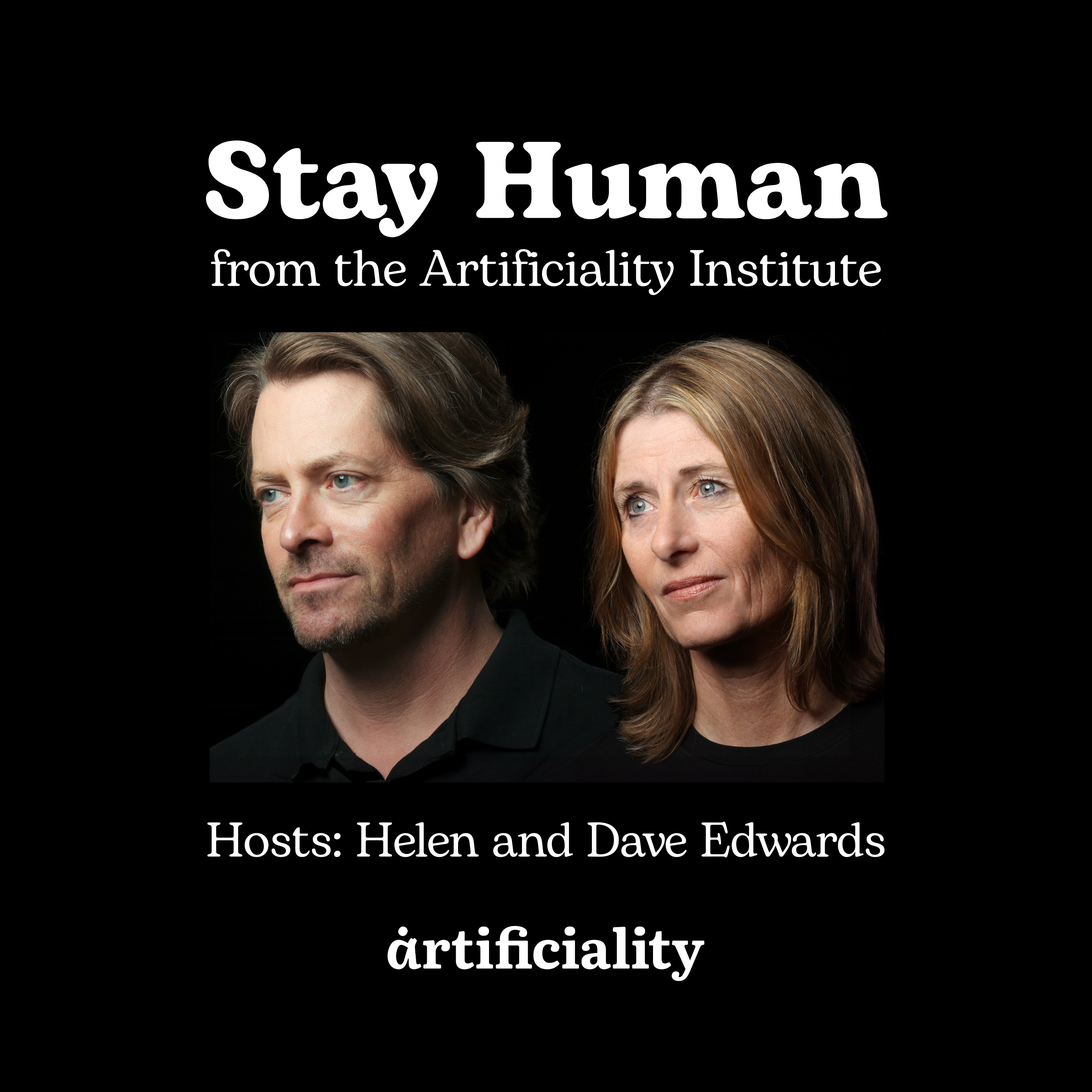
Hosted by Helen and Dave Edwards, Stay Human, from the Artificiality Institute is a conversation that lives in the messy, human space between our tools and our selves. Each episode digs into the subtle ways artificial intelligence is reshaping our daily decisions, our creative impulses, and even our sense of identity. This isn't a technical manual or a series of futuristic predictions; it's a grounded exploration of how we maintain our agency in a world increasingly mediated by algorithms. The podcast operates from a core belief: that our engagement with AI should be about more than just safety or efficiency-it needs to be meaningful and worthwhile. You'll hear discussions rooted in story-based research, where complex ideas about cognition and ethics are unpacked through relatable narratives and real-world examples. The goal is to provide a framework for thoughtful choice, helping each of us consciously design the relationship we want with the machines in our lives. Tuning in offers a chance to step back from the hype and consider how we can actively remain the authors of our own minds, preserving what makes us uniquely human even as the technology evolves. It's an essential listen for anyone curious about the personal and philosophical dimensions of our digital age.
Author: Language: en-us Episodes: 100

Stay Human, from the Artificiality Institute
Podcast Episodes
Megan Brown: Data Literacy [not-audio_url] [/not-audio_url]

Duration: 59:38
All major companies are working to increase the value of data science. Setting a goal may be easy but implementation often raises challenging questions. How should companies think about the role of data scientists, the c…
Peter Sterling: Decision Evolution [not-audio_url] [/not-audio_url]

Duration: 1:13:41
This week we talk with Peter Sterling, the author of What is Health. Peter has had a long career in medicine and neuroscience. He has recently published in Jama Psychiatry, with Michael Platt, on Why Deaths of Despair Ar…
Stephen Fleming: Metacognition [not-audio_url] [/not-audio_url]

Duration: 1:01:40
It’s human to know oneself. We are able to self-monitor, understand our cognition, and recognize gaps in our knowledge. This is called metacognition—we think about how we think. We can think of it as self-awareness or th…
Jevin West: Making Sense of Data [not-audio_url] [/not-audio_url]

Duration: 51:57
Have you ever wondered what it means to be data literate in a world of big data and AI? Now that so many decisions rely on information that is only readable by machine and our statistical intuitions, which were bad befor…
Michael Bungay Stanier: Staying Curious [not-audio_url] [/not-audio_url]

Duration: 43:25
Have you wondered what makes people different from machines? Well one thing is curiosity—curiosity is something that drives humans but as yet not machines. And one person that knows humans and curiosity is Michael Bungay…
Mollie Pettit: Visualizing Data [not-audio_url] [/not-audio_url]

Duration: 41:01
Making decisions with data requires some form of communication with data. But how do we communicate with numbers and characters and binary bits? The best way today is through data visualization. Visualizing data has come…
Josh Lovejoy: Designing AI [not-audio_url] [/not-audio_url]

Duration: 1:27:39
Have you ever wondered about what it takes to design AI that doesn’t do more harm than good? We speak with Josh Lovejoy who is perhaps the most experienced out there in the field of human-centered AI design. At the time…
Kate O'Neill: Humanizing Tech [not-audio_url] [/not-audio_url]

Duration: 43:52
Have you ever wondered what it means to be a humanist in the age of technology? How can we put human values into a machine? How can we even know what those human values are? We asked Kate O’Neill, founder of KO Insights…
Tania Lombrozo: Intuition and data [not-audio_url] [/not-audio_url]

Duration: 49:20
Have you ever wondered why we humans love to use our intuition even when we are surrounded by data and we also know that even simple algorithms can be more accurate than human judgment? We put that exact question to Tani…

«1...678910