Barber Violin Concerto

Barber Violin Concerto

Author: Joshua Weilerstein October 9, 2025 Duration: 47:26

There are so many great apocryphal stories in the long history of classical music, from the reason Tchaikovsky wrote his Sixth Symphony to what famous composers supposedly said on their deathbeds, to my favorite story: how Joseph Haydn's Symphony No. 96, The Miracle, got its name.

Apparently, during the premiere of the symphony, a chandelier fell, but miraculously didn't hit anyone. Hence, The Miracle Symphony. The chandelier did, in fact, fall, but we now know it happened during the premiere of Haydn's Symphony No. 102, which has no nickname. Coincidentally, or perhaps not so coincidentally, the 96th Symphony is performed far more often than the 102nd, likely because of its nickname, even though it's the nickname of the wrong symphony.

The Barber Violin Concerto has a great and true story behind it. But before certain information was revealed in 2010, the story everyone knew was quite different. The original version goes like this: Barber had completed the first two movements of his Violin Concerto and sent them to the soloist scheduled to premiere the work, Iso Briselli. Briselli didn't like the concerto, claiming it wasn't virtuosic enough, and asked Barber to write something more difficult.

Barber, perhaps with an evil laugh, obliged and returned with the third movement. When Briselli received it, he realized he couldn't play it because of its extreme difficulty and ultimately withdrew from the premiere, which instead went to violinist Albert Spalding. It's a perfect "Icarus flying too close to the sun" kind of classical music story, but as it turns out, it isn't the full story.

In 2010, letters were released between Barber, Briselli, and the real instigator in this little operetta, Briselli's violin teacher, Albert Meiff. I'll get into the whole story later, but it's a good one, even if it's not quite as cinematic as the legend.

More important than the dispute over its last movement is the remarkable beauty and creativity of this masterful 20th-century concerto. Barber's Violin Concerto is one of my favorite pieces to play and to conduct, and it has charmed audiences ever since its premiere. It features Americana music of a kind only Copland could equal, as well as a heartbreaking oboe solo that might be one of the greatest moments in the history of American classical music.

And then there's that pesky third movement, a challenge to every violinist (and orchestra) and a movement that remains controversial for many reasons.

There’s a particular kind of curiosity that draws people to classical music, but the sheer scale of the repertoire can feel overwhelming. Sticky Notes: The Classical Music Podcast, hosted by conductor Joshua Weilerstein, meets that curiosity right where it is. Think of it as a series of open conversations about the music itself, designed to be equally engaging for someone hearing a symphony for the first time and for a lifelong devotee. Episodes might feature a thoughtful interview with a performing artist, offering a glimpse behind the curtain, or they could focus entirely on a single piece, peeling back its layers to explore why it resonates. Weilerstein guides these explorations with clarity and enthusiasm, moving seamlessly from foundational concepts to more nuanced details about different musical eras. The entire premise of this podcast is built on a genuine belief that this music belongs to all of us. It’s about replacing any sense of intimidation with connection and understanding. While past seasons are gradually being re-released, each episode stands as its own invitation to listen more deeply.
Author: Language: English Episodes: 284

Sticky Notes: The Classical Music Podcast
Podcast Episodes
Dvorak Violin Concerto [not-audio_url] [/not-audio_url]

Duration: 49:16
Admit it: if you're a fan of classical music—or even just a regular concertgoer—you might have glanced at the title of this episode and done a double take. The Dvořák Violin Concerto? Not the Cello Concerto? One of the t…
Brahms Double Concerto [not-audio_url] [/not-audio_url]

Duration: 58:17
It's entirely possible that we would not know the name of Johannes Brahms very well if Brahms hadn't met Joseph Joachim as a very young man. Joachim, who was one of the greatest violinists of all time, had already establ…
Copland Clarinet Concerto [not-audio_url] [/not-audio_url]

Duration: 48:13
The commission for a new Clarinet Concerto from the great American composer Aaron Copland came from a rather unlikely source: Benny Goodman, the man known as the King of Swing. Goodman was one of the most famous and impo…
Steve Reich: Different Trains [not-audio_url] [/not-audio_url]

Duration: 52:30
Steve Reich, the great American contemporary composer, provided this program note about his work Different Trains: "The idea for the piece came from my childhood. When I was one year old my parents separated. My singer,…
Best of Frenemies: Debussy and Ravel [not-audio_url] [/not-audio_url]

Duration: 52:22
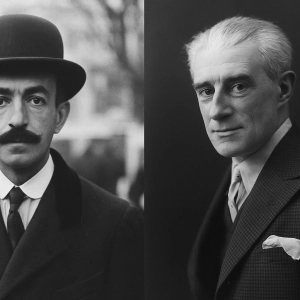
Debussy and Ravel are often described as the prototypical musical impressionists. It is often said that the two composers are the closest equivalents to the artistic world of Monet, Renoir, Pisarro, Degas, and others. Bu…
Shostakovich Cello Concerto No. 1 [not-audio_url] [/not-audio_url]

Duration: 50:05
It's hard to overstate the depth of the connection between Dmitri Shostakovich and the legendary cellist Mstistlav Rostropovich. Shostakovich and Rostropovich were extremely close friends, and Shostakovich wrote and dedi…
Ravel, Ravel, Ravel, w/Boris Giltburg and G. Henle Verlag! [not-audio_url] [/not-audio_url]

Duration: 59:12
Magician, Swiss Watchmaker, Aloof, Elegant, Precise, Soulful, Childlike, Naive, Warm: these are all words that have been used to describe Maurice Ravel, a man of elegant contradictions. But perhaps these contradictions a…
Amy Beach, "Gaelic" Symphony [not-audio_url] [/not-audio_url]

Duration: 1:00:56
Amy Beach is a name that might not be familiar to you. She was born in 1867 and died in 1944, and her life was one of the most fascinating and varied in musical history. She was a child prodigy, became a successful piani…
Smetana: Ma Vlast [not-audio_url] [/not-audio_url]

Duration: 1:05:54
Nationalism, patriotism, cultural identity, a sense of home; these are concepts and ideas whose popularity have ebbed and flowed throughout history. Nationalism has been seen as a natural expression of cultural identity…