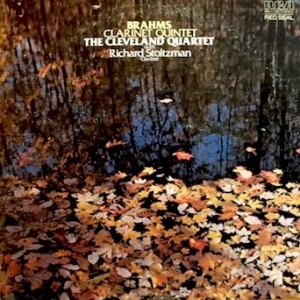
Brahms Clarinet Quintet

Brahms Clarinet Quintet

Author: Joshua Weilerstein November 14, 2024 Duration: 51:11

The muses were Ancient Greek goddesses of inspiration. Throughout history, the term muse has been used to describe any number of people, all of whom inspired works of great art and/or literature. In the popular imagination, muses are almost always women, inspiring brilliant men to their greatest artistic achievements. Why am I bringing this up? Because in the case of the piece we are going to talk about today, the Brahms Clarinet Quintet, the muse, and the source of inspiration, was very different. In 1890, Brahms retired from composing. In a way this was very rare. Composers very rarely retired, and most went on composing until their deaths, leaving unfinished works, but Brahms declared that he had nothing left to contribute, and that a younger generation should take over. He was only 57 years old, but he had become embittered both with the world of music and with the world as a whole. His 4th symphony had ended in a kind of apocalyptic destruction of the symphonic genre as a whole; a paroxysm of disillusionment with the direction music was going and with the direction of politics in Europe. But in March of 1891, Brahms heard a clarinetist named Richard Muhlfeld. Muhlfeld quickly became, for lack of a better word, Brahms' muse. His playing directly inspired Brahms to write 4 works for the clarinet, a trio, 2 sonatas, and a quintet, the topic for today's show. The clarinet quintet is practically the definition of the so-called autumnal Brahms. The clarinet quintet is one of Brahms' most expansive chamber works, and it is Brahms at his most wistful, nostalgic, and even tragic. Today on the show I'll take you through this magisterial work, exploring all of the things that make this piece so special, so touching, and so unforgettable. Join us!


There’s a particular kind of curiosity that draws people to classical music, but the sheer scale of the repertoire can feel overwhelming. Sticky Notes: The Classical Music Podcast, hosted by conductor Joshua Weilerstein, meets that curiosity right where it is. Think of it as a series of open conversations about the music itself, designed to be equally engaging for someone hearing a symphony for the first time and for a lifelong devotee. Episodes might feature a thoughtful interview with a performing artist, offering a glimpse behind the curtain, or they could focus entirely on a single piece, peeling back its layers to explore why it resonates. Weilerstein guides these explorations with clarity and enthusiasm, moving seamlessly from foundational concepts to more nuanced details about different musical eras. The entire premise of this podcast is built on a genuine belief that this music belongs to all of us. It’s about replacing any sense of intimidation with connection and understanding. While past seasons are gradually being re-released, each episode stands as its own invitation to listen more deeply.
Author: Language: English Episodes: 284

Sticky Notes: The Classical Music Podcast
Podcast Episodes
Bernstein: Symphonic Dances from Westside Story [not-audio_url] [/not-audio_url]

Duration: 46:37
We're back! Welcome to Season 10! Leonard Bernstein to his wife: "These days have flown so -- I don't sleep much; I work every -- literally every -- second (since I'm doing four jobs on this show -- composing, lyric-writ…
Lutoslawski Concerto for Orchestra [not-audio_url] [/not-audio_url]

Duration: 1:02:21
Throughout the history of Western Classical Music, folk music has imprinted itself as an invaluable resource for composers from all over the world. In fact, it's easier to make a list of composers who never used folk mus…
R. Schumann Piano Concerto [not-audio_url] [/not-audio_url]

Duration: 48:17
In January of 1839, Clara Wieck, Robert's future wife, wrote to Robert, "Don't take it amiss if I tell you that I've been seized by the desire to encourage you to write for orchestra. Your imagination and your spirit are…
Brahms Violin Concerto [not-audio_url] [/not-audio_url]

Duration: 50:26
Brahms' violin concerto is one of the most difficult works for any violinist to tackle. It is as virtuosic as the hardest piece of Paganini as well as being as musically complex as a Brahms symphony. It takes most violin…
What Does Music Mean? [not-audio_url] [/not-audio_url]

Duration: 52:27
Today is a bit of an unusual episode. Last month I was invited by the British Society of Aesthetics to address their annual conference. My task was to give a lecture on whatever topic I wanted, having to do with music. S…
William Grant Still Symphony No. 1., "Afro-American" [not-audio_url] [/not-audio_url]

Duration: 1:06:34
On October 29th, 1931, The Rochester Philharmonic presented the world premiere of a new symphony by the composer William Grant Still. A symphonic premiere is always something to look out for in musical history, but this…
Mahler Symphony No. 4, Part 2 [not-audio_url] [/not-audio_url]

Duration: 59:48
If you haven't listened to Part 1 of this episode about Mahler's 4th symphony, I highly recommend doing that, as every movement of this symphony builds to the "Heavenly Life" of the last movement. On Part 2, we'll be goi…