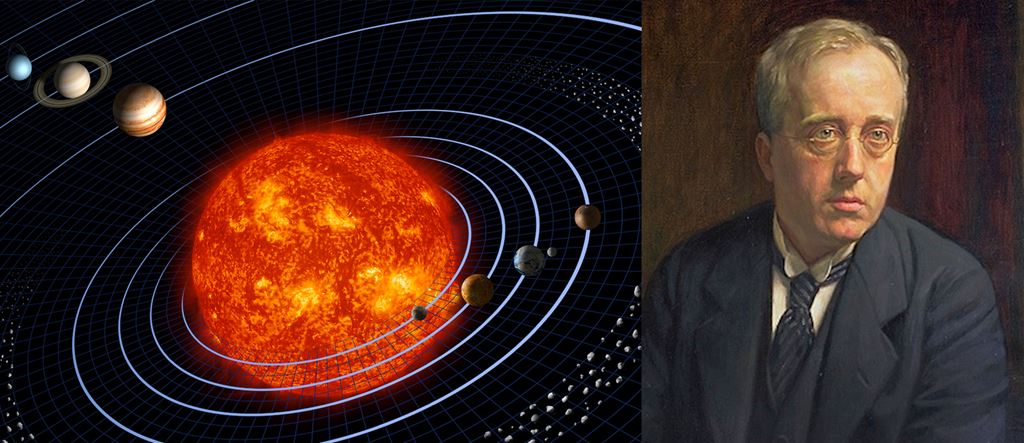
Gustav Holst: The Planets

Gustav Holst: The Planets

Author: Joshua Weilerstein December 4, 2025 Duration: 1:02:09

Mr. Holst, wherever you are, I apologize in advance for what I'm about to say. From my research, I know you resented this fact, but unfortunately, I think it's true. Here it is: despite the large catalogue of music Gustav Holst composed, much of it wonderful, he is essentially a one-hit wonder in the classical music world, à la Pachelbel, Dukas, Mascagni, and others. His one hit is a big one, though: an epic, seven-movement suite entitled The Planets.

As I said, Holst was not happy about this in the slightest. He was a prolific composer and someone who devoted himself fully to his subjects. He considered other works he wrote better than The Planets, and yet, in the end, we hear very little of his other music, though since the 1980s some of it has been performed more frequently, particularly in the UK.

But The Planets is truly a hit: the reason we know Holst's name today, and one of the most frequently performed pieces in the entire Western classical canon. Holst took a novel approach to his depiction of the planets. They are not ordered by their astronomical distance, but by musical cohesiveness. Nor do they depict the planets in a scientific sense; instead, they present a deeply personal astrological interpretation, something we'll explore as we discuss the piece.

The orchestration is massive yet subtle, with colors unique both to the work itself and to Holst's output more broadly. It is easy to listen to and straightforward, while also somehow intensely complex and varied. It is powerful, Romantic, thrilling, joyous, mysterious, terrifying, and ultimately cosmic in both conception and execution.

This is one of those pieces that people love without necessarily giving it the full respect it deserves. So today on the show, we'll learn a little about Holst's life, what led him to write The Planets, and why this piece grabs hold of us and doesn't let go throughout our journey through the stars. Join us! 


There’s a particular kind of curiosity that draws people to classical music, but the sheer scale of the repertoire can feel overwhelming. Sticky Notes: The Classical Music Podcast, hosted by conductor Joshua Weilerstein, meets that curiosity right where it is. Think of it as a series of open conversations about the music itself, designed to be equally engaging for someone hearing a symphony for the first time and for a lifelong devotee. Episodes might feature a thoughtful interview with a performing artist, offering a glimpse behind the curtain, or they could focus entirely on a single piece, peeling back its layers to explore why it resonates. Weilerstein guides these explorations with clarity and enthusiasm, moving seamlessly from foundational concepts to more nuanced details about different musical eras. The entire premise of this podcast is built on a genuine belief that this music belongs to all of us. It’s about replacing any sense of intimidation with connection and understanding. While past seasons are gradually being re-released, each episode stands as its own invitation to listen more deeply.
Author: Language: English Episodes: 284

Sticky Notes: The Classical Music Podcast
Podcast Episodes
Sibelius Symphony No. 2 [not-audio_url] [/not-audio_url]

Duration: 55:58
In 1901, in the throes of the Finnish Independence movement, Jean Sibelius composed his legendary 2nd Symphony. Sibelius' close colleague, the conductor Robert Kajanus, said that the symphony "strikes one as the most bro…
Dvorak Symphony No. 9, "From the New World" [not-audio_url] [/not-audio_url]

Duration: 58:06
Within three months of his arrival in New York, Antonin Dvorak was enamored with the sound of American music. Quickly he put forth what was at the time a controversial idea: "In the Negro melodies of America I discover a…
Havergal Brian, "Gothic Symphony" [not-audio_url] [/not-audio_url]

Duration: 1:09:19
Havergal Brian's ambitious Gothic Symphony has been called many things - massive, ambitious, barbaric, incompetent, insane, moving, brilliant, awful, torture, and much more. It is almost never performed due to the forces…
Bruckner Symphony No. 7 [not-audio_url] [/not-audio_url]

Duration: 58:12
With the rise of Wagner, the symphony seemed to be left for dead. But one composer in particular, Anton Bruckner, decided to take the plunge back into the symphonic genre, though he did it with a markedly Wagnerian touch…
A Conversation with Gabriela Lena Frank, Composer [not-audio_url] [/not-audio_url]

Duration: 34:54
Gabriela Lena Frank is currently serving as Composer-in-Residence with the storied Philadelphia Orchestra and was included in the Washington Post's list of the 35 most significant women composers in history, I've always…
Shostakovich Symphony #13: "Babi Yar" [not-audio_url] [/not-audio_url]

Duration: 1:03:42
In 1961, a poem appeared by the young poet Yevgeny Yevtushenko, entitled Babi Yar. The first line of this poem is: "There are no monuments over Babi Yar." In September of 1941 at least 33,771 Jews were murdered at the Ba…
The Story of "Blind" Tom Wiggins, w/ Deirdre O'Connell [not-audio_url] [/not-audio_url]

Duration: 40:26
Never heard of Tom Wiggins? You're in for a treat with this episode! Tom Wiggins was a fantastic 19th century pianist and composer who was ruthlessly exploited by his owner/guardian on account of his race and his mental…
Bach Chaconne for Solo Violin [not-audio_url] [/not-audio_url]

Duration: 52:18
The Bach Chaconne is one of the great masterpieces of Western Classical Music, and today we're going to be diving straight into this monumental work. We'll talk about the legends behind its composition, the work itself,…
Wynton Marsalis and the "Blues Symphony" [not-audio_url] [/not-audio_url]

Duration: 41:58
I had the chance to sit down with virtually with the legendary Wynton Marsalis for a conversation about Jazz, comparing jazz and classical pieces, why so many classical composers writing jazz fail and vice versa, and abo…
Beethoven Symphony No. 9, Part 2 [not-audio_url] [/not-audio_url]

Duration: 1:01:20
The cycle is complete! Would it surprise you to find out that Beethoven's 9th Symphony wasn't his last piece? Would it surprise you that he was actually considering an all instrumental movement for the last movement? Or…
