Liszt Faust Symphony

Liszt Faust Symphony

Author: Joshua Weilerstein May 14, 2026 Duration: 1:03:46

Thank you to Jerry for sponsoring today's episode on Patreon!

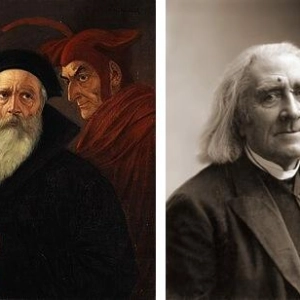
Goethe's Faust is considered to be the greatest work of German literature. This sprawling, 2-part play occupied Goethe's life for nearly 60 years, from its original version, begun in 1772, all the way to Goethe's final revisions before his death. It inspired just about every Romantic era composer who came after it, including Beethoven, Schubert, Schumann, Brahms, Berlioz, Gounod, Mahler, and our subject for the show today, Franz Liszt.

Liszt, who was in many ways the world's first pop star, was initially skeptical of Faust, saying that he couldn't relate to the eponymous main character of the play. He wrote: "Faust's personality scatters and dissipates itself; he takes no action, lets himself be driven, hesitates, experiments, loses his way, considers, bargains, and is interested in his own little happiness."

But slowly, Liszt began to be taken in by this remarkable play and decided to try his hand at a reflection on it, writing a massive, 3-movement, 75-minute-long symphony that never attempts to tell the story of Faust, but instead reflects on the psychological nature of the 3 central characters: Faust, Gretchen, and Mephistopheles (the Devil). A lot of English-speaking listeners will know this as the story of a man who sold his soul to the devil, but for Goethe it was much more than that, and it was for Liszt as well.

I've never talked about Liszt on the show, because frankly I've never been in love with his music. But this is one of the great things that these Patreon-sponsored episodes can do — help me discover pieces that I've never come across before. So today, we're going to talk about Liszt, Faust, and then take a stab at some of the greatest moments in this symphony. We'll talk about thematic transformation, a technique Liszt essentially invented and which is a vital part of understanding this piece.


There’s a particular kind of curiosity that draws people to classical music, but the sheer scale of the repertoire can feel overwhelming. Sticky Notes: The Classical Music Podcast, hosted by conductor Joshua Weilerstein, meets that curiosity right where it is. Think of it as a series of open conversations about the music itself, designed to be equally engaging for someone hearing a symphony for the first time and for a lifelong devotee. Episodes might feature a thoughtful interview with a performing artist, offering a glimpse behind the curtain, or they could focus entirely on a single piece, peeling back its layers to explore why it resonates. Weilerstein guides these explorations with clarity and enthusiasm, moving seamlessly from foundational concepts to more nuanced details about different musical eras. The entire premise of this podcast is built on a genuine belief that this music belongs to all of us. It’s about replacing any sense of intimidation with connection and understanding. While past seasons are gradually being re-released, each episode stands as its own invitation to listen more deeply.
Author: Language: English Episodes: 100

Sticky Notes: The Classical Music Podcast
Podcast Episodes
What Does a Conductor Really Do? [not-audio_url] [/not-audio_url]

Duration: 47:04
Have you ever wondered what it is that us conductors are really doing up there? Are we just waving our arms in time to the music? What role does the conductor actually play in a concert? How about a rehearsal? Do we also…
All things Piano with Marc-André Hamelin [not-audio_url] [/not-audio_url]

Duration: 52:38
Marc-André Hamelin is one of the world's greatest living pianists. He is known as a virtuoso of the highest order and has made nearly 100 recordings spanning the gamut of the piano repertoire. In this conversation we tal…
Tchaikovsky Symphony No. 4 [not-audio_url] [/not-audio_url]

Duration: 1:00:30
"This is Fate, the force of destiny, which ever prevents our pursuit of happiness from reaching its goal, which jealously stands watch lest our peace and well-being be full and cloudless, which hangs like the sword of Da…
My 25 Favorite Moments in Classical Music (Part 2) [not-audio_url] [/not-audio_url]

Duration: 55:12
Last week we covered moments 1-15 in my top 25 favorite moments in classical music, going all the way up towards the end of the 19th century. This week we're going to explore 9 of my favorite moments from the wide world…
My Top 25 Favorite Moments in Classical Music (Part 1) [not-audio_url] [/not-audio_url]

Duration: 52:28
What MAKES a moment in a piece of classical music? Sometimes it's the result of careful pacing from a composer, the slow build to a powerful release. Sometimes it's about surprise, a sudden explosion, or even a sudden ex…
Mendelssohn Octet in E Flat Major, Op. 20 [not-audio_url] [/not-audio_url]

Duration: 1:03:17
From 1825-1827, Mendelssohn wrote 3 of his most beloved and most played works: his Midsummer Night's Dream Overture, his String Quartet, Op. 13, and the piece were going to talk about today, his Octet. What is truly asto…
Mahler Symphony No. 5, Part 2 [not-audio_url] [/not-audio_url]

Duration: 48:53
I left you last week after Part 1 of Mahler's 5th symphony, dazed and defeated. There seems to be no hope, and no way out. But as many of you know by now, Mahler reaches for the entire emotional spectrum in his music, an…
Mahler Symphony No. 5, Part 1 [not-audio_url] [/not-audio_url]

Duration: 57:58
There is a thread of musical theory called Schenkerian analysis, based on the work of Heinrich Schenker. Schenker believed that musical works could be boiled down to their fundamental structures and harmonies. Entire wor…
Schoenberg: Verklärte Nacht [not-audio_url] [/not-audio_url]

Duration: 57:39
I'm not sure there's ever been a composer who changed as much throughout his or her life as Arnold Schoenberg. Schoenberg would become famous, or infamous, depending on who you talk to, for his invention of atonality; th…

«1...678910