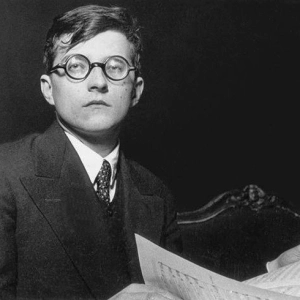
Shostakovich String Quartet No. 8

Shostakovich String Quartet No. 8

Author: Joshua Weilerstein June 1, 2023 Duration: 50:44

What did Dmitri Shostakovich intend to portray in his music? There is probably no more debated a question in all of 20th century Western Classica lMusic than this one. On the surface, it seems to have an easy answer. Shostakovich portrayed his own thoughts and feelings in his music, just as any other composer would. And that is certainly true. Shostakovich, above anything else, was truly one of the great composers in history. HIs mastery of form, meldoy, strcuture, pacing, and his ability to find a near universal expression of grief and passion is practically unparalelled among composers. That much is clear to those of us who love Shostakovich's music. But everything else, including that thorny question of what his music MEANS, is much, much, much less clear. Practically Shostakovich's entire life was lived under the shadow of Soviet Russia, and naturally his musical career was lived under that shadow as well. This means that a sometimes impenetrable layer of secrecy, mystery, and doubt always lies under the surface of Shostakovich's music.

In 1960, Kruschev, who had been loudly trumpetting Shostakovich's name to Western Press as an example of a free Soviet artist post the excesses of the Stalin regime, decided that Shostakovich should be the new head of the Russian Union of Composers. The catch was that Shostakovich would need to join the Communist Party in order to take the job. Shostakovich, who had long resisted becoming a full Party member, agreed. Shostakovich was clearly disappointed in himself, as his friend Lev Lebedinsky wrote this: "I will never forget some of the things he said that night [before his induction into the Party], sobbing hysterically: 'I'm scared to death of them.' 

Why does all this matter? Because just a few days after joining the Commhnist party and after meeting with his friends Isaac Glikman and Lev Lebedinsky, Shostakovich traveled to East Germany --  specifically to Dresden — to work on a film which would commemorate the destruction of the city during World War II. He was supposed to write music for this film, but instead, Shostakovich sat down, and in THREE DAYS, he wrote his 8th string quartet. He would later write to Glikman: "However much I've tried to draft my obligations for the film, I just couldn't do it. Instead I wrote an ideologically deficient quartet that nobody needs. I reflected that if I die it's not likely anyone will write a quartet dedicated to my memory. So I decided to write it myself. You could even write on the cover: 'Dedicated to the memory of the composer of this quartet." Today on the show we're going to explore this remarkable piece together - join us!


There’s a particular kind of curiosity that draws people to classical music, but the sheer scale of the repertoire can feel overwhelming. Sticky Notes: The Classical Music Podcast, hosted by conductor Joshua Weilerstein, meets that curiosity right where it is. Think of it as a series of open conversations about the music itself, designed to be equally engaging for someone hearing a symphony for the first time and for a lifelong devotee. Episodes might feature a thoughtful interview with a performing artist, offering a glimpse behind the curtain, or they could focus entirely on a single piece, peeling back its layers to explore why it resonates. Weilerstein guides these explorations with clarity and enthusiasm, moving seamlessly from foundational concepts to more nuanced details about different musical eras. The entire premise of this podcast is built on a genuine belief that this music belongs to all of us. It’s about replacing any sense of intimidation with connection and understanding. While past seasons are gradually being re-released, each episode stands as its own invitation to listen more deeply.
Author: Language: English Episodes: 284

Sticky Notes: The Classical Music Podcast
Podcast Episodes
Schubert Sonata in B Flat, D. 960 (Part 1) [not-audio_url] [/not-audio_url]

Duration: 40:07
For a long time I've received emails and messages from people asking, and sometimes demanding, that I explore the solo piano repertoire. Other than a look at the Goldberg Variations of Bach, I've basically neglected a hu…
Mozart Piano Concerto in D Minor, K. 466 [not-audio_url] [/not-audio_url]

Duration: 48:12
H.C. Robbins Landon, the great musicologist, once wrote about Mozart that his music was "an excuse for mankind's existence and a small hope for our ultimate survival." I couldn't agree more, especially when it comes to a…
What is a Mode? [not-audio_url] [/not-audio_url]

Duration: 44:37
My first interaction with the musical term modes was Leonard Bernstein's brilliant Young People's Concert, also called What is a Mode? In that show, Bernstein showed how modes are an essential part of what makes modern m…
Brahms Piano Concerto No. 1 [not-audio_url] [/not-audio_url]

Duration: 1:03:25
In 1857, Brahms wrote to his friend Joseph Joachim about his first Piano Concerto, saying, " "I have no judgment about this piece anymore, nor any control over it." Brahms first began sketching his first piano concerto i…
Fast, Furious, Fortissimo [not-audio_url] [/not-audio_url]

Duration: 46:31
Very often, when I tell people that I'm a classical musician, I am told, "wow, I love classical music! It's so relaxing!" I think almost all classical musicians have heard that before, and you know what? Sometimes, it's…
Copland Symphony No. 3 [not-audio_url] [/not-audio_url]

Duration: 1:01:02
There has always been a debate about "The Great American Symphony." By the time most prominent American composers got around to writing large scale symphonic works, the symphony had very nearly gone out of fashion. To ma…
An Exploration of Klezmer Music w/ Abigale Reisman [not-audio_url] [/not-audio_url]

Duration: 56:48
Klezmer music has always been very close to my heart, even as a classical violinist. During the pandemic I attempted to learn Klezmer clarinet, and soon I began collaborating with the great Klezmer(and classical!) violin…
Schumann Symphony No. 3, "Rhenish" [not-audio_url] [/not-audio_url]

Duration: 54:36
In 1850, Robert Schumann accepted a position as the new Music Director in Dusseldorf. This job had a lot of responsibilities, including conducting the city orchestra. Schumann, along with his wife, the legendary pianist…
Beethoven String Quartet, Op. 59, No. 1 [not-audio_url] [/not-audio_url]

Duration: 58:38
In 1806, the 36 year old Beethoven received a commission from the Russian ambassador in Vienna, Count Andreas Razumovsky. Razumovsky wanted a set of string quartets for what would soon be his house string quartet which i…
Ethel Smyth Serenade in D [not-audio_url] [/not-audio_url]

Duration: 48:09
I've mentioned Ethel Smyth a few times in the past on this show. This is partly because of her music, and partly because she remains one of the most interesting people who ever lived. She was a composer of course, but sh…