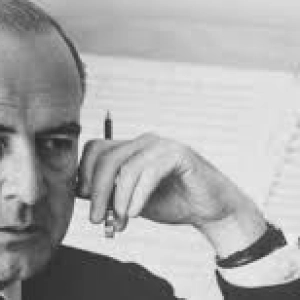
Steve Reich: Different Trains

Steve Reich: Different Trains

Author: Joshua Weilerstein April 17, 2025 Duration: 52:30

Steve Reich, the great American contemporary composer, provided this program note about his work Different Trains: "The idea for the piece came from my childhood. When I was one year old my parents separated. My singer, song-writer mother moved to Los Angeles and my attorney father stayed in New York. Since they arranged divided custody, I travelled back and forth by train frequently between New York and Los Angeles from 1939 to 1942 accompanied by my governess. While the trips were exciting and romantic at the time I now look back and think that, if I had been in Europe during this period, as a Jew I would have had to ride very different trains. With this in mind I wanted to make a piece that would accurately reflect the whole situation."

Reich went about this piece in a completely innovative way: he recorded voices and then created the musical material for the piece out of the voices themselves, something that had never been done before. Therefore, the text and music material were integrated in a groundbreaking way, and the results are at times unbearably moving. This is a piece that has captured listeners attention in a way that is relatively rare for contemporary music, and it is a piece of immense power and depth. I have always been fascinated by this piece and have wanted to perform an orchestral version of it, but I never have been able to cover it on the show. That is, until AJ contributed enough to my fundraiser last year before the election to sponsor a piece, and he chose Reich's Different Trains. Today we'll talk a bit about Steve Reich generally for those of you unfamiliar with him, and then we'll tackle this remarkable and unique piece in all of its creativity and profound communication. Join us!


There’s a particular kind of curiosity that draws people to classical music, but the sheer scale of the repertoire can feel overwhelming. Sticky Notes: The Classical Music Podcast, hosted by conductor Joshua Weilerstein, meets that curiosity right where it is. Think of it as a series of open conversations about the music itself, designed to be equally engaging for someone hearing a symphony for the first time and for a lifelong devotee. Episodes might feature a thoughtful interview with a performing artist, offering a glimpse behind the curtain, or they could focus entirely on a single piece, peeling back its layers to explore why it resonates. Weilerstein guides these explorations with clarity and enthusiasm, moving seamlessly from foundational concepts to more nuanced details about different musical eras. The entire premise of this podcast is built on a genuine belief that this music belongs to all of us. It’s about replacing any sense of intimidation with connection and understanding. While past seasons are gradually being re-released, each episode stands as its own invitation to listen more deeply.
Author: Language: English Episodes: 100

Sticky Notes: The Classical Music Podcast
Podcast Episodes
The Life and Music of Grazyna Bacewicz [not-audio_url] [/not-audio_url]

Duration: 57:46
The great Polish composer Witold Lutoslawski said this after the premature death of his contemporary Grazyna Bacewicz: "She was born with an incredible wealth of musical talent, which she succeeded to bring to full flour…
Sticky Notes meets You'll Hear It [not-audio_url] [/not-audio_url]

Duration: 1:10:04
I had such a wonderful time joining the jazz podcast You'll Hear It! We talked about the meeting of jazz and classical music, a topic I've explored before, but never in this much depth and never with so much input from j…
Impressions in Blue: Ravel & Gershwin [not-audio_url] [/not-audio_url]

Duration: 44:34
In the mid-1920s, Maurice Ravel wrote a letter to the legendary composition teacher Nadia Boulanger. Boulanger's class was a mecca for composers, both young and old, and musicians from all over the world vied to study wi…
Weill: The Seven Deadly Sins [not-audio_url] [/not-audio_url]

Duration: 1:00:01
The collaboration between Kurt Weill and Bertolt Brecht is rightly legendary. The two men could not have been more different from each other, and like the Brahms/Joachim relationship I mentioned in my recent show about t…
The Ravel Sound with Norbert Müllemann and Stefan Knüpfer [not-audio_url] [/not-audio_url]

Duration: 45:32
I so enjoyed making this latest episode in my collaboration with G Henle Publishers. I talked with two absolute experts in their fields, Norbert Mülleman and Stefan Knüpfer, all about how to edit Ravel's music, and how t…
Dvorak Violin Concerto [not-audio_url] [/not-audio_url]

Duration: 49:16
Admit it: if you're a fan of classical music—or even just a regular concertgoer—you might have glanced at the title of this episode and done a double take. The Dvořák Violin Concerto? Not the Cello Concerto? One of the t…
Brahms Double Concerto [not-audio_url] [/not-audio_url]

Duration: 58:17
It's entirely possible that we would not know the name of Johannes Brahms very well if Brahms hadn't met Joseph Joachim as a very young man. Joachim, who was one of the greatest violinists of all time, had already establ…
Copland Clarinet Concerto [not-audio_url] [/not-audio_url]

Duration: 48:13
The commission for a new Clarinet Concerto from the great American composer Aaron Copland came from a rather unlikely source: Benny Goodman, the man known as the King of Swing. Goodman was one of the most famous and impo…