ASTROMAN - Solar Eclipse

ASTROMAN - Solar Eclipse

Author: 365DaysOfAstronomy.org February 21, 2026 Duration: 8:12

Episode 14.

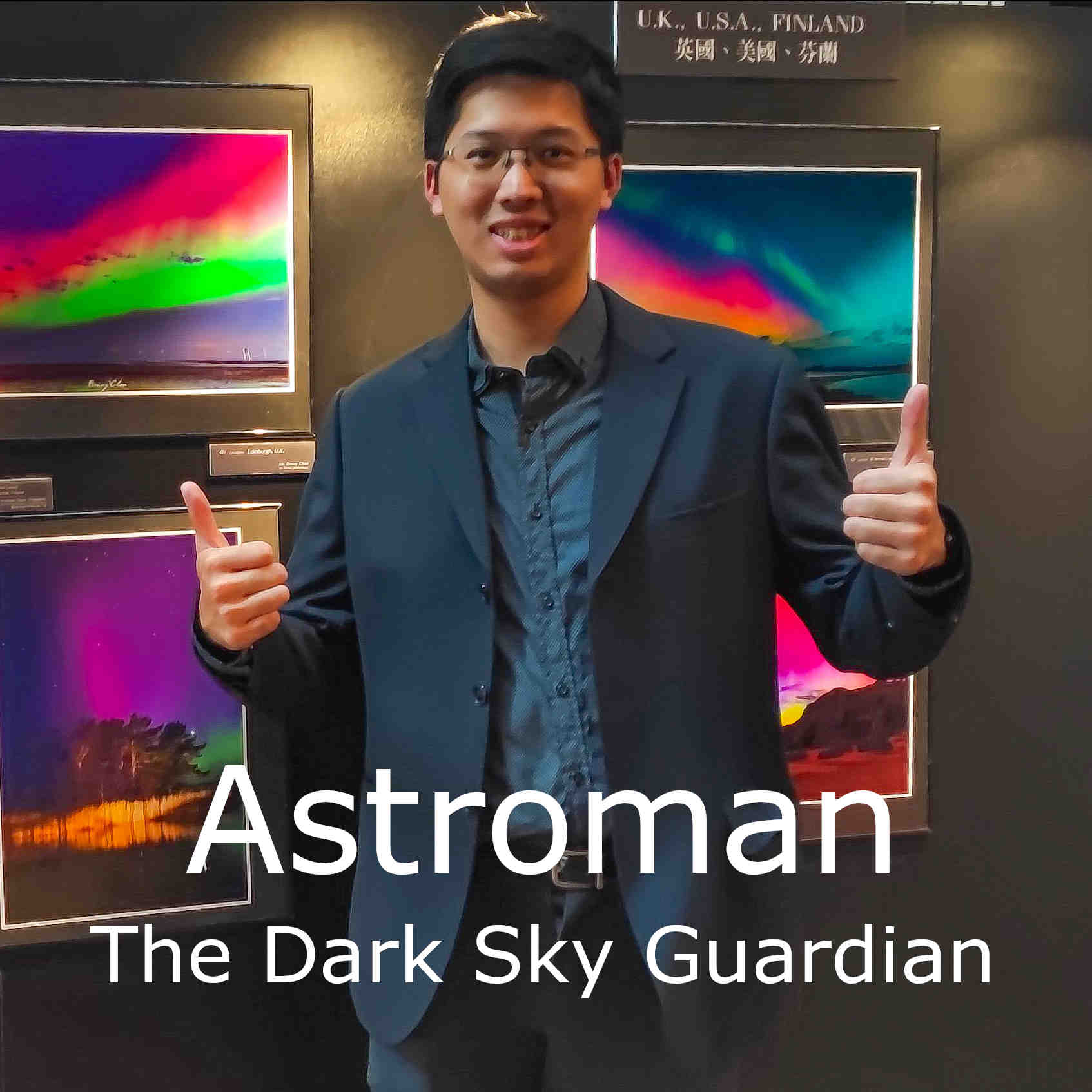
Our Sun is more than a glowing ball in the sky. It's a dynamic, ever-changing star at the peak of its solar cycle. In this episode of ASTROMAN: The Dark Sky Guardian, we learn how to safely observe sunspots and solar flares, and why studying solar activity helps protect satellites, power grids, and even predicts auroras.


"ASTROMAN: the Dark Sky Guardian" is a podcast channel that aims to explore popular science in multiple disciplines and research on interdisciplinary approaches, such as sustainability, dark-sky protection, astrophotography, space exploration, astronomy innovation, inclusive science communication, and STEAM Education by integrating science and arts.


Exodus CL Sit, also known as the ASTROMAN, is a transmedia astronomy educator, popular science author, STEAM educator, and science communicator in Hong Kong. He is recently the National Astronomy Education Coordinator (Chair of Hong Kong, China) of the International Astronomical Union and President of Starrix. He was also an International Committee Member of the Dark Sky International, regularly organizing public lectures at the Hong Kong Space Museum and the Hong Kong Science Museum. He was also the author of a popular science book "Decoding the Starry Night: A Guide to Stargazing and Astrophotography".


We've added a new way to donate to 365 Days of Astronomy to support editing, hosting, and production costs. 

Just visit: https://www.patreon.com/365DaysOfAstronomy and donate as much as you can!

Share the podcast with your friends and send the Patreon link to them too! 

Every bit helps! Thank you!

------------------------------------

Do go visit http://www.redbubble.com/people/CosmoQuestX/shop for cool Astronomy Cast and CosmoQuest t-shirts, coffee mugs and other awesomeness!

http://cosmoquest.org/Donate This show is made possible through your donations. 

Thank you! (Haven't donated? It's not too late! Just click!)

------------------------------------

The 365 Days of Astronomy Podcast is produced by the Planetary Science Institute. http://www.psi.edu

Visit us on the web at 365DaysOfAstronomy.org or email us at info@365DaysOfAstronomy.org.


Imagine a daily conversation about the cosmos, where each sunrise brings a fresh perspective from a different corner of the globe. That’s the essence of The 365 Days of Astronomy. Born from the spirit of the 2009 International Year of Astronomy, this enduring project has evolved into a genuine community effort, releasing a new episode every single day. You won’t hear the same host each time; instead, the microphone passes to astronomers, educators, enthusiasts, and scientists, each sharing their unique passion and expertise. This structure means the tone and topic can shift wonderfully from one day to the next-you might delve into the mechanics of a black hole on Tuesday and then explore ancient celestial myths on Wednesday. The consistent thread is a shared wonder for the universe, presented in accessible, bite-sized pieces. Managed by Avivah Yamani and edited by Richard Drumm, this daily podcast is a production of the Planetary Science Institute, sustained by listener support. It’s a calendar of the cosmos, offering a daily moment of reflection and discovery that proves you don’t need a telescope to have your perspective shifted. Tuning in regularly builds a habit of cosmic curiosity, connecting the vastness of space to the rhythm of our own days.
Author: Language: English Episodes: 269

The 365 Days of Astronomy
Podcast Episodes
UNAWE Space Scoop - What Did Our Solar System Look Like as a Baby? [not-audio_url] [/not-audio_url]

Duration: 6:28
Hosted by Richard Drumm, your editor! Planets don't just pop out of nowhere, fully formed and ready for astronomers to study. First, they begin as tiny little specks of dust, forming inside the clouds of gas around baby…
Cheap Astronomy Ep. 121: Black Holes Yet Again! [not-audio_url] [/not-audio_url]

Duration: 14:46
Very dense and podcastable. Cheap Astronomy finds there can never be too many podcasts about black holes. Dear Cheap Astronomy – What are squeezars? Squeezars are stars that orbit supermassive black holes. Essentially th…
Ask A Spaceman Ep. 252: Why Can't We Get Free Energy from the Vacuum? [not-audio_url] [/not-audio_url]

Duration: 36:12
Hosted by Dr. Paul M. Sutter. Why does the vacuum of spacetime have energy? How much energy does it have? What prevents us from using it to do anything useful? I discuss these questions and more in today's Ask a Spaceman…
Astronomy Cast Ep. 277: Orbit [not-audio_url] [/not-audio_url]

Duration: 33:01
From October 22, 2012. When an object is orbiting the Earth, it's really falling. The trick, described in the Hitchhiker's Guide to the Galaxy, is how to throw yourself at the ground and miss. There are several different…
Travelers in the Night Eps. 801 & 802: Jacqui's PHA & Bok Comet [not-audio_url] [/not-audio_url]

Duration: 6:05
Dr. Al Grauer hosts. Dr. Albert D. Grauer ( @Nmcanopus ) is an observational asteroid hunting astronomer. Dr. Grauer retired from the University of Arkansas at Little Rock in 2006. travelersinthenight.org From June 2024.…
EVSN - Magnetic Fields Help Find Ocean Worlds [not-audio_url] [/not-audio_url]

Duration: 26:28
Researchers have determined how to effectively measure the magnetic fields at Neptune to determine if any of the moons are ocean worlds… in just twelve minutes. Plus, lasers recreate galaxy cluster conditions, some mind-…