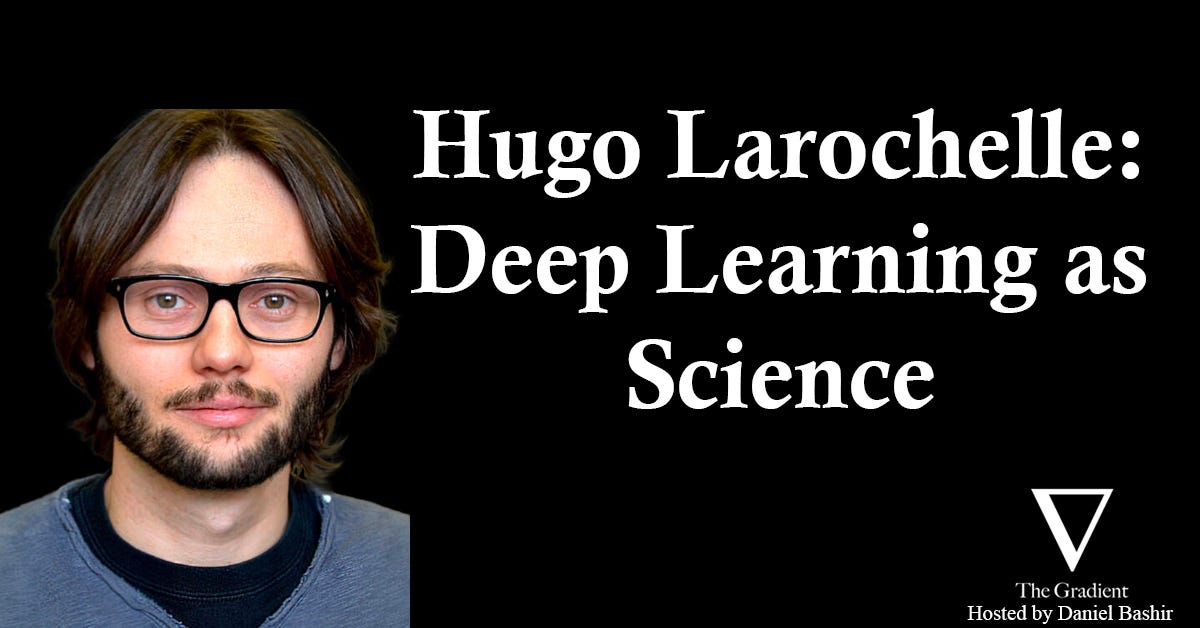
Arjun Ramani & Zhengdong Wang: Why Transformative AI is Really, Really Hard to Achieve

Arjun Ramani & Zhengdong Wang: Why Transformative AI is Really, Really Hard to Achieve

Author: Daniel Bashir September 21, 2023 Duration: 1:49:33

In episode 91 of The Gradient Podcast, Daniel Bashir speaks to Arjun Ramani and Zhengdong Wang.

Arjun is the global business and economics correspondent at The Economist.

Zhengdong is a research engineer at Google DeepMind.

Have suggestions for future podcast guests (or other feedback)? Let us know here or reach us at editor@thegradient.pub

Subscribe to The Gradient Podcast:  Apple Podcasts  | Spotify | Pocket Casts | RSSFollow The Gradient on Twitter

Outline:

* (00:00) Intro

* (03:53) Arjun intro

* (06:04) Zhengdong intro

* (09:50) How Arjun and Zhengdong met in the woods

* (11:52) Overarching narratives about technological progress and AI

* (14:20) Setting up the claim: Arjun on what “transformative” means

* (15:52) What enables transformative economic growth?

* (21:19) From GPT-3 to ChatGPT; is there something special about AI?

* (24:15) Zhengdong on “real AI” and divisiveness

* (27:00) Arjun on the independence of bottlenecks to progress/growth

* (29:05) Zhengdong on bottleneck independence

* (32:45) More examples on bottlenecks and surplus wealth

* (37:06) Technical arguments—what are the hardest problems in AI?

* (38:00) Robotics

* (40:41) Challenges of deployment in high-stakes settings and data sources / synthetic data, self-driving

* (45:13) When synthetic data works

* (49:06) Harder tasks, process knowledge

* (51:45) Performance art as a critical bottleneck

* (53:45) Obligatory Taylor Swift Discourse

* (54:45) AI Taylor Swift???

* (54:50) The social arguments

* (55:20) Speed of technology diffusion — “diffusion lags” and dynamics of trust with AI

* (1:00:55) ChatGPT adoption, where major productivity gains come from

* (1:03:50) Timescales of transformation

* (1:10:22) Unpredictability in human affairs

* (1:14:07) The economic arguments

* (1:14:35) Key themes — diffusion lags, different sectors

* (1:21:15) More on bottlenecks, AI trust, premiums on human workers

* (1:22:30) Automated systems and human interaction

* (1:25:45) Campaign text reachouts

* (1:30:00) Counterarguments

* (1:30:18) Solving intelligence and solving science/innovation

* (1:34:07) Strengths and weaknesses of the broad applicability of Arjun and Zhengdong’s argument

* (1:35:34) The “proves too much” worry — how could any innovation have ever happened?

* (1:37:25) Examples of bringing down barriers to innovation/transformation

* (1:43:45) What to do with all of this information?

* (1:48:45) Outro

Links:

* Zhengdong’s homepage and Twitter

* Arjun’s homepage and Twitter

* Why transformative artificial intelligence is really, really hard to achieve

* Other resources and links mentioned:

* Allan-Feuer and Sanders: Transformative AGI by 2043 is <1% likely

* On AlphaStar Zero

* Hardmaru on AI as applied philosophy

* Robotics Transformer 2

* Davis Blalock on synthetic data

* Matt Clancy on automating invention and bottlenecks

* Michael Webb on 80,000 Hours Podcast

* Bob Gordon: The Rise and Fall of American Growth

* OpenAI economic impact paper

* David Autor: new work paper

* Baumol effect paper

* Pew research centre poll, public concern on AI

* Human premium Economist piece

* Callum Williams — London tube and AI/jobs

* Culture Series book 1, Iain Banks


Get full access to The Gradient at thegradientpub.substack.com/subscribe
Hosted by Daniel Bashir, The Gradient: Perspectives on AI moves beyond surface-level headlines to explore the intricate machinery and human ideas shaping artificial intelligence. Each episode is built on a foundation of deep research, leading to conversations that are both technically substantive and broadly accessible. You'll hear from researchers, engineers, and philosophers who are actively building and critiquing our technological future, discussing not just how AI systems work, but the larger implications of their integration into society. This isn't about speculative hype; it's a grounded examination of real progress, persistent challenges, and ethical considerations from those on the front lines. The discussions peel back layers on topics like model architecture, policy, and the fundamental science behind the algorithms becoming part of our daily lives. For anyone curious about the substance behind the buzz-whether you have a technical background or are simply keen to understand a defining technology of our age-this podcast offers a crucial and thoughtful resource. Tune in for a consistently detailed and nuanced take that treats artificial intelligence with the complexity it deserves.
Author: Language: English Episodes: 100

The Gradient: Perspectives on AI
Podcast Episodes
Terry Winograd: AI, HCI, Language, and Cognition [not-audio_url] [/not-audio_url]

Duration: 1:33:21
In episode 87 of The Gradient Podcast, Daniel Bashir speaks to Professor Terry Winograd. Professor Winograd is Professor Emeritus of Computer Science at Stanford University. His research focuses on human-computer interac…
Gil Strang: Linear Algebra and Deep Learning [not-audio_url] [/not-audio_url]

Duration: 1:00:36
In episode 86 of The Gradient Podcast, Daniel Bashir speaks to Professor Gil Strang. Professor Strang is one of the world’s foremost mathematics educators and a mathematician with contributions to finite element theory,…
Anant Agarwal: AI for Education [not-audio_url] [/not-audio_url]

Duration: 47:40
In episode 85 of The Gradient Podcast, Andrey Kurenkov speaks to Anant AgarwalAnant Agarwal is the chief platform officer of 2U, and founder of edX. Anant taught the first edX course on circuits and electronics from MIT,…
Peli Grietzer: A Mathematized Philosophy of Literature [not-audio_url] [/not-audio_url]

Duration: 2:33:33
In episode 83 of The Gradient Podcast, Daniel Bashir speaks to Peli Grietzer. Peli is a scholar whose work borrows mathematical ideas from machine learning theory to think through “ambient” and ineffable phenomena like m…
Ryan Drapeau: Battling Fraud with ML at Stripe [not-audio_url] [/not-audio_url]

Duration: 1:06:31
In episode 82 of The Gradient Podcast, Daniel Bashir speaks to Ryan Drapeau.Ryan is a Staff Software Engineer at Stripe and technical lead for Stripe’s Payment Fraud organization, which uses machine learning to help prev…
Shiv Rao: Enabling Better Patient Care with AI [not-audio_url] [/not-audio_url]

Duration: 1:00:51
In episode 81 of The Gradient Podcast, Daniel Bashir speaks to Shiv Rao.Shiv Rao, MD is the co-founder and CEO of Abridge, a healthcare conversation company that uses cutting-edge NLP and generative AI to bring context a…
Hugo Larochelle: Deep Learning as Science [not-audio_url] [/not-audio_url]

Duration: 1:48:28
In episode 80 of The Gradient Podcast, Daniel Bashir speaks to Professor Hugo Larochelle. Professor Larochelle leads the Montreal Google DeepMind team and is adjunct professor at Université de Montréal and a Canada CIFAR…
Jeremie Harris: Realistic Alignment and AI Policy [not-audio_url] [/not-audio_url]

Duration: 1:30:35
In episode 79 of The Gradient Podcast, Daniel Bashir speaks to Jeremie Harris.Jeremie is co-founder of Gladstone AI, author of the book Quantum Physics Made Me Do It, and co-host of the Last Week in AI Podcast. Jeremy pr…
Antoine Blondeau: Alpha Intelligence Capital and Investing in AI [not-audio_url] [/not-audio_url]

Duration: 59:34
In episode 78 of The Gradient Podcast, Daniel Bashir speaks to Antoine Blondeau.Antoine is a serial AI entrepreneur and Co-Founder and Managing Partner of Alpha Intelligence Capital. He was chief executive at Dejima when…