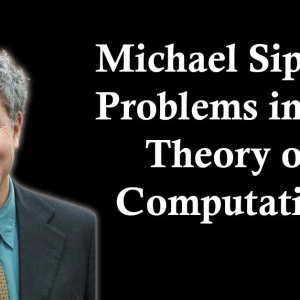
Michael Sipser: Problems in the Theory of Computation

Michael Sipser: Problems in the Theory of Computation

Author: Daniel Bashir April 11, 2024 Duration: 1:28:21

In episode 119 of The Gradient Podcast, Daniel Bashir speaks to Professor Michael Sipser.

Professor Sipser is the Donner Professor of Mathematics and member of the Computer Science and Artificial Intelligence Laboratory at MIT.

He received his PhD from UC Berkeley in 1980 and joined the MIT faculty that same year. He was Chairman of Applied Mathematics from 1998 to 2000 and served as Head of the Mathematics Department 2004-2014. He served as interim Dean of Science 2013-2014 and then as Dean of Science 2014-2020.

He was a research staff member at IBM Research in 1980, spent the 1985-86 academic year on the faculty of the EECS department at Berkeley and at MSRI, and was a Lady Davis Fellow at Hebrew University in 1988. His research areas are in algorithms and complexity theory, specifically efficient error correcting codes, interactive proof systems, randomness, quantum computation, and establishing the inherent computational difficulty of problems. He is the author of the widely used textbook, Introduction to the Theory of Computation (Third Edition, Cengage, 2012).

Have suggestions for future podcast guests (or other feedback)? Let us know here or reach Daniel at editor@thegradient.pub

Subscribe to The Gradient Podcast:  Apple Podcasts  | Spotify | Pocket Casts | RSSFollow The Gradient on Twitter

Outline:

* (00:00) Intro

* (01:40) Professor Sipser’s background

* (04:35) On interesting questions

* (09:00) Different kinds of research problems

* (13:00) What makes certain problems difficult

* (18:48) Nature of the P vs NP problem

* (24:42) Identifying interesting problems

* (28:50) Lower bounds on the size of sweeping automata

* (29:50) Why sweeping automata + headway to P vs. NP

* (36:40) Insights from sweeping automata, infinite analogues to finite automata problems

* (40:45) Parity circuits

* (43:20) Probabilistic restriction method

* (47:20) Relativization and the polynomial time hierarchy

* (55:10) P vs. NP

* (57:23) The non-connection between GO’s polynomial space hardness and AlphaGo

* (1:00:40) On handicapping Turing Machines vs. oracle strategies

* (1:04:25) The Natural Proofs Barrier and approaches to P vs. NP

* (1:11:05) Debates on methods for P vs. NP

* (1:15:04) On the possibility of solving P vs. NP

* (1:18:20) On academia and its role

* (1:27:51) Outro

Links:

* Professor Sipser’s homepage

* Papers discussed/read

* Halting space-bounded computations (1978)

* Lower bounds on the size of sweeping automata (1979)

* GO is Polynomial-Space Hard (1980)

* A complexity theoretic approach to randomness (1983)

* Parity, circuits, and the polynomial-time hierarchy (1984)

* A follow-up to Furst-Saxe-Sipser

* The Complexity of Finite Functions (1991)


Get full access to The Gradient at thegradientpub.substack.com/subscribe
Hosted by Daniel Bashir, The Gradient: Perspectives on AI moves beyond surface-level headlines to explore the intricate machinery and human ideas shaping artificial intelligence. Each episode is built on a foundation of deep research, leading to conversations that are both technically substantive and broadly accessible. You'll hear from researchers, engineers, and philosophers who are actively building and critiquing our technological future, discussing not just how AI systems work, but the larger implications of their integration into society. This isn't about speculative hype; it's a grounded examination of real progress, persistent challenges, and ethical considerations from those on the front lines. The discussions peel back layers on topics like model architecture, policy, and the fundamental science behind the algorithms becoming part of our daily lives. For anyone curious about the substance behind the buzz-whether you have a technical background or are simply keen to understand a defining technology of our age-this podcast offers a crucial and thoughtful resource. Tune in for a consistently detailed and nuanced take that treats artificial intelligence with the complexity it deserves.
Author: Language: English Episodes: 100

The Gradient: Perspectives on AI
Podcast Episodes
Joon Park: Generative Agents and Human-Computer Interaction [not-audio_url] [/not-audio_url]

Duration: 2:21:25
In episode 77 of The Gradient Podcast, Daniel Bashir speaks to Joon Park.Joon is a third-year PhD student at Stanford, advised by Professors Michael Bernstein and Percy Liang. He designs, builds, and evaluates interactiv…
Christoffer Holmgård: AI for Video Games [not-audio_url] [/not-audio_url]

Duration: 1:09:06
In episode 76 of The Gradient Podcast, Andrey Kurenkov speaks to Dr Christoffer HolmgårdDr. Holmgård is a co-founder and the CEO of Modl.ai, which is building AI Engine for game development. Before starting the company,…
Riley Goodside: The Art and Craft of Prompt Engineering [not-audio_url] [/not-audio_url]

Duration: 59:42
In episode 75 of The Gradient Podcast, Daniel Bashir speaks to Riley Goodside. Riley is a Staff Prompt Engineer at Scale AI. Riley began posting GPT-3 prompt examples and screenshot demonstrations in 2022. He previously…
Talia Ringer: Formal Verification and Deep Learning [not-audio_url] [/not-audio_url]

Duration: 1:45:35
In episode 74 of The Gradient Podcast, Daniel Bashir speaks to Professor Talia Ringer.Professor Ringer is an Assistant Professor with the Programming Languages, Formal Methods, and Software Engineering group at the Unive…
Brigham Hyde: AI for Clinical Decision-Making [not-audio_url] [/not-audio_url]

Duration: 41:43
In episode 72 of The Gradient Podcast, Daniel Bashir speaks to Brigham Hyde.Brigham is Co-Founder and CEO of Atropos Health. Prior to Atropos, he served as President of Data and Analytics at Eversana, a life sciences com…
Scott Aaronson: Against AI Doomerism [not-audio_url] [/not-audio_url]

Duration: 1:09:32
In episode 72 of The Gradient Podcast, Daniel Bashir speaks to Professor Scott Aaronson. Scott is the Schlumberger Centennial Chair of Computer Science at the University of Texas at Austin and director of its Quantum Inf…
Ted Underwood: Machine Learning and the Literary Imagination [not-audio_url] [/not-audio_url]

Duration: 1:43:59
In episode 71 of The Gradient Podcast, Daniel Bashir speaks to Ted Underwood.Ted is a professor in the School of Information Sciences with an appointment in the Department of English at the University of Illinois at Urba…
Irene Solaiman: AI Policy and Social Impact [not-audio_url] [/not-audio_url]

Duration: 1:12:11
In episode 70 of The Gradient Podcast, Daniel Bashir speaks to Irene Solaiman.Irene is an expert in AI safety and policy and the Policy Director at HuggingFace, where she conducts social impact research and develops publ…
Drago Anguelov: Waymo and Autonomous Vehicles [not-audio_url] [/not-audio_url]

Duration: 1:05:23
In episode 69 of The Gradient Podcast, Daniel Bashir speaks to Drago Anguelov.Drago is currently a Distinguished Scientist and Head of Research at Waymo, where he joined in 2018. Earlier, he spent eight years at Google w…
Joanna Bryson: The Problems of Cognition [not-audio_url] [/not-audio_url]

Duration: 1:13:05
In episode 68 of The Gradient Podcast, Daniel Bashir speaks to Professor Joanna Bryson.Professor Bryson is Professor of Ethics and Technology at the Hertie School, where her research focuses on the impact of technology o…