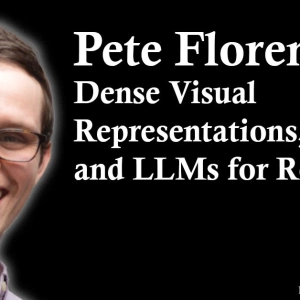
Pete Florence: Dense Visual Representations, NeRFs, and LLMs for Robotics

Pete Florence: Dense Visual Representations, NeRFs, and LLMs for Robotics

Author: Daniel Bashir January 5, 2023 Duration: 1:15:24

In episode 54 of The Gradient Podcast, Andrey Kurenkov speaks with Pete Florence.

Note: this was recorded 2 months ago. Andrey should be getting back to putting out some episodes next year.

Pete Florence is a Research Scientist at Google Research on the Robotics at Google team inside Brain Team in Google Research. His research focuses on topics in robotics, computer vision, and natural language -- including 3D learning, self-supervised learning, and policy learning in robotics. Before Google, he finished his PhD in Computer Science at MIT with Russ Tedrake.

Subscribe to The Gradient Podcast:  Apple Podcasts  | Spotify | Pocket Casts | RSSFollow The Gradient on Twitter

Outline:

* (00:00:00) Intro

* (00:01:16) Start in AI

* (00:04:15) PhD Work with Quadcopters

* (00:08:40) Dense Visual Representations 

* (00:22:00) NeRFs for Robotics

* (00:39:00) Language Models for Robotics

* (00:57:00) Talking to Robots in Real Time

* (01:07:00) Limitations

* (01:14:00) Outro

Papers discussed:

* Aggressive quadrotor flight through cluttered environments using mixed integer programming 

* Integrated perception and control at high speed: Evaluating collision avoidance maneuvers without maps

* High-speed autonomous obstacle avoidance with pushbroom stereo

* Dense Object Nets: Learning Dense Visual Object Descriptors By and For Robotic Manipulation. (Best Paper Award, CoRL 2018)

* Self-Supervised Correspondence in Visuomotor Policy Learning (Best Paper Award, RA-L 2020 )

* iNeRF: Inverting Neural Radiance Fields for Pose Estimation.

* NeRF-Supervision: Learning Dense Object Descriptors from Neural Radiance Fields.

* Reinforcement Learning with Neural Radiance Fields

* Socratic Models: Composing Zero-Shot Multimodal Reasoning with Language.

* Inner Monologue: Embodied Reasoning through Planning with Language Models

* Code as Policies: Language Model Programs for Embodied Control


Get full access to The Gradient at thegradientpub.substack.com/subscribe

Hosted by Daniel Bashir, The Gradient: Perspectives on AI moves beyond surface-level headlines to explore the intricate machinery and human ideas shaping artificial intelligence. Each episode is built on a foundation of deep research, leading to conversations that are both technically substantive and broadly accessible. You'll hear from researchers, engineers, and philosophers who are actively building and critiquing our technological future, discussing not just how AI systems work, but the larger implications of their integration into society. This isn't about speculative hype; it's a grounded examination of real progress, persistent challenges, and ethical considerations from those on the front lines. The discussions peel back layers on topics like model architecture, policy, and the fundamental science behind the algorithms becoming part of our daily lives. For anyone curious about the substance behind the buzz-whether you have a technical background or are simply keen to understand a defining technology of our age-this podcast offers a crucial and thoughtful resource. Tune in for a consistently detailed and nuanced take that treats artificial intelligence with the complexity it deserves.

Author: Language: English Episodes: 100

The Gradient: Perspectives on AI
Podcast Episodes
Steve Miller: Will AI Take Your Job? It's Not So Simple. [not-audio_url] [/not-audio_url]

Duration: 1:10:25
In episode 58 of The Gradient Podcast, Daniel Bashir speaks to Professor Steve Miller.Steve is a Professor Emeritus of Information Systems at Singapore Management University. Steve served as Founding Dean for the SMU Sch…
Linus Lee: At the Boundary of Machine and Mind [not-audio_url] [/not-audio_url]

Duration: 2:28:46
In episode 56 of The Gradient Podcast, Daniel Bashir speaks to Linus Lee. Linus is an independent researcher interested in the future of knowledge representation and creative work aided by machine understanding of langua…
Suresh Venkatasubramanian: An AI Bill of Rights [not-audio_url] [/not-audio_url]

Duration: 1:40:58
In episode 55 of The Gradient Podcast, Daniel Bashir speaks to Professor Suresh Venkatasubramanian. Professor Venkatasubramanian is a Professor of Computer Science and Data Science at Brown University, where his research…
Melanie Mitchell: Abstraction and Analogy in AI [not-audio_url] [/not-audio_url]

Duration: 54:47
Have suggestions for future podcast guests (or other feedback)? Let us know here!In episode 53 of The Gradient Podcast, Daniel Bashir speaks to Professor Melanie Mitchell. Professor Mitchell is the Davis Professor at the…
Marc Bellemare: Distributional Reinforcement Learning [not-audio_url] [/not-audio_url]

Duration: 1:12:22
Have suggestions for future podcast guests (or other feedback)? Let us know here!In episode 52 of The Gradient Podcast, Daniel Bashir speaks to Professor Marc Bellemare. Professor Bellemare leads the reinforcement learni…
François Chollet: Keras and Measures of Intelligence [not-audio_url] [/not-audio_url]

Duration: 1:28:50
In episode 51 of The Gradient Podcast, Daniel Bashir speaks to François Chollet.François is a Senior Staff Software Engineer at Google and creator of the Keras deep learning library, which has enabled many people (includ…
Yoshua Bengio: The Past, Present, and Future of Deep Learning [not-audio_url] [/not-audio_url]

Duration: 1:14:09
Happy episode 50! This week’s episode is being released on Monday to avoid Thanksgiving. Have suggestions for future podcast guests (or other feedback)? Let us know here!In episode 50 of The Gradient Podcast, Daniel Bash…
Kanjun Qiu and Josh Albrecht: Generally Intelligent [not-audio_url] [/not-audio_url]

Duration: 47:21
In episode 49 of The Gradient Podcast, Daniel Bashir speaks to Kanjun Qiu and Josh Albrecht. Kanjun and Josh are CEO and CTO of Generally Intelligent, an AI startup aiming to develop general-purpose agents with human-lik…

«1...678910