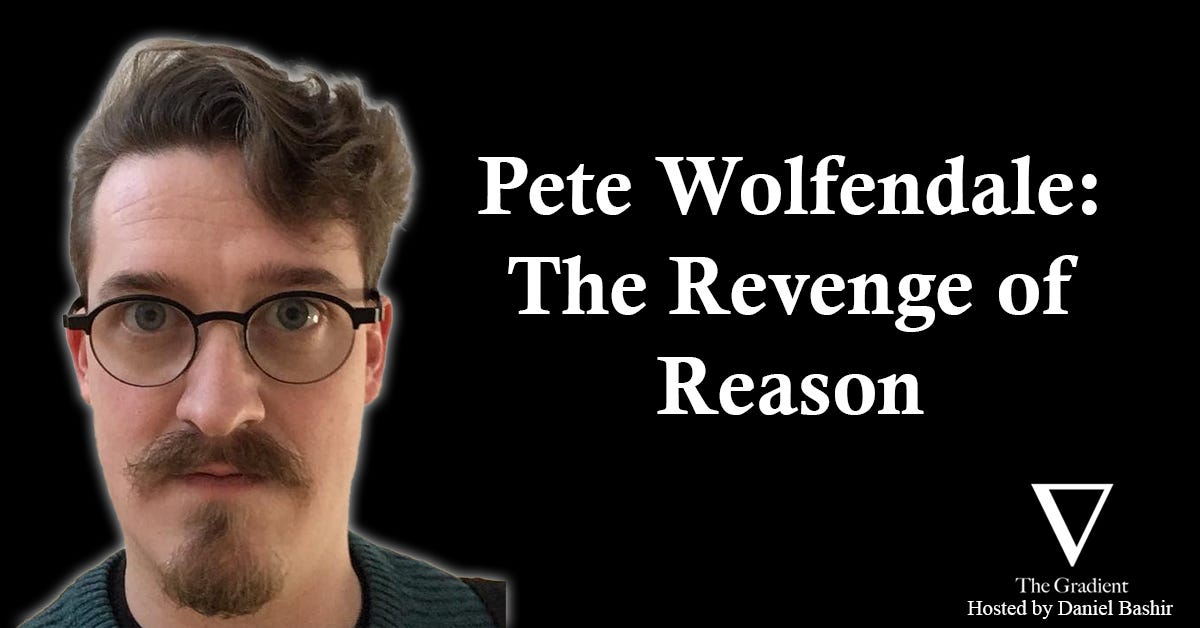
Pete Wolfendale: The Revenge of Reason

Pete Wolfendale: The Revenge of Reason

Author: Daniel Bashir August 8, 2024 Duration: 2:52:57

Episode 134

I spoke with Pete Wolfendale about:

* The flaws in longtermist thinking

* Selections from his new book, The Revenge of Reason

* Metaphysics

* What philosophy has to say about reason and AI

Enjoy—and let me know what you think!

Pete is an independent philosopher based in Newcastle. Dr. Wolfendale got both his undergraduate degree and his Ph.D in Philosophy at the University of Warwick. His Ph.D  thesis offered a re-examination of the Heideggerian Seinsfrage, arguing that Heideggerian scholarship has failed to fully do justice to its philosophical significance, and supplementing the shortcomings in Heidegger’s thought about Being with an alternative formulation of the question. He is the author of Object-Oriented Philosophy: The Noumenon's New Clothes and The Revenge of Reason. His blog is Deontologistics.

Find me on Twitter for updates on new episodes, and reach me at editor@thegradient.pub for feedback, ideas, guest suggestions.

I spend a lot of time on this podcast—if you like my work, you can support me on Patreon :) You can also support upkeep for the full Gradient team/project through a paid subscription on Substack!

Subscribe to The Gradient Podcast:  Apple Podcasts  | Spotify | Pocket Casts | RSSFollow The Gradient on Twitter

Outline:

* (00:00) Intro

* (01:30) Pete’s experience with (para-)academia, incentive structures

* (10:00) Progress in philosophy and the analytic tradition

* (17:57) Thinking through metaphysical questions

* (26:46) Philosophy of science, uncovering categorical properties vs. dispositions

* (31:55) Structure of thought and the world, epistemological excess

* (49:31) What reason is, relation to language models, semantic fragmentation of AGI

* (1:00:55) Neural net interpretability and intervention

* (1:08:16) World models, architecture and behavior of AI systems

* (1:12:35) Language acquisition in humans and LMs

* (1:15:30) Pretraining vs. evolution

* (1:16:50) Technological determinism

* (1:18:19) Pete’s thinking on e/acc

* (1:27:45) Prometheanism vs. e/acc

* (1:29:39) The Weight of Forever — Pete’s critique of What We Owe the Future

* (1:30:15) Our rich deontological language and longtermism’s limits

* (1:43:33) Longtermism and the opacity of desire

* (1:44:41) Longtermism’s historical narrative and technological determinism, theories of power

* (1:48:10) The “posthuman” condition, language and techno-linguistic infrastructure

* (2:00:15) Type-checking and universal infrastructure

* (2:09:23) Multitudes and selfhood

* (2:21:12) Definitions of the self and (non-)circularity

* (2:32:55) Freedom and aesthetics, aesthetic exploration and selfhood

* (2:52:46) Outro

Links:

* Pete’s blog and Twitter

* Book: The Revenge of Reason

* Writings / References

* The Weight of Forever

* On Neorationalism

* So, Accelerationism, what’s that all about?


Get full access to The Gradient at thegradientpub.substack.com/subscribe
Hosted by Daniel Bashir, The Gradient: Perspectives on AI moves beyond surface-level headlines to explore the intricate machinery and human ideas shaping artificial intelligence. Each episode is built on a foundation of deep research, leading to conversations that are both technically substantive and broadly accessible. You'll hear from researchers, engineers, and philosophers who are actively building and critiquing our technological future, discussing not just how AI systems work, but the larger implications of their integration into society. This isn't about speculative hype; it's a grounded examination of real progress, persistent challenges, and ethical considerations from those on the front lines. The discussions peel back layers on topics like model architecture, policy, and the fundamental science behind the algorithms becoming part of our daily lives. For anyone curious about the substance behind the buzz-whether you have a technical background or are simply keen to understand a defining technology of our age-this podcast offers a crucial and thoughtful resource. Tune in for a consistently detailed and nuanced take that treats artificial intelligence with the complexity it deserves.
Author: Language: English Episodes: 100

The Gradient: Perspectives on AI
Podcast Episodes
Joon Park: Generative Agents and Human-Computer Interaction [not-audio_url] [/not-audio_url]

Duration: 2:21:25
In episode 77 of The Gradient Podcast, Daniel Bashir speaks to Joon Park.Joon is a third-year PhD student at Stanford, advised by Professors Michael Bernstein and Percy Liang. He designs, builds, and evaluates interactiv…
Christoffer Holmgård: AI for Video Games [not-audio_url] [/not-audio_url]

Duration: 1:09:06
In episode 76 of The Gradient Podcast, Andrey Kurenkov speaks to Dr Christoffer HolmgårdDr. Holmgård is a co-founder and the CEO of Modl.ai, which is building AI Engine for game development. Before starting the company,…
Riley Goodside: The Art and Craft of Prompt Engineering [not-audio_url] [/not-audio_url]

Duration: 59:42
In episode 75 of The Gradient Podcast, Daniel Bashir speaks to Riley Goodside. Riley is a Staff Prompt Engineer at Scale AI. Riley began posting GPT-3 prompt examples and screenshot demonstrations in 2022. He previously…
Talia Ringer: Formal Verification and Deep Learning [not-audio_url] [/not-audio_url]

Duration: 1:45:35
In episode 74 of The Gradient Podcast, Daniel Bashir speaks to Professor Talia Ringer.Professor Ringer is an Assistant Professor with the Programming Languages, Formal Methods, and Software Engineering group at the Unive…
Brigham Hyde: AI for Clinical Decision-Making [not-audio_url] [/not-audio_url]

Duration: 41:43
In episode 72 of The Gradient Podcast, Daniel Bashir speaks to Brigham Hyde.Brigham is Co-Founder and CEO of Atropos Health. Prior to Atropos, he served as President of Data and Analytics at Eversana, a life sciences com…
Scott Aaronson: Against AI Doomerism [not-audio_url] [/not-audio_url]

Duration: 1:09:32
In episode 72 of The Gradient Podcast, Daniel Bashir speaks to Professor Scott Aaronson. Scott is the Schlumberger Centennial Chair of Computer Science at the University of Texas at Austin and director of its Quantum Inf…
Ted Underwood: Machine Learning and the Literary Imagination [not-audio_url] [/not-audio_url]

Duration: 1:43:59
In episode 71 of The Gradient Podcast, Daniel Bashir speaks to Ted Underwood.Ted is a professor in the School of Information Sciences with an appointment in the Department of English at the University of Illinois at Urba…
Irene Solaiman: AI Policy and Social Impact [not-audio_url] [/not-audio_url]

Duration: 1:12:11
In episode 70 of The Gradient Podcast, Daniel Bashir speaks to Irene Solaiman.Irene is an expert in AI safety and policy and the Policy Director at HuggingFace, where she conducts social impact research and develops publ…
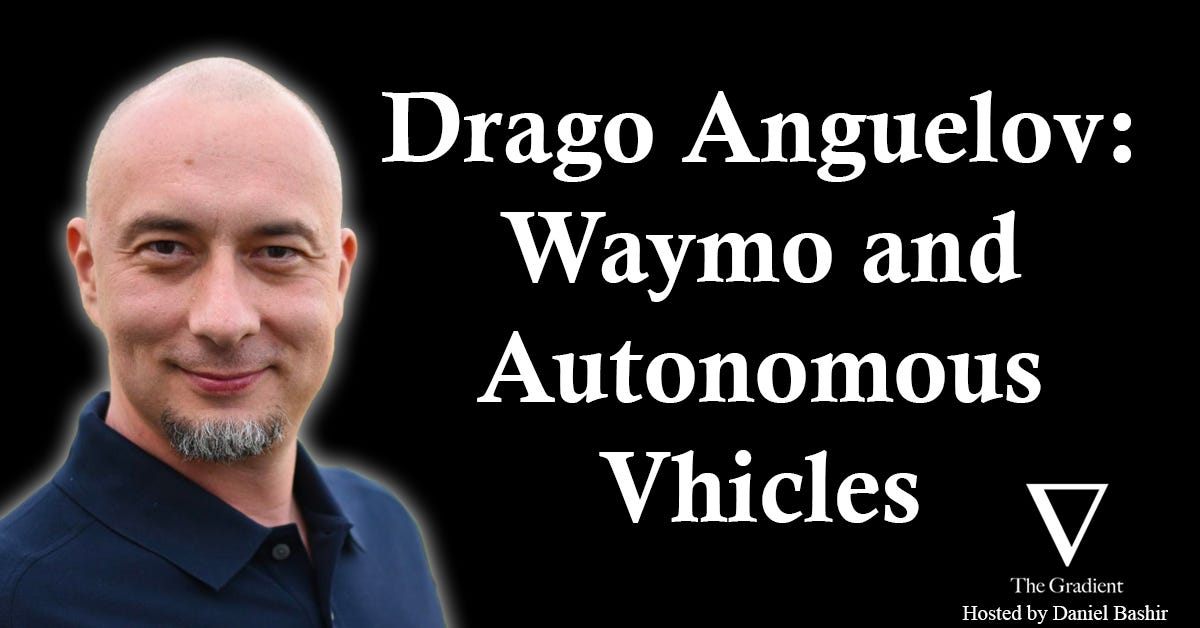
Drago Anguelov: Waymo and Autonomous Vehicles [not-audio_url] [/not-audio_url]

Duration: 1:05:23
In episode 69 of The Gradient Podcast, Daniel Bashir speaks to Drago Anguelov.Drago is currently a Distinguished Scientist and Head of Research at Waymo, where he joined in 2018. Earlier, he spent eight years at Google w…
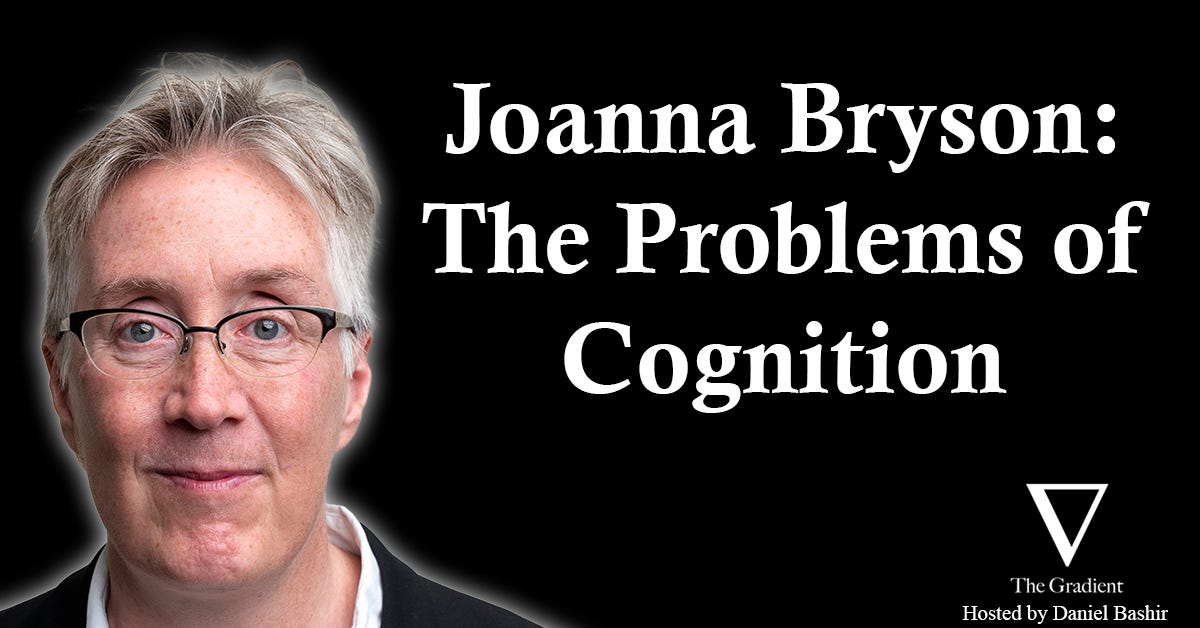
Joanna Bryson: The Problems of Cognition [not-audio_url] [/not-audio_url]

Duration: 1:13:05
In episode 68 of The Gradient Podcast, Daniel Bashir speaks to Professor Joanna Bryson.Professor Bryson is Professor of Ethics and Technology at the Hertie School, where her research focuses on the impact of technology o…