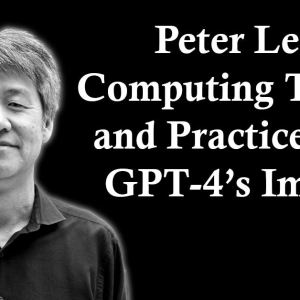
Peter Lee: Computing Theory and Practice, and GPT-4's Impact

Peter Lee: Computing Theory and Practice, and GPT-4's Impact

Author: Daniel Bashir August 1, 2024 Duration: 1:01:48

Episode 133

I spoke with Peter Lee about:

* His early work on compiler generation, metacircularity, and type theory

* Paradoxical problems

* GPT-4s impact, Microsoft’s “Sparks of AGI” paper, and responses and criticism

Enjoy—and let me know what you think!

Peter is President of Microsoft Research. He leads Microsoft Research and incubates new research-powered products and lines of business in areas such as artificial intelligence, computing foundations, health, and life sciences. Before joining Microsoft in 2010, he was at DARPA, where he established a new technology office that created operational capabilities in machine learning, data science, and computational social science. Prior to that, he was a professor and the head of the computer science department at Carnegie Mellon University. Peter is a member of the National Academy of Medicine and serves on the boards of the Allen Institute for Artificial Intelligence, the Brotman Baty Institute for Precision Medicine, and the Kaiser Permanente Bernard J. Tyson School of Medicine. He served on President Obama’s Commission on Enhancing National Cybersecurity. He has testified before both the US House Science and Technology Committee and the US Senate Commerce Committee. With Carey Goldberg and Dr. Isaac Kohane, he is the coauthor of the best-selling book, “The AI Revolution in Medicine: GPT-4 and Beyond.” In 2024, Peter was named by Time magazine as one of the 100 most influential people in health and life sciences.

Find me on Twitter for updates on new episodes, and reach me at editor@thegradient.pub for feedback, ideas, guest suggestions.

I spend a lot of time on this podcast—if you like my work, you can support me on Patreon :) You can also support upkeep for the full Gradient team/project through a paid subscription on Substack!

Subscribe to The Gradient Podcast:  Apple Podcasts  | Spotify | Pocket Casts | RSSFollow The Gradient on Twitter

Outline:

* (00:00) Intro

* (00:50) Basic vs. applied research

* (05:20) Theory and practice in computing

* (10:28) Traditional denotational semantics and semantics engineering in modern-day systems

* (16:47) Beauty and practicality

* (20:40) Metacircularity in the polymorphic lambda calculus: research directions

* (24:31) Understanding the nature of difficulties with metacircularity

* (26:30) Difficulties with reflection, classic paradoxes

* (31:02) Sparks of AGI

* (31:41) Reproducibility

* (38:04) Confirming and disconfirming theories, foundational work

* (42:00) Back and forth between commitments and experimentation

* (51:01) Dealing with responsibility

* (56:30) Peter’s picture of AGI

* (1:01:38) Outro

Links:

* Peter’s Twitter, LinkedIn, and Microsoft Research pages

* Papers and references

* The automatic generation of realistic compilers from high-level semantic descriptions

* Metacircularity in the polymorphic lambda calculus

* A Fresh Look at Combinator Graph Reduction

* Sparks of AGI

* Re-envisioning DARPA

* Fundamental Research in Engineering


Get full access to The Gradient at thegradientpub.substack.com/subscribe
Hosted by Daniel Bashir, The Gradient: Perspectives on AI moves beyond surface-level headlines to explore the intricate machinery and human ideas shaping artificial intelligence. Each episode is built on a foundation of deep research, leading to conversations that are both technically substantive and broadly accessible. You'll hear from researchers, engineers, and philosophers who are actively building and critiquing our technological future, discussing not just how AI systems work, but the larger implications of their integration into society. This isn't about speculative hype; it's a grounded examination of real progress, persistent challenges, and ethical considerations from those on the front lines. The discussions peel back layers on topics like model architecture, policy, and the fundamental science behind the algorithms becoming part of our daily lives. For anyone curious about the substance behind the buzz-whether you have a technical background or are simply keen to understand a defining technology of our age-this podcast offers a crucial and thoughtful resource. Tune in for a consistently detailed and nuanced take that treats artificial intelligence with the complexity it deserves.
Author: Language: English Episodes: 100

The Gradient: Perspectives on AI
Podcast Episodes
Joon Park: Generative Agents and Human-Computer Interaction [not-audio_url] [/not-audio_url]

Duration: 2:21:25
In episode 77 of The Gradient Podcast, Daniel Bashir speaks to Joon Park.Joon is a third-year PhD student at Stanford, advised by Professors Michael Bernstein and Percy Liang. He designs, builds, and evaluates interactiv…
Christoffer Holmgård: AI for Video Games [not-audio_url] [/not-audio_url]

Duration: 1:09:06
In episode 76 of The Gradient Podcast, Andrey Kurenkov speaks to Dr Christoffer HolmgårdDr. Holmgård is a co-founder and the CEO of Modl.ai, which is building AI Engine for game development. Before starting the company,…
Riley Goodside: The Art and Craft of Prompt Engineering [not-audio_url] [/not-audio_url]

Duration: 59:42
In episode 75 of The Gradient Podcast, Daniel Bashir speaks to Riley Goodside. Riley is a Staff Prompt Engineer at Scale AI. Riley began posting GPT-3 prompt examples and screenshot demonstrations in 2022. He previously…
Talia Ringer: Formal Verification and Deep Learning [not-audio_url] [/not-audio_url]

Duration: 1:45:35
In episode 74 of The Gradient Podcast, Daniel Bashir speaks to Professor Talia Ringer.Professor Ringer is an Assistant Professor with the Programming Languages, Formal Methods, and Software Engineering group at the Unive…
Brigham Hyde: AI for Clinical Decision-Making [not-audio_url] [/not-audio_url]

Duration: 41:43
In episode 72 of The Gradient Podcast, Daniel Bashir speaks to Brigham Hyde.Brigham is Co-Founder and CEO of Atropos Health. Prior to Atropos, he served as President of Data and Analytics at Eversana, a life sciences com…
Scott Aaronson: Against AI Doomerism [not-audio_url] [/not-audio_url]

Duration: 1:09:32
In episode 72 of The Gradient Podcast, Daniel Bashir speaks to Professor Scott Aaronson. Scott is the Schlumberger Centennial Chair of Computer Science at the University of Texas at Austin and director of its Quantum Inf…
Ted Underwood: Machine Learning and the Literary Imagination [not-audio_url] [/not-audio_url]

Duration: 1:43:59
In episode 71 of The Gradient Podcast, Daniel Bashir speaks to Ted Underwood.Ted is a professor in the School of Information Sciences with an appointment in the Department of English at the University of Illinois at Urba…
Irene Solaiman: AI Policy and Social Impact [not-audio_url] [/not-audio_url]

Duration: 1:12:11
In episode 70 of The Gradient Podcast, Daniel Bashir speaks to Irene Solaiman.Irene is an expert in AI safety and policy and the Policy Director at HuggingFace, where she conducts social impact research and develops publ…
Drago Anguelov: Waymo and Autonomous Vehicles [not-audio_url] [/not-audio_url]

Duration: 1:05:23
In episode 69 of The Gradient Podcast, Daniel Bashir speaks to Drago Anguelov.Drago is currently a Distinguished Scientist and Head of Research at Waymo, where he joined in 2018. Earlier, he spent eight years at Google w…
Joanna Bryson: The Problems of Cognition [not-audio_url] [/not-audio_url]

Duration: 1:13:05
In episode 68 of The Gradient Podcast, Daniel Bashir speaks to Professor Joanna Bryson.Professor Bryson is Professor of Ethics and Technology at the Hertie School, where her research focuses on the impact of technology o…