Suresh Venkatasubramanian: An AI Bill of Rights

Suresh Venkatasubramanian: An AI Bill of Rights

Author: Daniel Bashir January 12, 2023 Duration: 1:40:58

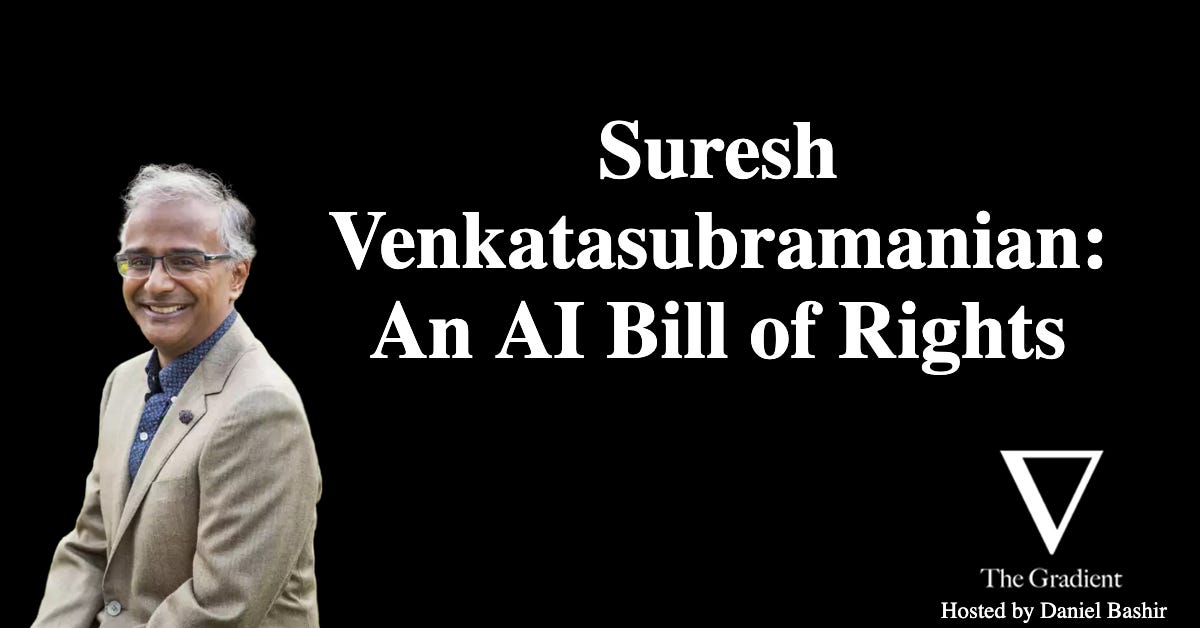
In episode 55 of The Gradient Podcast, Daniel Bashir speaks to Professor Suresh Venkatasubramanian.

Professor Venkatasubramanian is a Professor of Computer Science and Data Science at Brown University, where his research focuses on algorithmic fairness and the impact of automated decision-making systems in society. He recently served as Assistant Director for Science and Justice in the White House Office of Science and Technology Policy, where he co-authored the Blueprint for an AI Bill of Rights.

Have suggestions for future podcast guests (or other feedback)? Let us know here!

Subscribe to The Gradient Podcast:  Apple Podcasts  | Spotify | Pocket Casts | RSSFollow The Gradient on Twitter

Outline:

* (00:00) Intro

* (02:25) Suresh’s journey into AI and policymaking

* (08:00) The complex graph of designing and deploying “fair” AI systems

* (09:50) The Algorithmic Lens

* (14:55) “Getting people into a room” isn’t enough

* (16:30) Failures of incorporation

* (21:10) Trans-disciplinary vs interdisciplinary, the limiting nature of “my lane” / “your lane” thinking, going beyond existing scientific and philosophical ideas

* (24:50) The trolley problem is annoying, its usefulness and limitations

* (25:30) Breaking the frame of a discussion, self-driving doesn’t fit into the parameters of the trolley problem

* (28:00) Acknowledging frames and their limitations

* (29:30) Social science’s inclination to critique, flaws and benefits of solutionism

* (30:30) Computer security as a model for thinking about algorithmic protections, the risk of failure in policy

* (33:20) Suresh’s work on recourse

* (38:00) Kantian autonomy and the value of recourse, non-Western takes and issues with individual benefit/harm as the most morally salient question

* (41:00) Community as a valuable entity and its implications for algorithmic governance, surveillance systems

* (43:50) How Suresh got involved in policymaking / the OSTP

* (46:50) Gathering insights for the AI Bill of Rights Blueprint

* (51:00) One thing the Bill did miss… Struggles with balancing specificity and vagueness in the Bill

* (54:20) Should “automated system” be defined in legislation? Suresh’s approach and issues with the EU AI Act

* (57:45) The danger of definitions, overlap with chess world controversies

* (59:10) Constructive vagueness in law, partially theorized agreements

* (1:02:15) Digital privacy and privacy fundamentalism, focus on breach of individual autonomy as the only harm vector

* (1:07:40) GDPR traps, the “legacy problem” with large companies and post-hoc regulation

* (1:09:30) Considerations for legislating explainability

* (1:12:10) Criticisms of the Blueprint and Suresh’s responses

* (1:25:55) The global picture, AI legislation outside the US, legislation as experiment

* (1:32:00) Tensions in entering policy as an academic and technologist

* (1:35:00) Technologists need to learn additional skills to impact policy

* (1:38:15) Suresh’s advice for technologists interested in public policy

* (1:41:20) Outro

Links:

* Suresh is on Mastodon @geomblog@mastodon.social (and also Twitter)

* Suresh’s blog

* Blueprint for an AI Bill of Rights

* Papers

* Fairness and abstraction in sociotechnical systems

* A comparative study of fairness-enhancing interventions in machine learning

* The Philosophical Basis of Algorithmic Recourse

* Runaway Feedback Loops in Predictive Policing


Get full access to The Gradient at thegradientpub.substack.com/subscribe
Hosted by Daniel Bashir, The Gradient: Perspectives on AI moves beyond surface-level headlines to explore the intricate machinery and human ideas shaping artificial intelligence. Each episode is built on a foundation of deep research, leading to conversations that are both technically substantive and broadly accessible. You'll hear from researchers, engineers, and philosophers who are actively building and critiquing our technological future, discussing not just how AI systems work, but the larger implications of their integration into society. This isn't about speculative hype; it's a grounded examination of real progress, persistent challenges, and ethical considerations from those on the front lines. The discussions peel back layers on topics like model architecture, policy, and the fundamental science behind the algorithms becoming part of our daily lives. For anyone curious about the substance behind the buzz-whether you have a technical background or are simply keen to understand a defining technology of our age-this podcast offers a crucial and thoughtful resource. Tune in for a consistently detailed and nuanced take that treats artificial intelligence with the complexity it deserves.
Author: Language: English Episodes: 100

The Gradient: Perspectives on AI
Podcast Episodes
Stevan Harnad: AI's Symbol Grounding Problem [not-audio_url] [/not-audio_url]

Duration: 1:58:21
In episode 88 of The Gradient Podcast, Daniel Bashir speaks to Professor Stevan Harnad.Stevan Harnad is professor of psychology and cognitive science at Université du Québec à Montréal, adjunct professor of cognitive sci…
Terry Winograd: AI, HCI, Language, and Cognition [not-audio_url] [/not-audio_url]

Duration: 1:33:21
In episode 87 of The Gradient Podcast, Daniel Bashir speaks to Professor Terry Winograd. Professor Winograd is Professor Emeritus of Computer Science at Stanford University. His research focuses on human-computer interac…
Gil Strang: Linear Algebra and Deep Learning [not-audio_url] [/not-audio_url]

Duration: 1:00:36
In episode 86 of The Gradient Podcast, Daniel Bashir speaks to Professor Gil Strang. Professor Strang is one of the world’s foremost mathematics educators and a mathematician with contributions to finite element theory,…
Anant Agarwal: AI for Education [not-audio_url] [/not-audio_url]

Duration: 47:40
In episode 85 of The Gradient Podcast, Andrey Kurenkov speaks to Anant AgarwalAnant Agarwal is the chief platform officer of 2U, and founder of edX. Anant taught the first edX course on circuits and electronics from MIT,…
Peli Grietzer: A Mathematized Philosophy of Literature [not-audio_url] [/not-audio_url]

Duration: 2:33:33
In episode 83 of The Gradient Podcast, Daniel Bashir speaks to Peli Grietzer. Peli is a scholar whose work borrows mathematical ideas from machine learning theory to think through “ambient” and ineffable phenomena like m…
Ryan Drapeau: Battling Fraud with ML at Stripe [not-audio_url] [/not-audio_url]

Duration: 1:06:31
In episode 82 of The Gradient Podcast, Daniel Bashir speaks to Ryan Drapeau.Ryan is a Staff Software Engineer at Stripe and technical lead for Stripe’s Payment Fraud organization, which uses machine learning to help prev…
Shiv Rao: Enabling Better Patient Care with AI [not-audio_url] [/not-audio_url]

Duration: 1:00:51
In episode 81 of The Gradient Podcast, Daniel Bashir speaks to Shiv Rao.Shiv Rao, MD is the co-founder and CEO of Abridge, a healthcare conversation company that uses cutting-edge NLP and generative AI to bring context a…
Hugo Larochelle: Deep Learning as Science [not-audio_url] [/not-audio_url]

Duration: 1:48:28
In episode 80 of The Gradient Podcast, Daniel Bashir speaks to Professor Hugo Larochelle. Professor Larochelle leads the Montreal Google DeepMind team and is adjunct professor at Université de Montréal and a Canada CIFAR…
Jeremie Harris: Realistic Alignment and AI Policy [not-audio_url] [/not-audio_url]

Duration: 1:30:35
In episode 79 of The Gradient Podcast, Daniel Bashir speaks to Jeremie Harris.Jeremie is co-founder of Gladstone AI, author of the book Quantum Physics Made Me Do It, and co-host of the Last Week in AI Podcast. Jeremy pr…