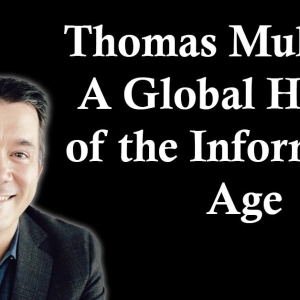
Thomas Mullaney: A Global History of the Information Age

Thomas Mullaney: A Global History of the Information Age

Author: Daniel Bashir May 30, 2024 Duration: 1:43:45

Episode 125

False universalism freaks me out. It doesn’t freak me out as a first principle because of epistemic violence; it freaks me out because it works.

I spoke with Professor Thomas Mullaney about:

* Telling stories about your work and balancing what feels meaningful with practical realities

* Destabilizing our understandings of the technologies we feel familiar with, and the work of researching the history of the Chinese typewriter

* The personal nature of research

The Chinese Typewriter and The Chinese Computer are two of the best books I’ve read in a very long time. And they’re not just good and interesting, but important to read, for the history they tell and the ideas and arguments they present—I can’t recommend them and Professor Mullaney’s other work enough.

Tom is Professor of History and Professor of East Asian Languages and Cultures, by courtesy. He is also the Kluge Chair in Technology and Society at the Library of Congress, and a Guggenheim Fellow. He is the author or lead editor of 8 books, including The Chinese Computer, The Chinese Typewriter (winner of the Fairbank prize), Your Computer is on Fire, and Coming to Terms with the Nation: Ethnic Classification in Modern China.

Reach me at editor@thegradient.pub for feedback, ideas, guest suggestions.

Subscribe to The Gradient Podcast:  Apple Podcasts  | Spotify | Pocket Casts | RSSFollow The Gradient on Twitter

Outline:

* (00:00) Intro

* (01:00) “In Their Own Words” interview: on telling stories about your work

* (07:42) Clashing narratives and authenticity/inauthenticity in pursuing your work

* (15:48) Why Professor Mullaney pursued studying the Chinese typewriter

* (18:20) Worldmaking, transforming the physical world to fit our descriptive models

* (30:07) Internal and illegible continuities/coherence in work

* (31:45) The role of a “self”

* (43:06) The 2008 Beijing Olympics and false (alphabetical) universalism, projectivism

* (1:04:23) “Kicking the ladder” and the personal nature of research

* (1:18:07) The “Technolinguistic Chinese Exclusion Act” — the situatedness of historians in their work

* (1:33:00) Is the Chinese typewriter project finished? / on the resolution of problems

* (1:43:35) Outro

Links:

* Professor Mullaney’s homepage and Twitter

* In Their Own Words: Thomas Mullaney

* Books

* The Chinese Computer: A Global History of the Information Age

* The Chinese Typewriter: A History

* Coming to Terms with the Nation: Ethnic Classification in Modern China


Get full access to The Gradient at thegradientpub.substack.com/subscribe

Hosted by Daniel Bashir, The Gradient: Perspectives on AI moves beyond surface-level headlines to explore the intricate machinery and human ideas shaping artificial intelligence. Each episode is built on a foundation of deep research, leading to conversations that are both technically substantive and broadly accessible. You'll hear from researchers, engineers, and philosophers who are actively building and critiquing our technological future, discussing not just how AI systems work, but the larger implications of their integration into society. This isn't about speculative hype; it's a grounded examination of real progress, persistent challenges, and ethical considerations from those on the front lines. The discussions peel back layers on topics like model architecture, policy, and the fundamental science behind the algorithms becoming part of our daily lives. For anyone curious about the substance behind the buzz-whether you have a technical background or are simply keen to understand a defining technology of our age-this podcast offers a crucial and thoughtful resource. Tune in for a consistently detailed and nuanced take that treats artificial intelligence with the complexity it deserves.
Author: Language: English Episodes: 100

The Gradient: Perspectives on AI
Podcast Episodes
2025 in AI, with Nathan Benaich [not-audio_url] [/not-audio_url]

Duration: 1:01:15
Episode 144Happy New Year! This is one of my favorite episodes of the year — for the fourth time, Nathan Benaich and I did our yearly roundup of AI news and advancements, including selections from this year’s State of AI…
Iason Gabriel: Value Alignment and the Ethics of Advanced AI Systems [not-audio_url] [/not-audio_url]

Duration: 58:39
Episode 143I spoke with Iason Gabriel about:* Value alignment* Technology and worldmaking* How AI systems affect individuals and the social worldIason is a philosopher and Senior Staff Research Scientist at Google DeepMi…
2024 in AI, with Nathan Benaich [not-audio_url] [/not-audio_url]

Duration: 1:48:43
Episode 142Happy holidays! This is one of my favorite episodes of the year — for the third time, Nathan Benaich and I did our yearly roundup of all the AI news and advancements you need to know. This includes selections…
Philip Goff: Panpsychism as a Theory of Consciousness [not-audio_url] [/not-audio_url]

Duration: 1:00:04
Episode 141I spoke with Professor Philip Goff about:* What a “post-Galilean” science of consciousness looks like* How panpsychism helps explain consciousness and the hybrid cosmopsychist viewEnjoy!Philip Goff is a Britis…
Some Changes at The Gradient [not-audio_url] [/not-audio_url]

Duration: 34:25
Hi everyone!If you’re a new subscriber or listener, welcome. If you’re not new, you’ve probably noticed that things have slowed down from us a bit recently. Hugh Zhang, Andrey Kurenkov and I sat down to recap some of The…
Jacob Andreas: Language, Grounding, and World Models [not-audio_url] [/not-audio_url]

Duration: 1:52:43
Episode 140I spoke with Professor Jacob Andreas about:* Language and the world* World models* How he’s developed as a scientistEnjoy!Jacob is an associate professor at MIT in the Department of Electrical Engineering and…
Evan Ratliff: Our Future with Voice Agents [not-audio_url] [/not-audio_url]

Duration: 1:19:59
Episode 139I spoke with Evan Ratliff about:* Shell Game, Evan’s new podcast, where he creates an AI voice clone of himself and sets it loose. * The end of the Longform Podcast and his thoughts on the state of journalism.…
Meredith Ringel Morris: Generative AI's HCI Moment [not-audio_url] [/not-audio_url]

Duration: 1:37:45
Episode 138I spoke with Meredith Morris about:* The intersection of AI and HCI and why we need more cross-pollination between AI and adjacent fields* Disability studies and AI* Generative ghosts and technological determi…
Davidad Dalrymple: Towards Provably Safe AI [not-audio_url] [/not-audio_url]

Duration: 1:20:50
Episode 137I spoke with Davidad Dalrymple about:* His perspectives on AI risk* ARIA (the UK’s Advanced Research and Invention Agency) and its Safeguarded AI ProgrammeEnjoy—and let me know what you think!Davidad is a Prog…
Clive Thompson: Tales of Technology [not-audio_url] [/not-audio_url]

Duration: 2:27:35
Episode 136I spoke with Clive Thompson about:* How he writes* Writing about the climate and biking across the US* Technology culture and persistent debates in AI* PoetryEnjoy—and let me know what you think!Clive is a jou…