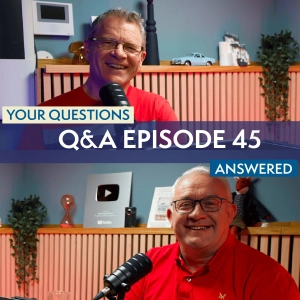
In this episode of the MeaningfulMoney Q&A, Pete and Roger answer six listener questions covering a wide range of personal finance topics. We tackle a tricky inheritance tax situation involving a property bought in children's names, look at pension and ISA options for a daughter likely to spend her career working outside the UK, and offer some perspective on balancing financial sensibility with life's genuine passions. We also cover whether a minimal LISA contribution strategy actually works, how to manage the transition from 100% equities to a retirement asset allocation in the years before you stop work, and what income protection options exist for a young professional wanting to guard against long-term illness or injury.
Shownotes: https://meaningfulmoney.tv/QA45
02:20 Question 1
Hello Peter and Roger (without a D)
I am so pleased I discovered your podcast a few months ago, since then your words of wisdom accompany me on my daily dog walks and I have become the annoying older colleague in the office telling the younger colleagues about the power of compounding and contributing to the pension scheme.
I have a rather unusual query I would really appreciate your view on and maybe the potential pitfalls we are experiencing would be of interest to other listeners as I have read lots of questions on-line about potential benefits of putting property in children's names.
My parents retired to Spain 25 years ago, they cash-purchased a UK flat for when they come back 10 years ago. In a bid to avoid inheritance tax they bought this in mine and 3 siblings names (all in our late 40/early 50s). They did not seek professional advice, just assuming it was the right thing to do, which could be the morale of the story.
Sadly my Dad recently died and as executor of his will I have been looking into the UK assets. I realise now that this cunning plan does not work, as they regularly stay in the flat without paying rent. Therefore, it is classed as gift with reserved benefits and still included in the estate. However this is not an issue as they are well below the IHT threshold.
The question I have relates to the future financial position that I think they have inadvertently created. My mum wants to sell up in Spain buy a house in the UK and then either rent the flat for some more income or potential sell it. But how does this work if the property is in our names? Can she legitimately take rent (with our permission) without it having income tax implications on us (I am higher rate so do not want this!). If she wants to sell it I assume it will be sales to us siblings so we will pay capital gains (but what rate? we are a mix of tax brackets and one of my sisters doesn't own another house.) She says she might be best just transferring into her name, but I don't think it will be that easy and we will still be liable for capital gains as it will effectively be a sale to her. Is there something we have missed here and is it something we should be concerned about? Or is it OK to leave as is and let her keep to draw down income. Could it be the right thing to do and having the property in our names be simpler to resolve when she dies?
I am hoping your soothing Yorkshire/Cornish tones can reassure me all will be OK.
Vicky a faithful listener.
11:24 Question 2
Hi Pete and Rog
I only discovered the podcast fairly recently, but have been following your web-based lessons on Meaningful Money for a while (and have read the books). I am really loving the podcast - so many back episodes to listen to! Super-informative, and your dulcet tones are also very soothing!
My question is to do with advice for an adult child who is likely to spend her career working outside the UK.
My husband and I are both late 50s and technically have reached FIRE (years of finance-nerdery despite relatively low incomes) but I am still doing consultancy because I quite enjoy it.
Our older three children are all getting established in their careers, and I've brainwashed/ educated them in the ways of financial sensibleness, so they're all set up with emergency funds/S&S ISAs/employer pensions/SIPPS. Our youngest daughter is studying at university in Poland (the kids and I all have dual Polish/UK citizenship, as my mum was Polish). This means my daughter can work anywhere in the EU, and although she will always have strong ties to the UK, it's looking as if she is more likely to work outside the UK once she graduates in summer 2026.
This opens up a whole new world of options in terms of setting her on a path to financial security, and there's quite a lot of conflicting information - I would really appreciate some input on what are likely to be the best options for someone in this situation.
At the moment she's 'ordinarily resident' in the UK, on the electoral roll etc., but doesn't have any UK income. Can she make pension contributions in the UK even if she's working elsewhere? I assume she still has an ISA allowance if she's a UK citizen working abroad, but a LISA would make less sense if she's not likely to buy a UK property? I am self-employed via a limited company and she has occasionally done bits of tech support for me, so she could register as self-employed in the UK and bill me for that - would that count as UK employment? My accountant is super-scrupulous, so I'm not interested in anything that might be sailing even vaguely close to the wind in HMRC terms.
I would appreciate any thoughts on this perhaps slightly non-standard situation, although I assume there must be quite a few other people out there with dual UK/EU citizenship who might be facing similar questions?
Many thanks, Felicia
19:06 Question 3
Dear Pete and Roger.
I listen to your podcast all the time and it keeps me right. It has really helped me navigate my financial literacy or lack thereof. I am now in a situation where I have much better understanding of what I need to be doing with my money, and have made sense of all financial decisions such as paying into my workplace pension, owning my own home, and I have a recently paid job and some side projects which earn me a little.
My question is, I think, a search for a validation of my life choices! Basically, despite having a good job and owning my own home outright, I am still struggling to budget every month. This is because I have made a terrible financial decision of owning two horses. These horses are my pride and joy, but the financial strain of it does make me feel guilty in terms of the distribution of spending between me and my husband. I spent about 600 a month on the horses, give or take a bit each month.
Do you have any words of wisdom about how to balance being sensible with money Vs 'investing' in my life passions? I don't think I'll ever give up the horses, so it's more about whether I continue to stress about it or not.
Many thanks for your wisdom as always
Josie
25:20 Question 4
Thank you for all the great content!
I have a LISA question for the podcast in relation to my 25 year old son? He currently lives with me in SW London and is saving to buy his own place. I love having him stay and I am in no rush for him to move out.
He/we decided not to go with a LISA because he is likely to buy a property in or around London and we are concerned about the £450K cap which I believe has remained fixed since 2017. He is very motivated, ambitious and hard working and has already had several promotions with an opportunity to work in the US next year. He has already saved £50K for a deposit and I intend helping him too. He is not in a rush to buy as it feels like the property market is no longer running away from him.
He told me he thinks it makes more sense to enter the property market on the second rung of the ladder rather than the first as it costs so much to move with stamp duty, fees etc. So perhaps a 2 bed in a nice(ish) area rather than a starter home (and renting the second bedroom to a friend). I think I agree with him, especially if he ends up working in the US for an unknown period of time. A 2 bed in a nice(ish) area where he actually wants to live would cost more than the £450K cap which is why we are reluctant to use the LISA for saving for his first home (I understand it can also be a pension investment but he is already contributing to his workplace pension).
However, I have in my head a bug that says he can put minimal contributions into a LISA each year (say £5) which he could top up retrospectively if he changes his mind and does find somewhere to buy for under £450K. Am I correct?
Your thoughts would be much appreciated.
Michelle
29:04 Question 5
Hi Pete and Roger
Thanks so much for all the work you do, I've only found the podcast recently but already enjoying learning more and thinking about things differently.
My question relates to saving for retirement and specifically the period leading up to retiring. Nearly all of our (mine and my husband's) pensions are in SIPPs where we have been happy to be 100% equity, in global index funds. We are now maybe 7-10 years from the point where we could retire, and I've been able to research withdrawal strategies to the point where I'm confident managing that when we get there. We have determined our target asset allocation split between equities / bond funds / individual gilts and money market funds for the start point of retirement.
I haven't been able to find much information about the period of transition from 100% equity to the asset allocation we want in place for the start of retirement. Obviously it's a balance between reducing exposure to volatility as we approach retirement and accepting a drag on the portfolio caused by the increasing allocation to cash and bonds and my instinctive (but not evidence-based!) approach would be to gradually move from one to the other over a number of years.
So my question is this - is there a better approach than just a straightline shift from one to the other? How far out from retirement is it appropriate to start making the transition? The best advice I can find online is just to pick whatever makes you feel comfortable and do that but surely there must be some more robust guidance out there? I appreciate it might not be a one size fits all answer but would appreciate your thoughts on how to approach this.
The one piece of advice I do seem to have found is that however we decide to do it, to stick to a predetermined schedule to avoid temptation to try to time the market - does that sound sensible or have I missed the mark on that?
Thanks so much for any help you can give.
Fran
35:26 Question 6
Hey Pete & Roger,
Thank you for the great podcast!
I have a question about income protection insurance. I'm quite young (25 - probably among your youngest listeners!), no dependents, renting with my partner, and am fortunate enough to have a well paid job and a promising future career.
I recognise that my biggest asset is my future earning potential and would like to protect that in case of the worst. I have a 6 month emergency fund, healthy amounts (for my age) invested across ISAs and pensions, and my work offers 50% loss of income protection for accident or illness for 3 years, which is all great.
My question is - to what extent should I think about trying to protect against the tail risk of not being able to work for >3 years, possibly till pension age? This is of course quite unlikely, but would be very detrimental if it were to occur - the exact sort of place where insurance would make sense. However I can't seem to find any insurance policies with such a long deferral period and I can't "double up" by having a shorter referral period. So, do such products exist, and if not are there any alternatives other than just accepting that risk and re-evaluating if and when my circumstances change? Is this even a reasonable risk to be thinking about, or is it overkill? Is there anything I should think about that I may be missing?
Many thanks, Sarah
*Affiliate - https://meaningfulmoney.tv/lifesearch