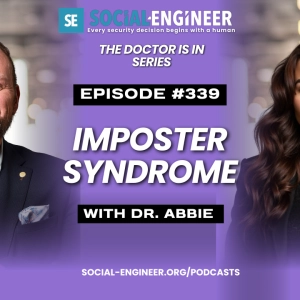
Ep. 339 - The Doctor Is In Series - Are You An Imposter?

Ep. 339 - The Doctor Is In Series - Are You An Imposter?

Author: Social-Engineer, LLC February 2, 2026 Duration: 31:25

Welcome to the Social-Engineer Podcast: The Doctor Is In Series – where we will discuss understandings and developments in the field of psychology.   

In today's episode, Chris and Dr. Abbie explore imposter syndrome, examining what it is, why it occurs, and how cultural and professional pressures can intensify it. They discuss common symptoms, personal experiences, and the psychological roots behind feeling undeserving of success. Through scientific insight and practical strategies, they share ways to recognize, reframe, and manage imposter syndrome with greater self-awareness and confidence. 

[Feb 2, 2026] 

00:00 Intro 

00:20 - Meet the Hosts 

00:54 Upcoming Events and Announcements 

02:29 Defining Imposter Syndrome 

06:42 Cultural and Gender Influences 

12:26 Personality Traits and Imposter Syndrome 

14:46 Sponsor 

16:12 Balancing Humility and Confidence 

19:34 Strategies to Overcome Imposter Syndrome 

27:02 Billy Boatwright's Story 

30:36  Conclusion and Next Episode Preview 


Find us online: 


References: 

Beck, J. S. (2011).Cognitive behavior therapy: Basics and beyond(2nd ed.). Guilford Press.  

Bennett-Levy, J., Butler, G., Fennell, M., Hackmann, A., Mueller, M., & Westbrook, D. (2004).The Oxford guide to behavioral experiments in cognitive therapy. Oxford University Press.  

Breines, J. G., & Chen, S. (2012). Self-compassion increases self-improvement motivation.Personality and Social Psychology Bulletin, 38(9), 1133–1143.https://doi.org/10.1177/0146167212445599 

Bravata, D. M., Watts, S. A., Keefer, A. L., Madhusudhan, D. K., Taylor, K. T., Clark, D. M., Nelson, R. S., Cokley, K. O., & Hagg, H. K. (2020). Prevalence, predictors, and treatment of impostor syndrome: A systematic review.Journal of General Internal Medicine, 35(4), 1252–1275.https://doi.org/10.1007/s11606-019-05364-1 

Clance, P. R. (1985).The impostor phenomenon: Overcoming the fear that haunts your success. Peachtree Publishers.  

Clance, P. R., & Imes, S. A. (1978). The impostor phenomenon in high achieving women: Dynamics and therapeutic intervention.Psychotherapy: Theory, Research and Practice, 15(3), 241–247.https://doi.org/10.1037/h0086006 

Edmondson, A. (1999). Psychological safety and learning behavior in work teams.Administrative Science Quarterly, 44(2), 350–383.https://doi.org/10.2307/2666999 


At its core, The Social-Engineer Podcast examines the most complex system in any security equation: people. Hosted by the team at Social-Engineer, LLC, this series digs into the psychology, communication patterns, and inherent vulnerabilities that shape human interaction. Each episode moves beyond dry technical analysis to explore real-world stories and expert conversations that reveal how social engineers operate-the subtle cues, the persuasive language, and the manipulation of trust that can lead to a security breach. You’ll hear discussions that sit at the fascinating intersection of behavioral science and modern technology, dissecting everything from phishing attempts and pretexting to the non-verbal tells that can give us away. This isn't just about warning against threats; it's a deep dive into understanding why we make the decisions we do, both online and off. By unpacking the mechanics of influence and connection, the podcast provides listeners with a clearer lens to see their own daily interactions, ultimately fostering a more critical and aware mindset. Tune in for a thought-provoking blend of research and practical insight that makes the art of human hacking both comprehensible and compelling.

Author: Language: English Episodes: 100

The Social-Engineer Podcast
Podcast Episodes