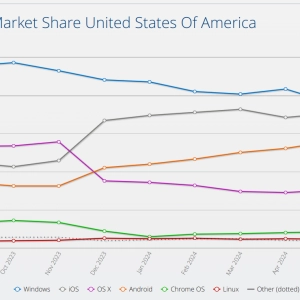
The news cycle today indicates we’re moving through another Cold War, and despite the heightened tensions with Russia and China, neither country has shown significant progress in kicking Microsoft out of their countries. An estimated 84% of Russians and 77% of Chinese citizens still use Microsoft Windows when comparing desktop operating systems.
Of course when you compare with mobile usage the picture transforms and Windows quickly loses its dominance. In China, Android has surpassed Windows with an estimated 52% usage, and in Russia - the picture looks drastically different with Android usage booming and surpassing Windows. And in Russia, Android is inching closer at 35% compared to Windows 44.76% market share.
This does reflect the ongoing trend of the mobile revolution, as mobile phones have become more accessible to developing countries and are taking over the market. Even in the United States there’s just as many iPhone visitors as Windows visitors.
Despite the push towards mobile, US based big tech continues to rule supreme in consumer desktop computing. Civilians in these countries may be vulnerable to the many instances of surveillance embedded in Microsoft and Apple’s operating systems.
The Cold War becomes more obvious in government or military sectors, with marching orders to throw your Windows machine out and pick up a device made closer to home. Is Linux on the menu for these countries?
China’s closed-source Linux distribution ‘Kylin’ is named after a mythical dragon responsible for protecting the heavens. Developed by the National University of Defense Technology in 2001 and designed for the military an government, this operating system has had several stages of evolution, moving from a FreeBSD to Linux Kernel (named Kylin Linux) by version 3.0 and working with Canonical to release an Ubuntu based Linux OS (Ubuntu Kylin) intended for desktop and laptop computers in 2013.
An internal memo to Chinese governmental organizations in 2022 quietly instructed them to replace all of their US made equipment with something local. This definitely strikes a blow to Microsoft as millions of devices will need to be replaced, but doesn’t make a mark compared to the long-running US beatdown of Chinese electronics giant Huawei. Huawei was originally flagged by US authorities for selling restricted computer equipment to Iran, leading to banned imports in 2019 and being kicked off of the 5G networks in a laundry list of countries including US, UK, Australia, and India.
It’s a shame really, Huawei phones and laptops were light-years ahead of American companies.
Russia is on the same trajectory, Putin banned the purchase of foreign software in 2022 in Order 166, government organizations must get approval before buying foreign technology for critical infrastructure. Additionally, public works must stop using foreign software by January 2025.
Internally, Russian military and government use operating systems like Astra Linux to replace Microsoft Windows, rated to protect Top Secret information among devices. Developed by Rusbitech, in January 2018 it was announced as a replacement to Microsoft Windows. Since then Astra Linux has received 2B in license sales and is used by national gas, nuclear power plants, and military. With Microsoft pulling out of Russia due to the Ukraine conflict, this should give Linux the upper hand in continuing to increase its market share.
Despite their attempts, consumers in these regions are stuck on Windows. However, cracks are beginning to show in their global dominance.
TechRights follows the numbers closely, noting sharp decreases in Windows market share in countries like Algeria and the Congo. Still, these decreases can also be attributed to the accessibility and popularity of mobile phones for computing.
The fact remains, Russia, China, and Iran are losing the information war and allowing their populace to be spied on, while privacy tools like Tor and Signal get global recognition as anti-surveillance and anti-censorship tools despite funding from the US government and ties to intelligence agencies.
Why take this geopolitical view on promoting free technology? Because if open-source technology like Linux could flourish anywhere, it would be foreign countries with a chip on their shoulder and a bone to pick. Promoting Linux within their borders would be an noble and forward-thinking move, a peaceful action through educating the populace while seriously damaging the surveillance economy.
But hey, what more can you expect from a government? Ruling by punishment and fear is all they know. It’s up to us people to inspire and educate each other of new choices.
Sources
https://www.elevenforum.com/t/enable-or-disable-send-activity-history-to-microsoft-in-windows-11.7810/
https://mjtsai.com/blog/2022/06/16/apple-reneged-on-ocsp-privacy/
https://www.bloomberg.com/news/articles/2022-05-06/china-orders-government-state-firms-to-dump-foreign-pcs
https://www.politico.com/story/2019/05/15/trump-ban-huawei-us-1042046
https://regmedia.co.uk/2022/03/31/putin_order.pdf
https://www.theverge.com/2022/6/8/23159656/microsoft-russia-business-changes
https://techrights.org/n/2024/08/04/GNU_Linux_Smashing_Records_in_Australia_and_the_Pacific.shtml
https://gs.statcounter.com/os-market-share/desktop/
https://www.cia.gov/the-world-factbook/field/internet-users
https://techrights.org/n/2024/08/05/Microsoft_Windows_Fell_From_35_to_22_Market_Share_in_China_Sinc.shtml
https://techrights.org/n/2024/08/05/Algerian_Adoption_of_Android_and_GNU_Linux_at_Microsoft_s_Expen.shtml
This is a public episode. If you'd like to discuss this with other subscribers or get access to bonus episodes, visit
tbot.substack.com/subscribe