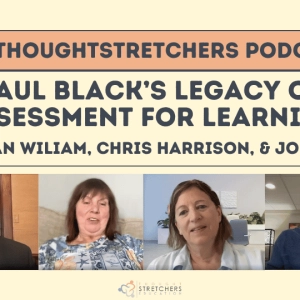
In this episode of the ThoughtStretchers Education Podcast, Drew Perkins talks with leading education thinkers Dylan Wiliam, Jo Boaler, and Chris Harrison to explore the work and life of Paul Black and his profound impact on teaching and learning, especially the concept of assessment for learning.
Links & Resources Mentioned In This Episode
Have some feedback you'd like to share? You can email me at drew@thoughtstretchers.org.
If you enjoyed this episode, please share it and please leave a review on Apple Podcasts or wherever you're listening.
Episode Overview
In this special episode, host Drew Perkins brings together a panel of world-renowned educational figures, Dylan Wiliam, Jo Boaler, and Chris Harrison, to evaluate the profound, global impact of the late Paul Black on international education policy and classroom practice. Transitioning from a distinguished background in physics and crystallography to become the absolute cornerstone of modern science education and assessment framework, Paul Black fundamentally reshaped how the world defines student evaluation. This conversation bridges historical policy milestones, such as Black's masterful chairing of the 1987 Task Group on Assessment and Testing (TGAT), with modern instructional hurdles, illustrating beautifully why assessment must serve as a vehicle for authentic meaning-making, intellectual humility, and autonomous learner agency rather than a mechanical system for tracking or ranking students.
Core Themes & Key Takeaways
- The Historical Architecture: The 1987 TGAT Reform: Commissioned by Secretary of State for Education Kenneth Baker, Paul Black chaired the Task Group on Assessment and Testing. His team proposed a revolutionary, age-independent progressive assessment scale that reframed student growth as continuous development rather than static metrics. Despite major political pushback, this foundational blueprint successfully dictated national curriculum frameworks in England for two decades.
- Inside the Black Box: Moving Research directly into Practitioners' Hands: Dylan Wiliam and Chris Harrison recount the deliberate, user-centric choice to look past dense, extensive academic journal articles and publish the seminal 1998 work, Inside the Black Box, as a slim, highly accessible 28-page booklet. This targeted dissemination placed actionable research directly in front of busy classroom practitioners. Furthermore, Wiliam clarifies why their historical look was a configurative review meant to map the conceptual schema of the field rather than a simple meta-analysis.
- Redefining Assessment for Learning (AfL): Dialogue over Spreadsheets: The panel issues a stark, cross-continental warning against institutional evaluation frameworks (heavily prevalent in the United States) that compress formative assessment into teacher-led data entries on spreadsheets every few weeks. True Assessment for Learning is an interactive, real-time diagnostic process rooted in rich classroom dialogue, extracting student misconceptions, and adjusting the immediate pedagogical path.
- Cultivating Learner Agency: Releasing "Explorer Mode": Formative feedback must move toward its own redundancy, systematically transitioning students out of passive compliance ("Passenger Mode") or fragile grade-chasing ("Achiever Mode") into self-regulating agents of their own intellectual development ("Explorer Mode").
- The Pedagogy of Humility and Curiosity: Jo Boaler and Chris Harrison share intimate reflections on Paul Black's style as a PhD advisor and colleague. Despite his massive national stature, Black routinely deferred to doctoral students, treating them as co-investigators and displaying immense intellectual curiosity about how young minds think.
Episode Timeline & Milestone Highlights
Use these timestamp tokens to jump directly to key points in the panel's conversation:
- 00:00:11 – Introductions, cross-continental logistics, and session framing.
- 00:04:25 – Unpacking the historical impact: Paul Black's transition from physics and crystallography to science education policy.
- 00:08:16 – Dylan Wiliam outlines his multi-decade intellectual partnership with Black starting at Chelsea College.
- 00:10:36 – Chris Harrison details Black's post-retirement career and managing 19 international translational action research projects.
- 00:13:39 – Jo Boaler discusses Black's guidance on validating qualitative research data and handling academic journal rejections.
- 00:19:43 – The inner workings of the 1987 Task Group on Assessment and Testing (TGAT) and Kenneth Baker's national curriculum scale.
- 00:22:05 – Subject-specific progression models: Unpacking the "progression is harder" vs. "progression is better" friction across disciplines.
- 00:26:19 – The rationale behind a configurative review over traditional meta-analysis inside poorly theorized fields.
- 00:31:57 – Collaborative research dynamics: Working alongside teachers to let them build localized knowledge instead of imposing top-down scripts.
- 00:36:06 – Integrating growth mindset structures into math classrooms via open-ended, speed-independent tasks.
- 00:41:44 – Cultivating student self-regulation as an alternative to US data entry tracking spreadsheets.
- 00:47:47 – Exploring the three distinct pathways of progression: harder, better, and more independent.
- 00:58:01 – Debunking the mathematical efficiency myth: Reasoning and pattern discovery vs. computational speed.
- 01:06:02 – Long-term learning goals vs. short-term multiple-choice testing metrics in an AI-driven future.
- 01:10:05 – Teachers as knowledge workers: David Daniel's research on why lab findings reverse when deployed into complex classrooms.
- 01:15:56 – Utilizing psychometrics (Mark Wilson's framework) to discover what a student needs to learn next rather than simply to rank them.