Show, Don't Just Tell: Explaining For Understanding

Show, Don't Just Tell: Explaining For Understanding

Author: ThoughtStretchers Education May 6, 2026 Duration: 1:06:01

Drew Perkins talks with James Moore, author of Explain Yourself: Master the Art of Explanation in the Age of AI, about how educators and communicators can effectively teach complex concepts.

Links & Resources Mentioned In This Episode

Have some feedback you'd like to share? You can email me at drew@thoughtstretchers.org.

If you enjoyed this episode, please share it and please leave a review on Apple Podcasts or wherever you're listening.

James, a former physics teacher and writer for the science-focused YouTube channel Veritasium, champions the core principle of "Show, Don't Just Tell". They unpack his powerful framework for clear explanation: SAD (Structure, Audience, Detail). The conversation tackles the tension between explicit instruction and inquiry, the role of cognitive load in learning, and why balancing technical accuracy with clarity is essential. Learn how starting with concrete examples (a bottom-up approach) and creating a curiosity gap can make the content click.

Tune in for a masterclass on teaching, communication, and understanding in the age of AI.

The discussion features James Moore, who shares his mission to help people explain complex concepts as clearly as possible.

  • [0:05:07] The Motivation Behind Explain Yourself: James's transition from a classroom physics teacher to an online content creator required creating content that is understood the first time, leading to his obsession with clear explanation.
  • [0:06:50] The Core Thesis: Show, Don't Tell: The most effective way to explain something is often not to tell, but to show through stories or examples that connect to biologically primary knowledge.
  • [0:08:45] The SAD Framework: Explaining complex concepts is best approached through three lenses: Structure, Audience, and Detail.
  • [0:16:22] Cognitive Load, Curiosity, and Schema Building: Curiosity acts as a motivator that helps ease the friction of cognitive load, with the goal of making content "click".
  • [0:18:50] Expert vs. Learner Thinking: Experts store information top-down, but teaching should start bottom-up, using a series of examples to allow learners to infer the rule and build schema.

Instructional Strategies & Audience

  • [0:22:13] Checking for Understanding: Asking "Does that make sense?" is a poor proxy for comprehension. Use targeted application problems or specific questions instead.
  • [0:28:18] Unpacking Structure (S): Start with a specific, concrete example to create context and an image in the learner's mind before introducing the abstract, general rule.
  • [0:31:37] Unpacking Audience (A): This lens involves balancing technical accuracy with clarity. Use simple models, like the staircase analogy for quantum physics, that can be refined later to avoid losing the audience.
  • [0:45:34] Unpacking Detail (D): The principle is "Less is More" to manage cognitive load. It also means atomizing complex concepts to avoid the "curse of knowledge," where experts assume their audience has already chunked the information.
  • [0:53:28] The Narrative Structure: Using the "And, But, Therefore/So" story structure helps maintain audience attention by constantly building tension, conflict, and resolution.
  • [0:58:20] Content Dictates Modality: The subject matter (e.g., learning a language or installing a car part) should drive the choice of teaching modality (video vs. text) rather than relying on learner preferences.

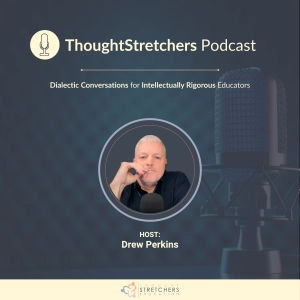
Hosted by ThoughtStretchers Education, The ThoughtStretchers Podcast is built on the belief that the best teaching emerges from genuine dialogue and challenging questions. This isn't about quick tips or superficial trends. Instead, each episode engages in the kind of dialectic conversations that push beyond comfortable assumptions, examining the foundational ideas and complex issues that shape modern learning environments. You'll hear deep, often meandering discussions that probe the "why" behind educational practices, fostering a space for intellectual rigor rarely found in typical professional development. Tuning into this podcast feels like sitting in on a thoughtful, sometimes provocative, roundtable where curiosity is the primary curriculum. It’s for educators who find energy in debate and refinement of thought, who believe that strengthening their own intellectual framework is the first step toward nurturing it in others. The dialogue here is designed to stretch your perspective on pedagogy, curriculum, and the very purpose of education, making it a sustained exercise in professional growth. If you’re looking to engage with education on a more philosophical and principled level, these conversations offer a compelling and substantive resource.
Author: Language: en-us Episodes: 50

The ThoughtStretchers Podcast
Podcast Episodes
When Politics Hijacks Education [not-audio_url] [/not-audio_url]

Duration: 1:15:44
Drew Perkins talks with Vladimir Kogan about his new book, No Adult Left Behind: How Politics Hijacks Education Policy and Hurts Kids. Links & Resources Mentioned In This Episode
A Dynamic Equilibrium Of Research And Practice [not-audio_url] [/not-audio_url]

Duration: 1:09:28
Drew Perkins talks with Rod Naquin about balancing educational research with practice as he returns to the classroom after 7 years doing educational leadership work. Links & Resources Mentioned In This Episode
Bridging Gaps With Mental Models [not-audio_url] [/not-audio_url]

Duration: 1:13:53
Drew Perkins talks with Jim Heal and Rebekah Berlin about their new book, Mental Models: How understanding the mind can transform the way you work and learn. Links & Resources Mentioned In This Episode
"Soul-Destroying" Or Empowering Pedagogy? [not-audio_url] [/not-audio_url]

Duration: 1:22:42
Drew Perkins talks with Karen Vaites about navigating educational tribalism, the "Science of Learning," and the impact of knowledge-rich, coherent curricula on student outcomes. Links & Resources Mentioned In This Episod…
Strategic Leadership [not-audio_url] [/not-audio_url]

Duration: 1:19:03
Drew Perkins talks with Rachel Curtis and Liz City, co-authors of the book Leading Strategically: Achieving Ambitious Goals in Education. Links & Resources Mentioned In This Episode
Using A Prohuman Curriculum To Build Character And Civic Virtue [not-audio_url] [/not-audio_url]

Duration: 54:03
Drew Perkins talks with Christina LaRose about her work with the Prohuman Foundation to develop a curriculum focused on learning character through literature. Links & Resources Mentioned In This Episode
Bridging The Science of Learning And Inquiry With Socratic Experience [not-audio_url] [/not-audio_url]

Duration: 1:07:50
Drew Perkins talks with Michael Strong, founder of The Socratic Experience, a K–12 high-touch virtual school that equips students through Socratic dialogue, 1:1 mentoring, and creative and entrepreneurial projects. Links…
Is The Science of Learning 'Soul Destroying'? [not-audio_url] [/not-audio_url]

Duration: 1:26:05
Drew Perkins talks with teacher-educator Rachael Jefferson about her Education HQ article from an interview that is critical of the Science of Learning movement. Links & Resources Mentioned In This Episode
How To Have Nuanced Conversation [not-audio_url] [/not-audio_url]

Duration: 28:44
Drew Perkins talks with Shane Leaning as a guest on his Education Leaders podcast about how to have conversations that focus on nuance, complexity, and understanding. Links & Resources Mentioned In This Episode
AI In Education [not-audio_url] [/not-audio_url]

Duration: 49:33
Drew Perkins talks with Songyee Yoon, author and founder and managing partner of the venture capital firm Principal Venture Partners (PVP), where she focuses on investing in AI-native companies transforming industries. L…
