A Jewish Philosophy of Man (E5): The Dialectical Approach to the Individual and the Community

A Jewish Philosophy of Man (E5): The Dialectical Approach to the Individual and the Community

Author: Tradition Online February 18, 2026 Duration: 1:43:15
A Lecture Series by Rabbi Joseph B. Soloveitchik Lecture 5: Delivered January 15, 1959 The two Creation accounts reflect not a split in the text but a split in Man. Judaism has a dialectical view of Man, accepting mutually exclusive positions. Man was created alone as a unique and solitary being, but he was also created in a relationship with the Thou, in a communal existence. Man craves both, opposite modes of existence, oscillating like a pendulum between surging towards relationships with others and withdrawing into oneself. Judaism, unlike Catholicism, allows divorce, because only the kerygmatic side of Man can commit to another person, not the numinous side. We are limited in our ability to connect with other personalities due to the numinous aspect of Man. For numinous Man, the question “who am I” is unanswerable, since the I is an eternal mystery beyond rationalization, like a tune I can feel but that cannot be sung. Judaism insists that the worth of the individual is to be judged not by kerygmatic contributions to the community, but by the very fact that the person exists. The dignity of Man comes from the image of God which is found in numinous, not kerygmatic, Man. Judaism revolutionized social philosophy with this idea, upsetting the Classical view of Man. A series of halakhic laws demonstrates Judaism’s “doctrine of idealization of anonymity,” meaning, the chosen-ness of the unknown, forlorn individual. One such law states that if a band of heathens demands the surrender of one person, or else the whole city will be destroyed, we do not turn over the one person, even if that person is a criminal. Another example of such a law is the obligation on whomever finds it to bury an anonymous dead body, even if the High Priest would consequently have to cancel the Yom Kipur atonement service. The uniqueness of each person is the foundation of Judaic ethics. However, the dialectical approach says that although we treat others according to their intrinsic, numinous worth, I myself must not rely on my intrinsic worth but am obligated to contribute to the community. Discussions prompted by audience questions include Holocaust decisions to save only a part of the community by handing over another part, Judaism’s attitudes towards war, towards parochialism vs. universalism, towards body and soul, and towards religion and ethics. 00:01:15 Dialectical interpretation of the Creation story in Genesis 00:23:25 Inability of institutions like marriage to commit one’s numinous side 00:51:16 Judging the worth of the personality not by kerygma but by numinous existence 01:03:44 Halakhah prohibiting the handing over of one person to save the city 01:07:54 Questions from audience and responses about war and Holocaust situations 01:18:55 Halakhah of finding an anonymous corpse 01:29:45 Questions from audience and responses about radical individualism and other topics Access lecture summaries and course materials at www.TraditionOnline.org/JPM The post A Jewish Philosophy of Man (E5): The Dialectical Approach to the Individual and the Community appeared first on Tradition Online.

The Tradition Podcast extends the deep, considered conversation of its long-standing journal into an audio format. Each episode draws from the rich well of Orthodox Jewish thought, but frames these ideas for a contemporary listener grappling with modern questions. You'll hear discussions that sit at the intersection of ancient texts and present-day life, where timeless philosophy meets current ethical dilemmas, historical context informs cultural shifts, and spiritual inquiry finds practical expression. This isn't about delivering simple answers, but rather exploring the nuanced arguments and diverse perspectives that have defined a living tradition for centuries. The podcast naturally delves into the same rigorous topics as the journal-Jewish law, theology, societal trends, and moral philosophy-but with the accessible, engaging flow of a spoken dialogue. It’s for anyone curious about how a vibrant intellectual and religious tradition navigates the complexities of the human experience, offering thoughtful reflection that resonates far beyond the page. Tune in for a series that honors the depth of its source material while creating a new space for auditory learning and reflection.
Author: Language: en-us Episodes: 50

Tradition Podcast
Podcast Episodes
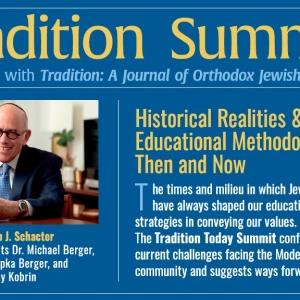
Historical Realities and Educational Methodologies [not-audio_url] [/not-audio_url]

Duration: 1:44:03
As part of the Tradition Today Summit, held on November 9, 2025, convened by Yeshiva University’s Azrieli Graduate School of Jewish Studies and TRADITION’s publisher the Rabbinical Council of America, we hosted a communi…
Tradition Today Summit [not-audio_url] [/not-audio_url]

Duration: 25:33
On Sunday, November 9th, 75 Jewish educators, rabbis, lay-leaders, and thought leaders gathered for the second Tradition Today Summit, convened together with Yeshiva University’s Azrieli Graduate School of Jewish Educati…
Not By Might [not-audio_url] [/not-audio_url]

Duration: 46:48
In this episode of our podcast, Tzvi Sinensky, co-editor of TRADITION’s special issue on the intellectual legacy of Rabbi Jonathan Sacks, speaks with author Alex Israel about his essay in the volume, “Not by Might: Avers…
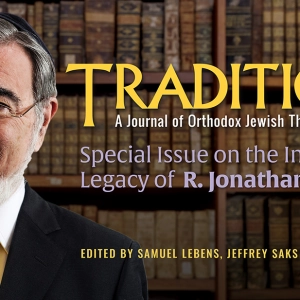
The Intellectual Legacy of Rabbi Sacks [not-audio_url] [/not-audio_url]

Duration: 1:10:38
Listen to the recording of our online event marking the publication of TRADITION‘s special volume, published in partnership with the Rabbi Sacks Legacy, exploring the intellectual legacy of Rabbi Jonathan Sacks z”l (Nove…
Jane Austen and Halakhic Morality [not-audio_url] [/not-audio_url]

Duration: 55:13
December 16th will mark the 250th birthday of the renowned English novelist Jane Austen, and “Janeites” (as her fans call themselves) are aflutter worldwide. In this episode of the TRADITION Podcast Mali Brofsky chats wi…
PODCAST: Children of the Book [not-audio_url] [/not-audio_url]

Duration: 54:46
For many mothers, especially literary-minded ones, raising young children may feel like an intellectual regression. In this episode of the TRADITION Podcast, Ilana Kurshan and Sarah Rindner Blum discuss how the time spen…
Catching Up with TraditionOnline [not-audio_url] [/not-audio_url]

Duration: 45:04
In this episode of the Tradition Podcast we update our listeners on some happenings over on our website, TraditionOnline.org. Check out the Tradition Summer Book Endorsements: Our yearly tradition of turning to our estee…
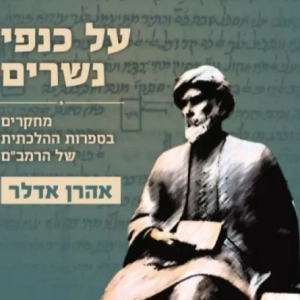
Rambam in the Yeshiva and the University [not-audio_url] [/not-audio_url]

Duration: 59:54
This episode of the Tradition Podcast features an engaging conversation about current scholarship on Maimonides—the “Great Eagle.” TRADITION’s Winter 2025 issue presented a review essay by Marc Herman on Prof. Mordechai…
R. Lichtenstein on Women’s Torah Study [not-audio_url] [/not-audio_url]

Duration: 42:58
TRADITION’s subscribers have already received our special Spring 2025 issue, containing content commemorating R. Aharon Lichtenstein zt”l, timed with his 10th yahrzeit marked this month. Five years ago we were pleased to…
Rav Lichtenstein’s Legacy [not-audio_url] [/not-audio_url]

Duration: 1:02:03
This episode of the Tradition Podcast is being released on Rosh Hodesh Iyar, the tenth yahrzeit of Rav Aharon Lichtenstein zt”l. In eulogizing his father-in-law, Rabbi Soloveitchik, R. Lichtenstein observed that the Rav…