A Jewish Philosophy of Man (E8): The Content of the Covenant of Egypt – The Jewish Existential Community

A Jewish Philosophy of Man (E8): The Content of the Covenant of Egypt – The Jewish Existential Community

Author: Tradition Online March 11, 2026 Duration: 1:46:46
A Lecture Series by Rabbi Joseph B. Soloveitchik Lecture 8: Delivered February 26, 1959 Jewish loneliness should be transformed into the kind of prophetic solitude that embraces the uniqueness of Jewish destiny. Jewish uniqueness is expressed by the covenant. Just as the prophets felt compelled to relay their message despite the burden involved, even to the degree that they would be harmed for doing so, we too must accept our covenant on that level of commitment, as something we are compelled to do and cannot cast off. What is the content of this covenant? God established two covenants. At the Exodus from Egypt, He calls the people an am, implying the togetherness and unity of peoplehood. At Sinai, with the giving of the Torah, He calls them a goy, referring to a political nation. These are the two covenants, but the focus of this lecture is the Egyptian covenant. Am refers to an existential community. Because it involves God, it commits the numinous side of man, compelling Man to draw himself out from his seclusion to join other people, even people he doesn’t like, in this community of I, thou, and He, i.e., God. In practical terms, the covenant of Egypt creates a community of shared history, but also of shared experiences on three levels: 1. shared interests, 2. shared feelings or emotions, and 3. shared responsibilities. 1. Shared interests mean that all Jews share the same fate and no one can escape it, and even assimilation does not help. 2. Shared emotional involvement means that we must feel compassion and co-suffering with others of the community, as well as joy with others of the community. 3. Shared responsibilities mean, first, that we are morally accountable to one another. We must answer for the conduct of our brother to a degree that no other nation must.  We share collective liability in the eyes of non-Jewish society, and also in the eyes of the Torah. The mitzvah of sanctifying God’s name and the prohibition of profaning God’s name are based on this community of collective responsibility and liability. So is the prohibition of squealing. Secondly, besides moral accountability for one another, shared responsibilities refer to a unique sense of justice, according to which we are accountable by law to support one another. This is the mitzvah and halakhah of tzedakah, which, unlike charity, can be compelled by authority. Tzedakah is not a moral but a juridic requirement. Tzedakah is the halakhic expression of the existential community of am. Jump to: 00:01:17 Prophecy and prophetic solitude as a burden 00:15:35 The two covenants, at the Exodus and at Sinai 00:25:15 The existential community 00:40:12 Community of shared interests 01:01:41 Community of shared emotional involvement 01:03:20 Community of shared responsibilities 01:30:37 Tzedakah as justice Access lecture summaries and course materials at www.TraditionOnline.org/JPM   The post A Jewish Philosophy of Man (E8): The Content of the Covenant of Egypt – The Jewish Existential Community appeared first on Tradition Online.

The Tradition Podcast extends the deep, considered conversation of its long-standing journal into an audio format. Each episode draws from the rich well of Orthodox Jewish thought, but frames these ideas for a contemporary listener grappling with modern questions. You'll hear discussions that sit at the intersection of ancient texts and present-day life, where timeless philosophy meets current ethical dilemmas, historical context informs cultural shifts, and spiritual inquiry finds practical expression. This isn't about delivering simple answers, but rather exploring the nuanced arguments and diverse perspectives that have defined a living tradition for centuries. The podcast naturally delves into the same rigorous topics as the journal-Jewish law, theology, societal trends, and moral philosophy-but with the accessible, engaging flow of a spoken dialogue. It’s for anyone curious about how a vibrant intellectual and religious tradition navigates the complexities of the human experience, offering thoughtful reflection that resonates far beyond the page. Tune in for a series that honors the depth of its source material while creating a new space for auditory learning and reflection.
Author: Language: en-us Episodes: 50

Tradition Podcast
Podcast Episodes
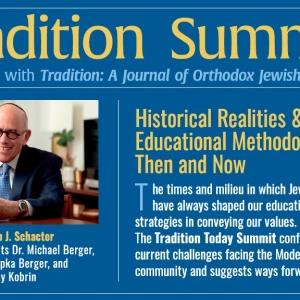
Historical Realities and Educational Methodologies [not-audio_url] [/not-audio_url]

Duration: 1:44:03
As part of the Tradition Today Summit, held on November 9, 2025, convened by Yeshiva University’s Azrieli Graduate School of Jewish Studies and TRADITION’s publisher the Rabbinical Council of America, we hosted a communi…
Tradition Today Summit [not-audio_url] [/not-audio_url]

Duration: 25:33
On Sunday, November 9th, 75 Jewish educators, rabbis, lay-leaders, and thought leaders gathered for the second Tradition Today Summit, convened together with Yeshiva University’s Azrieli Graduate School of Jewish Educati…
Not By Might [not-audio_url] [/not-audio_url]

Duration: 46:48
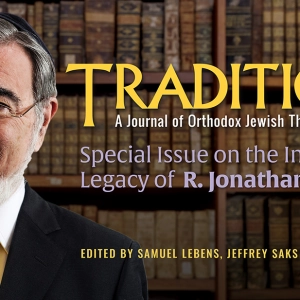
In this episode of our podcast, Tzvi Sinensky, co-editor of TRADITION’s special issue on the intellectual legacy of Rabbi Jonathan Sacks, speaks with author Alex Israel about his essay in the volume, “Not by Might: Avers…
The Intellectual Legacy of Rabbi Sacks [not-audio_url] [/not-audio_url]

Duration: 1:10:38
Listen to the recording of our online event marking the publication of TRADITION‘s special volume, published in partnership with the Rabbi Sacks Legacy, exploring the intellectual legacy of Rabbi Jonathan Sacks z”l (Nove…
Jane Austen and Halakhic Morality [not-audio_url] [/not-audio_url]

Duration: 55:13
December 16th will mark the 250th birthday of the renowned English novelist Jane Austen, and “Janeites” (as her fans call themselves) are aflutter worldwide. In this episode of the TRADITION Podcast Mali Brofsky chats wi…
PODCAST: Children of the Book [not-audio_url] [/not-audio_url]

Duration: 54:46
For many mothers, especially literary-minded ones, raising young children may feel like an intellectual regression. In this episode of the TRADITION Podcast, Ilana Kurshan and Sarah Rindner Blum discuss how the time spen…
Catching Up with TraditionOnline [not-audio_url] [/not-audio_url]

Duration: 45:04
In this episode of the Tradition Podcast we update our listeners on some happenings over on our website, TraditionOnline.org. Check out the Tradition Summer Book Endorsements: Our yearly tradition of turning to our estee…
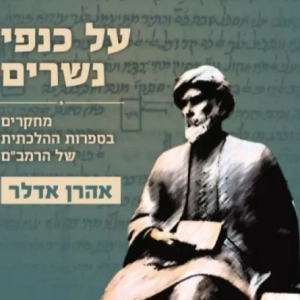
Rambam in the Yeshiva and the University [not-audio_url] [/not-audio_url]

Duration: 59:54
This episode of the Tradition Podcast features an engaging conversation about current scholarship on Maimonides—the “Great Eagle.” TRADITION’s Winter 2025 issue presented a review essay by Marc Herman on Prof. Mordechai…
R. Lichtenstein on Women’s Torah Study [not-audio_url] [/not-audio_url]

Duration: 42:58
TRADITION’s subscribers have already received our special Spring 2025 issue, containing content commemorating R. Aharon Lichtenstein zt”l, timed with his 10th yahrzeit marked this month. Five years ago we were pleased to…
Rav Lichtenstein’s Legacy [not-audio_url] [/not-audio_url]

Duration: 1:02:03
This episode of the Tradition Podcast is being released on Rosh Hodesh Iyar, the tenth yahrzeit of Rav Aharon Lichtenstein zt”l. In eulogizing his father-in-law, Rabbi Soloveitchik, R. Lichtenstein observed that the Rav…