It’s the Feast of Advent Feria, 3rd Class, with the color of Violet. In this episode: the meditation: “Jesus, Meek and Humble of Heart”, today’s news from the Church: “Polygamy: The Vatican Has No Intention of Changing Canon Law”, a preview of the Sermon: “The Dangers of Venial Sin”, and today’s thought from the Archbishop.
Have feedback or questions about the DD or our other shows? podcast@sspx.org
Sources Used Today:
- “Jesus, Meek and Humble of Heart” – From Advent to Epiphany
- “Polygamy: The Vatican Has No Intention of Changing Canon Law” (FSSPX.news)
- “The Dangers of Venial Sin” (SSPX Sermons)
- The Spiritual Life – Archbishop Lefebvre (Angelus Press)
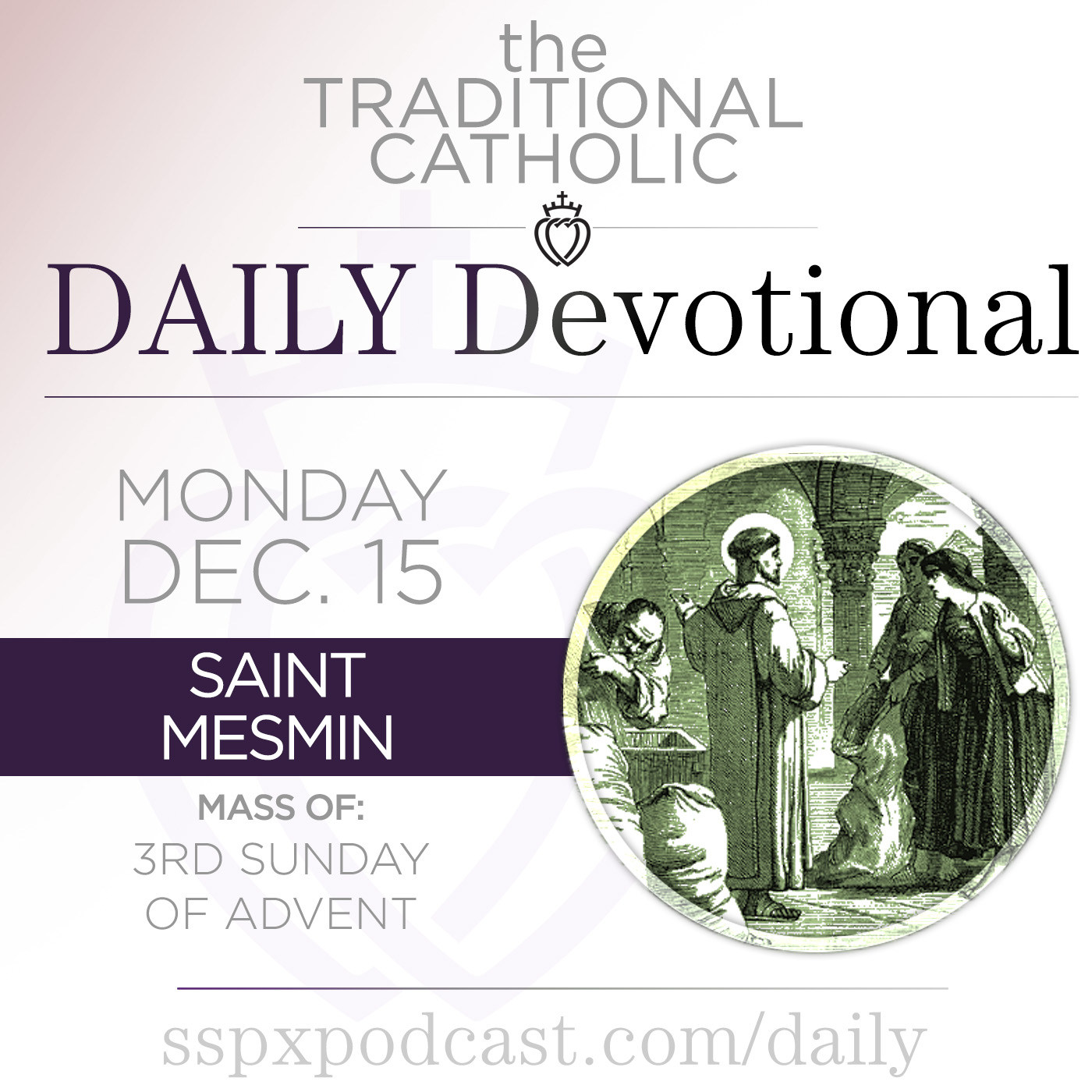
Saint Mesmin, also known as Saint Maximinus of Micy, belongs to the generation of quiet founders who shaped Christian Gaul through prayer, stability, and patient leadership. He lived in the late fifth and early sixth centuries, a time when Roman authority had collapsed and much of France was being reorganized under new rulers. Amid that uncertainty, Mesmin helped anchor Christian life along the Loire through the steady rhythm of monastic prayer.
He was a disciple of Saint Euspicius, a hermit priest living near Orléans. King Clovis, newly converted to Christianity, encountered Euspicius and granted him land on the banks of the Loire at a place called Micy. There Euspicius founded a monastery, and Mesmin soon emerged as his closest collaborator. When Euspicius died, Mesmin succeeded him as abbot, guiding the community with firmness and humility. Under his leadership, the monastery of Micy became one of the most influential spiritual centers in the region, helping to evangelize the surrounding countryside and to form clergy for service in the growing Frankish Church.
Mesmin was known for his austerity and his love of silence, but also for his practical charity. He trained monks not only in prayer and fasting, but in obedience, hospitality, and manual labor. Ancient sources emphasize his authority over the spiritual realm, recording episodes in which he confronted lingering pagan practices and demonic fears that troubled rural communities. One well-known tradition describes Mesmin entering a cave believed to be inhabited by an evil spirit and consecrating it to God, transforming a place of fear into one of prayer. Whether read literally or symbolically, the story captures his role as a man who brought order and peace where darkness once ruled.
He died around the year 520, mourned as a spiritual father whose influence extended far beyond his monastery walls. His relics were later transferred to Orléans, and devotion to him spread throughout the Loire Valley.
Traditions surrounding Saint Mesmin remained largely regional. His feast on December 15 was kept in Orléans with prayers for protection against spiritual harm and for perseverance in monastic life. In rural areas, he was invoked against lingering superstitions and fears, remembered as a saint who reclaimed unsettled places for Christ through prayer and trust.
Saint Mesmin, faithful abbot and servant of God, pray for us!
- - - - - -
- - - - - -
Explore more:
What is the SSPX Podcast?
The SSPX Podcast is produced by Angelus Press, which has as its mission the fortification of traditional Catholics so that they can defend the Faith, and reaching out to those who have not yet found Tradition.
What is the SSPX?
The main goal of the Society of Saint Pius X is to preserve the Catholic Faith in its fullness and purity, to teach its truths, and to diffuse its virtues, especially through the Roman Catholic priesthood.
Authentic spiritual life, the sacraments, and the traditional liturgy are its primary means of bringing this life of grace to souls.
Although the traditional Latin Mass is the most visible and public expression of the work of the Society, we are committed to defending Catholic Tradition in its entirety: all of Catholic doctrine and morals as the Church has always defended them. What people need is the Catholic Faith, without compromise, with all the truth and beauty which accompanies it.
https://sspx.org