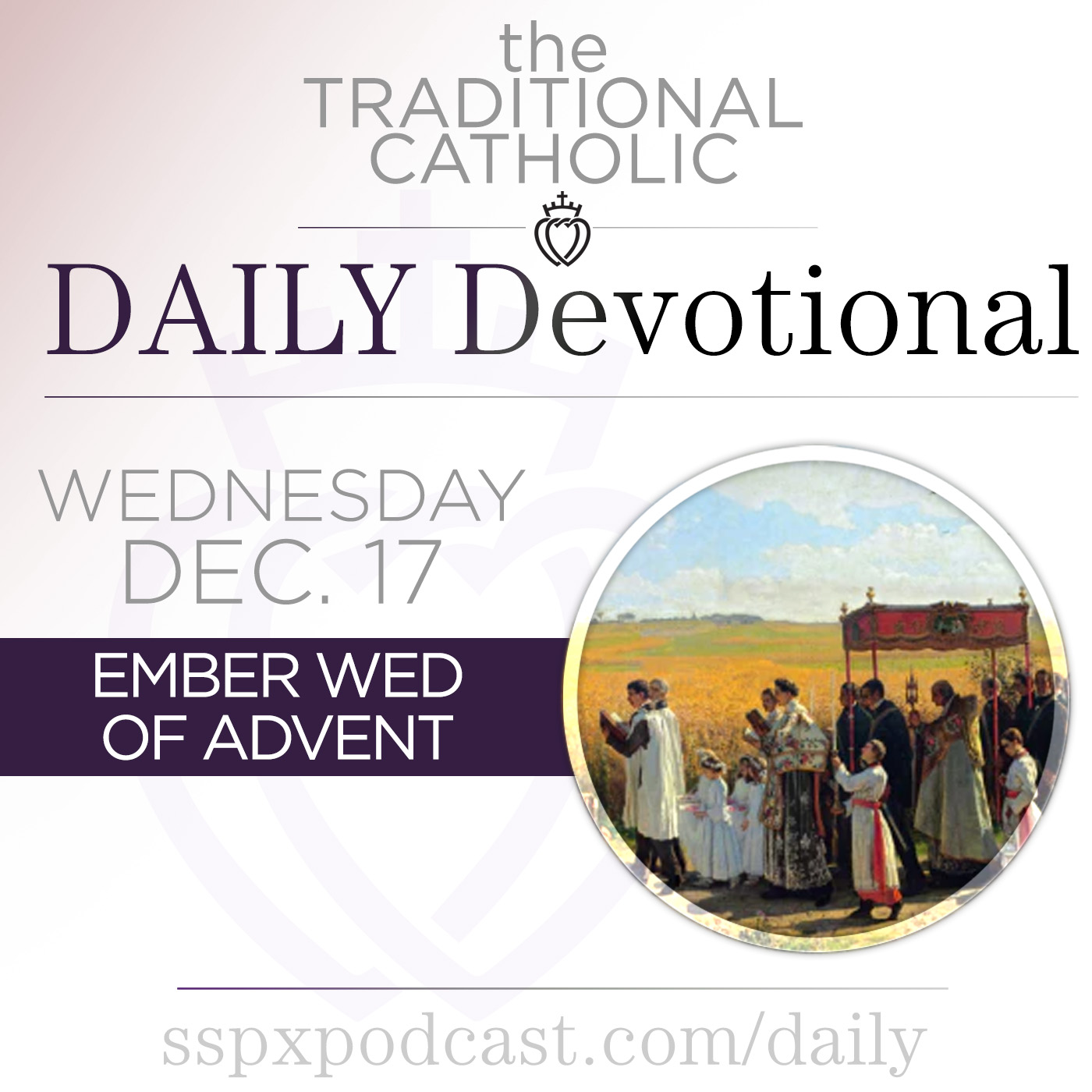
It’s the Ember Wednesday in Advent, 2nd Class, with the color of Violet. In this episode: the meditation: “Jesus, Emmanuel”, today’s news from the Church: “Centenary of Quas Primas, the Encyclical on Christ the King”, a preview of the Sermon: “Recognizing Our Lord in Our Midst”, and today’s thought from the Archbishop.
Have feedback or questions about the DD or our other shows? podcast@sspx.org
Sources Used Today:
- “Jesus, Emmanuel” – From Advent to Epiphany
- “Centenary of Quas Primas, the Encyclical on Christ the King” (FSSPX.news)
- “Recognizing Our Lord in Our Midst” (SSPX Sermons)
- The Spiritual Life – Archbishop Lefebvre (Angelus Press)
The Ember Days are among the Church’s oldest and most quietly profound practices, woven into the rhythm of the year long before most modern calendars took shape. In the traditional Catholic life of prayer, the Ember Days were set aside as recurring moments of fasting, abstinence, thanksgiving, and supplication, marking the turning of the seasons and consecrating time itself to God. They were not feasts in the celebratory sense, but sacred pauses, moments when the Church collectively slowed down to pray, give thanks, and ask for grace.
There are four sets of Ember Days each year, occurring on Wednesday, Friday, and Saturday after certain key points in the liturgical calendar: after the First Sunday of Lent, after Pentecost, after the Exaltation of the Holy Cross in September, and after the Third Sunday of Advent. Together, they sanctified winter, spring, summer, and autumn. Their roots stretch back to ancient Rome, where Christians adapted earlier agricultural customs, transforming prayers for harvest and fertility into acts of Christian worship. Over time, the Ember Days became deeply penitential, combining fasting with prayer for the needs of the Church and the world.
In traditional practice, the Ember Days carried several layers of meaning. They were days of thanksgiving for the fruits of the earth, recognizing God as the giver of all sustenance. They were days of penance, reminding the faithful that creation itself had been wounded by sin and needed redemption. And they were days of petition, especially for priests. Ember Saturdays, in particular, were traditionally associated with ordinations, making the Ember Days a time to pray earnestly for holy vocations and faithful clergy.
The liturgy of the Ember Days reflected this seriousness. The Masses included multiple readings, often drawn from Scripture passages about repentance, sacrifice, and divine blessing. Violet vestments were used outside of Pentecost, reinforcing the penitential character. Silence, restraint, and attentiveness marked these days, especially in contrast to the feasts that surrounded them. They taught Catholics that joy and discipline belong together, and that gratitude is deepened by sacrifice.
Culturally, the Ember Days shaped Catholic life in subtle but lasting ways. Farmers planned planting and harvest around them. Families knew them as days when meals were simpler and prayer more intentional. Seminaries and monasteries treated them as spiritual hinges in the year, moments to examine conscience and renew commitment. Though no longer widely observed, the Ember Days remain a powerful expression of how the Church once lived fully inside sacred time, attentive to nature, labor, fasting, and grace.
The Ember Days remind us that the Christian life is not only marked by great feasts, but by faithful pauses. They teach that conversion is seasonal, recurring, and necessary, and that the world itself is meant to be offered back to God in prayer.
May the Lord bless the seasons of our lives and make our hearts ready to receive His grace.
- - - - - -
- - - - - -
Explore more:
What is the SSPX Podcast?
The SSPX Podcast is produced by Angelus Press, which has as its mission the fortification of traditional Catholics so that they can defend the Faith, and reaching out to those who have not yet found Tradition.
What is the SSPX?
The main goal of the Society of Saint Pius X is to preserve the Catholic Faith in its fullness and purity, to teach its truths, and to diffuse its virtues, especially through the Roman Catholic priesthood.
Authentic spiritual life, the sacraments, and the traditional liturgy are its primary means of bringing this life of grace to souls.
Although the traditional Latin Mass is the most visible and public expression of the work of the Society, we are committed to defending Catholic Tradition in its entirety: all of Catholic doctrine and morals as the Church has always defended them. What people need is the Catholic Faith, without compromise, with all the truth and beauty which accompanies it.
https://sspx.org