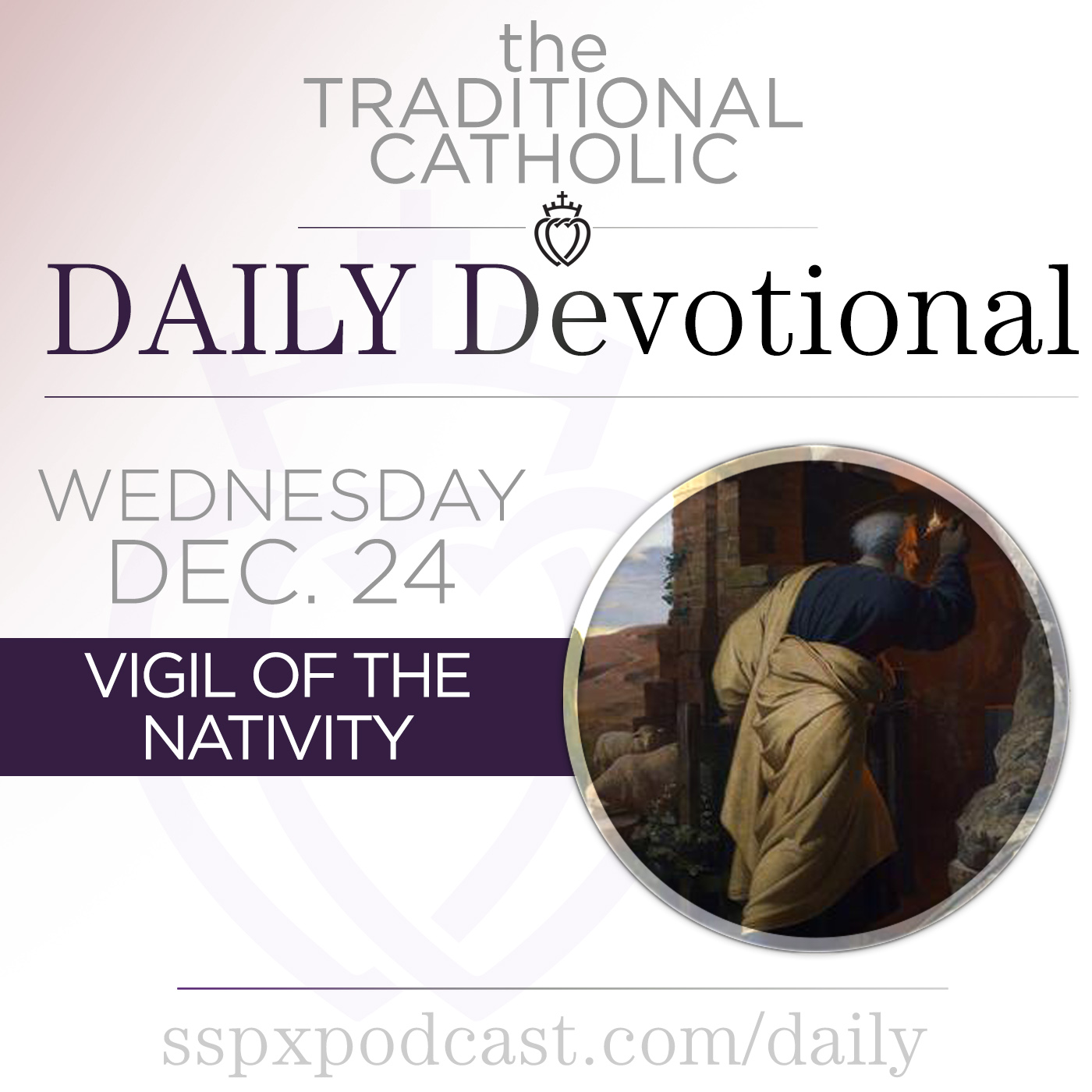
It’s the Feast of Vigil of the Nativity, 1st Class, with the color of Violet. In this episode: the meditation: “In the Cave of Bethlehem”, today’s news from the Church: “A Book-Interview in Which Leo XIV Speaks About the Traditional Latin Mass”, a preview of the Sermon: “Our Lady's Dispositions”, and today’s thought from the Archbishop.
Have feedback or questions about the DD or our other shows? podcast@sspx.org
Sources Used Today:
- “In the Cave of Bethlehem” – From Advent to Epiphany
- “A Book-Interview in Which Leo XIV Speaks About the Traditional Latin Mass” (FSSPX.news)
- “Our Lady's Dispositions” (SSPX Sermons)
- The Spiritual Life – Archbishop Lefebvre (Angelus Press)
The Vigil of the Nativity is one of the Church’s most hushed and expectant moments, a threshold day that stands between waiting and fulfillment. Traditionally kept on December 24 until nightfall, it is not yet Christmas, and that distinction mattered deeply in the older liturgical rhythm. The Vigil was a day of restraint, silence, and longing, meant to sharpen the joy that would soon arrive. It taught the faithful that the mystery of the Incarnation is not rushed into, but received after patient preparation.
In the traditional calendar, the Vigil of Christmas was penitential in character. Fasting and abstinence were observed until the first Mass of Christmas, usually Midnight Mass. Violet vestments were used earlier in the day, and the liturgy carried a sober tone. The Church placed before the faithful the genealogy of Christ, reminding them that the Word entered history slowly, through generations marked by faithfulness and failure alike. The Collects and readings spoke of longing, promise, and fulfillment held just out of reach. Even the absence of the Gloria reinforced the sense that the song of angels was still waiting to be heard.
Spiritually, the Vigil draws attention to the hidden years and quiet hours before Christ’s birth. It invites reflection on Mary’s final hours of waiting, on Joseph’s trust in the dark, and on a world unaware that salvation was already at its doorstep. The Church asks the faithful to remain watchful, echoing the ancient call to vigilance that runs through Advent. The Vigil teaches that God often comes not in noise or immediacy, but after silence has done its work.
Culturally, the Vigil shaped Christmas customs for centuries. In many Catholic regions, December 24 was marked by simple meals, often meatless, and a noticeable pause in festivity. Homes were cleaned, candles prepared, and cribs left empty until nightfall. In parts of Europe, families gathered late in the evening for prayer before attending Midnight Mass, sometimes walking through dark streets lit only by lanterns. Children were taught that gifts and celebration waited until Christ had come. Even the joy of Christmas was disciplined by reverence.
The Vigil of the Nativity reminds us that joy deepens when it is awaited, and that the greatest gift arrives quietly. It is the Church standing at the door of Bethlehem, listening, watching, and holding its breath. When night finally falls and the Church sings of glory, it does so having first learned how to wait.
Come, Lord Jesus, and do not delay.
- - - - - -
- - - - - -
Explore more:
What is the SSPX Podcast?
The SSPX Podcast is produced by Angelus Press, which has as its mission the fortification of traditional Catholics so that they can defend the Faith, and reaching out to those who have not yet found Tradition.
What is the SSPX?
The main goal of the Society of Saint Pius X is to preserve the Catholic Faith in its fullness and purity, to teach its truths, and to diffuse its virtues, especially through the Roman Catholic priesthood.
Authentic spiritual life, the sacraments, and the traditional liturgy are its primary means of bringing this life of grace to souls.
Although the traditional Latin Mass is the most visible and public expression of the work of the Society, we are committed to defending Catholic Tradition in its entirety: all of Catholic doctrine and morals as the Church has always defended them. What people need is the Catholic Faith, without compromise, with all the truth and beauty which accompanies it.
https://sspx.org