The Traditional Catholic Daily Devotional is delivered each day, around 4am Eastern Time (US). It contains a meditation, a reflection on the saint or feast, news from the Church, and other information to help you begin your day in the mind of the Catholic Church!
Have feedback or questions about the DD or our other shows? podcast@sspx.org
Sources Used Today:
- “Can Courts Compel the Reinstatement of a Former Nun to Her Cell?” (FSSPX.news)
- “The Childlike Wonder of St Francis de Sales at Christmas” (SSPX Sermons)
- The Spiritual Life – Archbishop Lefebvre (Angelus Press)
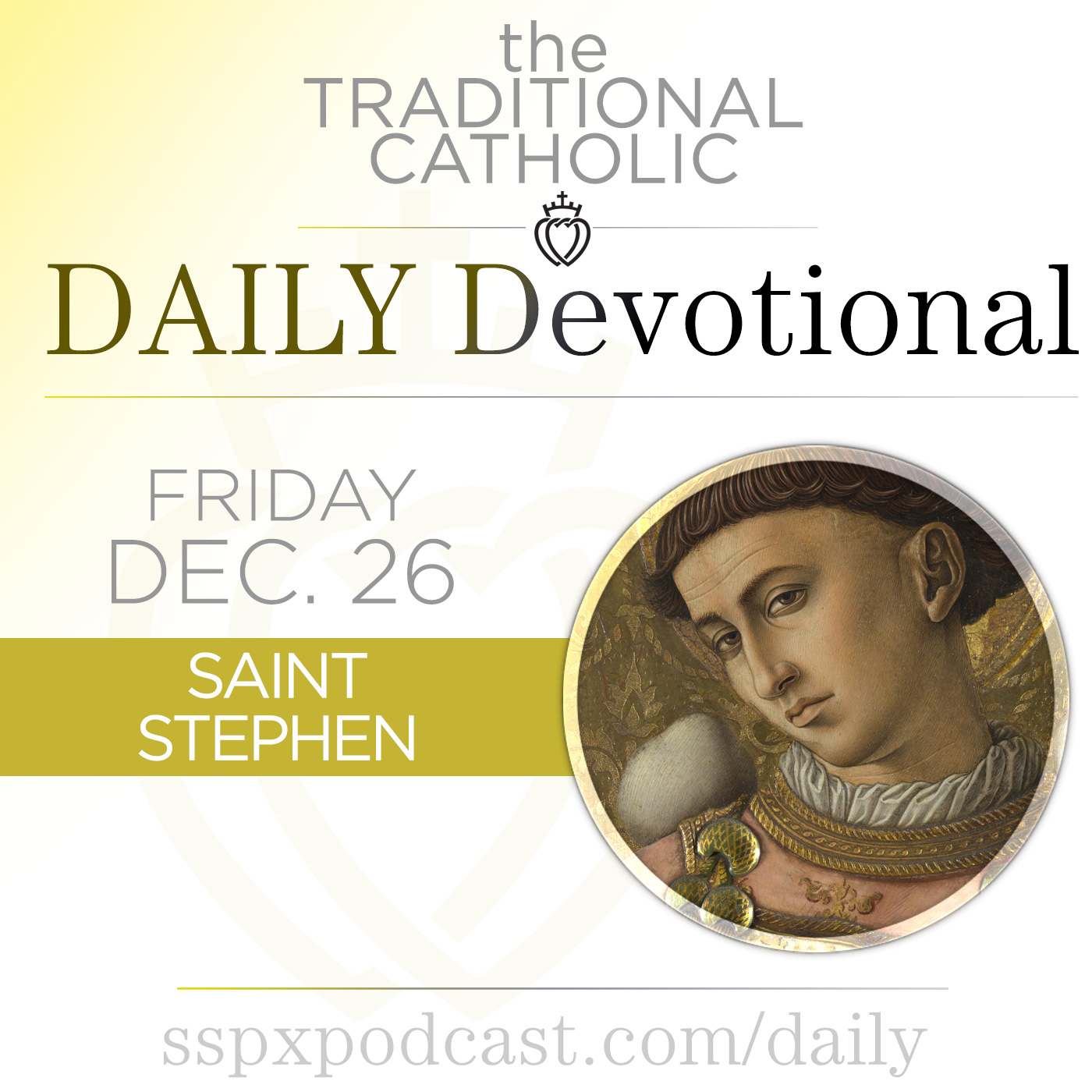
Saint Stephen stands at the very beginning of the Church’s long line of martyrs, a man whose witness shows how quickly joy and suffering can meet when the Gospel is taken seriously. He appears in the Acts of the Apostles not as one of the Twelve, but as one of the first deacons, chosen to serve the practical needs of the growing Christian community. Yet Stephen’s service was never merely administrative. Scripture describes him as “full of grace and power,” a man whose faith overflowed into preaching, teaching, and fearless witness.
Stephen’s preaching quickly drew opposition. He spoke openly about Christ as the fulfillment of the Law and the Prophets, and his words unsettled those who believed the old order was being threatened. Brought before the Sanhedrin, Stephen did not defend himself with caution. Instead, he gave a sweeping account of Israel’s history, showing how God had always been faithful even when His people resisted Him. His speech was not an attack but a mirror, and it provoked rage rather than repentance. As the crowd dragged him outside the city to stone him, Stephen prayed aloud, asking God not to hold the sin against them. His final words echoed Christ Himself, as he commended his spirit to the Lord.
One detail often overlooked makes Stephen’s martyrdom especially poignant. Among those who approved of his death was a young man named Saul, who guarded the cloaks of the executioners. The Church has long seen Stephen’s prayer as the first seed of Saul’s conversion. The blood of the first martyr fell into the soil where the greatest missionary would later rise. Stephen’s death was not an ending, but a beginning.
Stephen is called the Protomartyr, the first to die for Christ after the Resurrection. His feast on December 26 is placed deliberately right after Christmas Day, reminding the Church that the joy of the Incarnation is inseparable from the cost of discipleship. The Child born in Bethlehem is the same Lord for whom Stephen gave his life.
Traditionally, Stephen became the patron of deacons, stone masons, and those falsely accused. In medieval Europe, his feast was associated with acts of charity, especially almsgiving to the poor and care for servants and workers. In some regions, animals were blessed on his day, recalling the theme of service and protection. Even amid Christmas joy, the Church pauses to remember a young deacon whose love for Christ was stronger than fear.
Saint Stephen teaches us that holiness can move swiftly from the manger to the cross, and that forgiveness spoken in suffering can change the course of history.
Saint Stephen, first martyr of the Church, pray for us!
- - - - - -
- - - - - -
Explore more:
What is the SSPX Podcast?
The SSPX Podcast is produced by Angelus Press, which has as its mission the fortification of traditional Catholics so that they can defend the Faith, and reaching out to those who have not yet found Tradition.
What is the SSPX?
The main goal of the Society of Saint Pius X is to preserve the Catholic Faith in its fullness and purity, to teach its truths, and to diffuse its virtues, especially through the Roman Catholic priesthood.
Authentic spiritual life, the sacraments, and the traditional liturgy are its primary means of bringing this life of grace to souls.
Although the traditional Latin Mass is the most visible and public expression of the work of the Society, we are committed to defending Catholic Tradition in its entirety: all of Catholic doctrine and morals as the Church has always defended them. What people need is the Catholic Faith, without compromise, with all the truth and beauty which accompanies it.
https://sspx.org