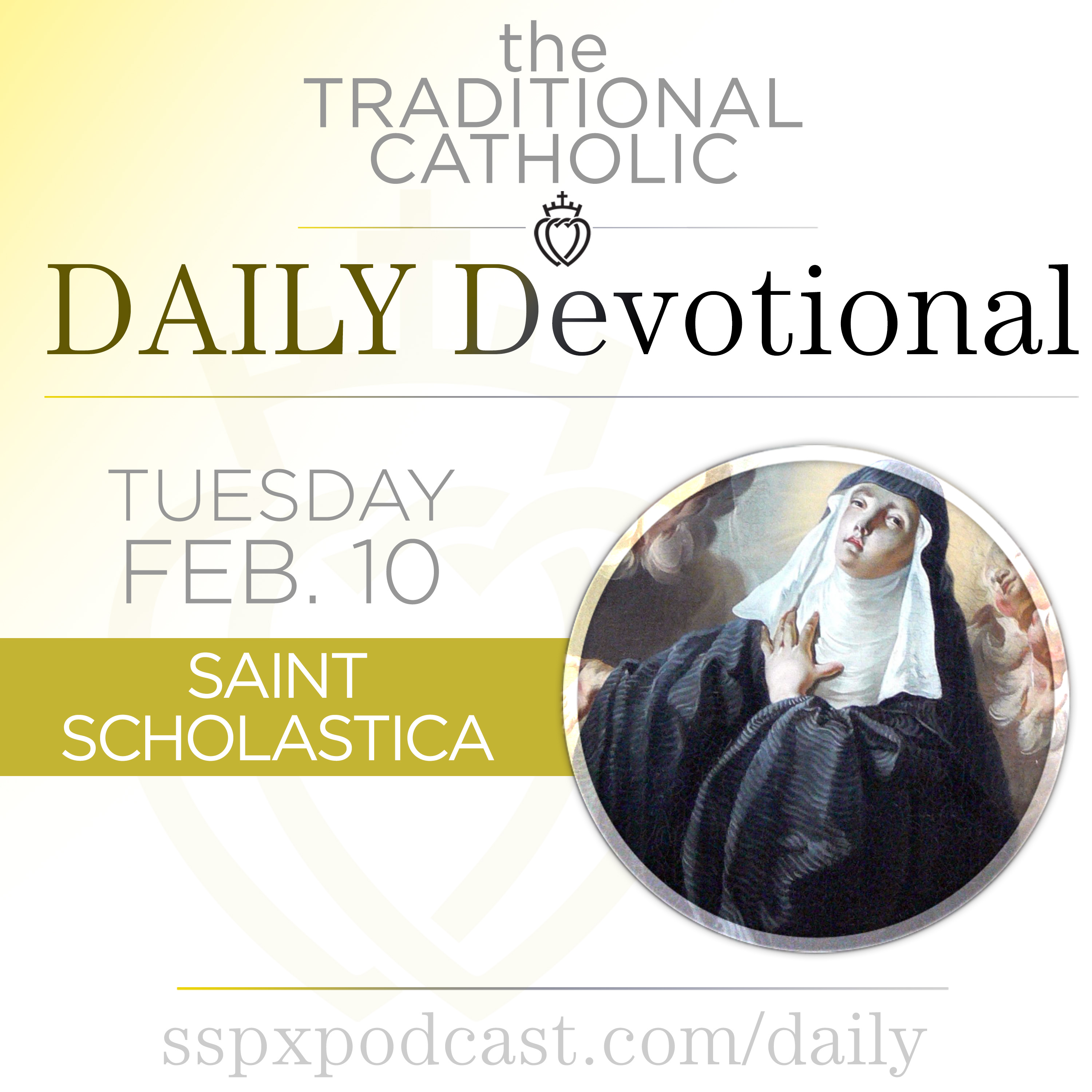
It’s the Feast of St. Scholastica, 3rd Class, with the color of White. In this episode: the meditation: “Nature: A School of Life”, today’s news from the Church: “Well-Documented Book Reveals Secrets About the Last Conclave”, and today’s thought from the Archbishop.
Have feedback or questions about the DD or our other shows? podcast@sspx.org
Sources Used Today:
- “Nature: A School of Life” – From Epiphany to Lent
- “Well-Documented Book Reveals Secrets About the Last Conclave” (FSSPX.news)
- The Spiritual Life – Archbishop Lefebvre (Angelus Press)
Saint Scholastica stands as a quiet but powerful witness to the primacy of love in the Christian life, a woman whose holiness unfolded alongside one of the Church’s greatest fathers yet followed its own unmistakable path. Born around 480 in Italy, Scholastica was the twin sister of Saint Benedict. From early on, both siblings were drawn toward God, but where Benedict’s vocation would shape Western monasticism through structure and rule, Scholastica’s sanctity would reveal the interior heart of that life. She consecrated herself to God as a young woman and lived near the monastery Benedict later founded at Monte Cassino, pursuing a life of prayer, simplicity, and hidden fidelity.
The sources tell us little about Scholastica’s daily life, but what they do preserve is decisive. Once a year, she and Benedict met in a small house halfway between their communities to speak together of God. These meetings were not casual family visits. They were spiritual encounters, conversations rooted entirely in prayer, Scripture, and the desire for heaven. On one such visit, Scholastica sensed that her death was near and asked Benedict to remain longer, to continue speaking of divine things through the night. Benedict, bound strictly to his rule, refused. Scholastica responded not with argument, but with prayer.
According to Saint Gregory the Great, she bowed her head and prayed silently, and immediately a violent storm broke out, making it impossible for Benedict to return to his monastery. Benedict protested, but Scholastica answered calmly that she had asked him and he would not listen, so she had asked God, and God had listened. Benedict stayed, and the two spent the night in holy conversation. Three days later, Benedict saw his sister’s soul rise to heaven in the form of a dove. Only then did he fully understand what had taken place.
Gregory’s conclusion is famous and deliberate. Scholastica prevailed because she loved more. Her holiness was not lesser or secondary. It was deeper in charity. She did not reject obedience, but she revealed its purpose. Rules exist to serve love, not replace it. In Scholastica, the Church sees contemplative wisdom that knows when love itself fulfills the law.
Scholastica died around 543 and was buried near her brother. Over time, devotion to her spread through Benedictine communities, where she was honored as a spiritual mother. Her feast on February 10 was associated with prayer for perseverance, unity, and charity within religious life. She became a patron for nuns, oblates, and all who seek God through prayer shaped by love rather than rigor alone.
Saint Scholastica reminds the Church that holiness is not measured by strictness, but by love that listens, trusts, and dares to ask God boldly.
Saint Scholastica, woman of prayer and love, pray for us.
- - - - - -
- - - - - -
Explore more:
What is the SSPX Podcast?
The SSPX Podcast is produced by Angelus Press, which has as its mission the fortification of traditional Catholics so that they can defend the Faith, and reaching out to those who have not yet found Tradition.
What is the SSPX?
The main goal of the Society of Saint Pius X is to preserve the Catholic Faith in its fullness and purity, to teach its truths, and to diffuse its virtues, especially through the Roman Catholic priesthood.
Authentic spiritual life, the sacraments, and the traditional liturgy are its primary means of bringing this life of grace to souls.
Although the traditional Latin Mass is the most visible and public expression of the work of the Society, we are committed to defending Catholic Tradition in its entirety: all of Catholic doctrine and morals as the Church has always defended them. What people need is the Catholic Faith, without compromise, with all the truth and beauty which accompanies it.
https://sspx.org