It’s the Saturday After Ash Wednesday, 3rd Class, with the color of Violet. In this episode: the meditation: “Sins of the Tongue”, today’s news from the Church: “Order and Jurisdiction: The Futility of the Schism Accusation”, and today’s thought from the Archbishop.
Have feedback or questions about the DD or our other shows? podcast@sspx.org
Sources Used Today:
- “Sins of the Tongue” – Toward Easter
- “Order and Jurisdiction: The Futility of the Schism Accusation” (FSSPX.news)
- The Spiritual Life – Archbishop Lefebvre (Angelus Press)
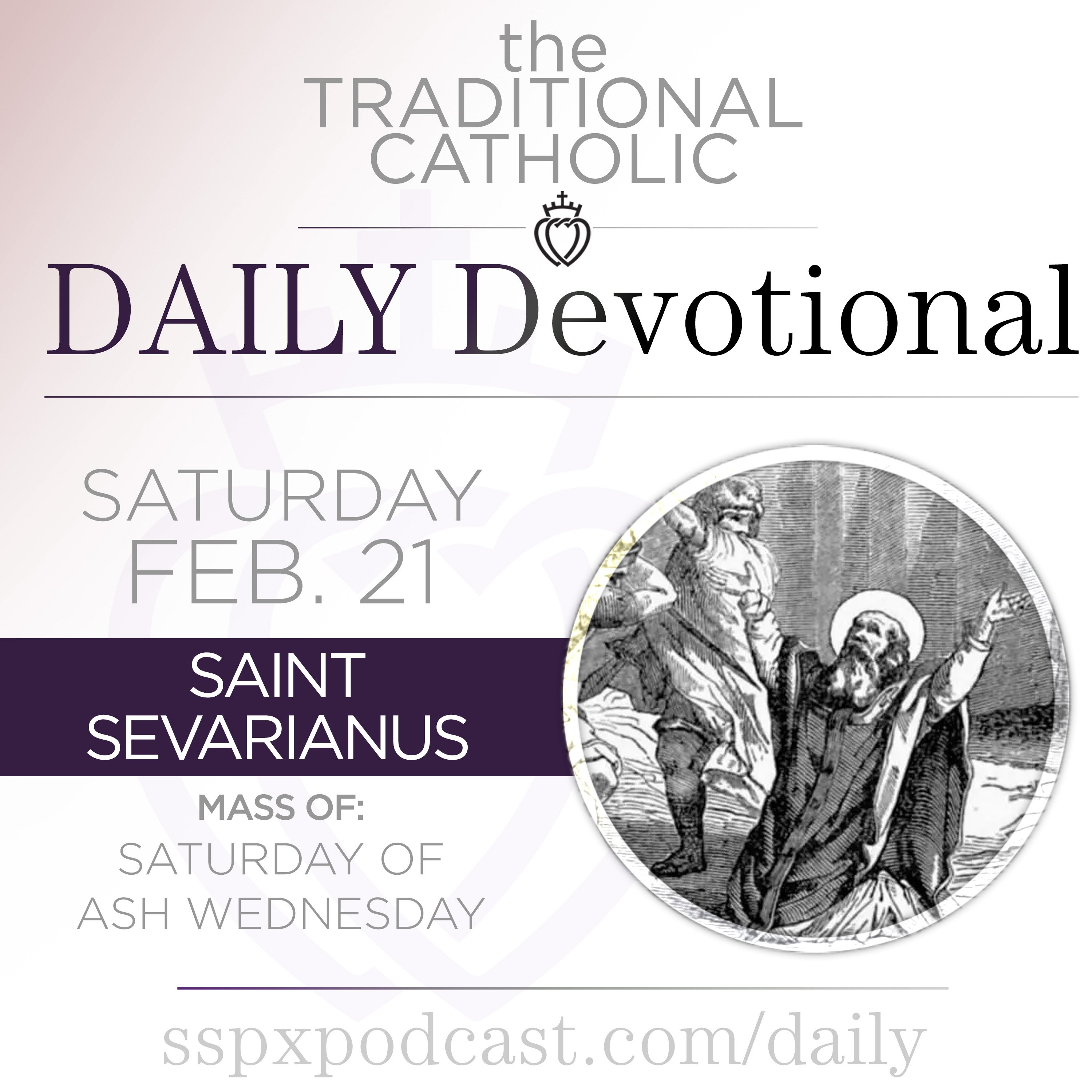
Saint Severianus is remembered as a martyr whose fidelity was tested not by philosophical controversy but by public humiliation and physical suffering. He lived in the late third or early fourth century, most likely in Scythopolis in Palestine, during the fierce persecutions under Emperor Diocletian. Christianity was still illegal, and believers were expected to prove loyalty to Rome by sacrificing to the gods. Severianus, a respected Christian layman and possibly a civic official, refused.
According to ancient tradition, Severianus had been known for integrity and upright character even before his arrest. When the governor required public sacrifice, Severianus openly confessed Christ instead. He did not try to evade questioning or argue for compromise. His refusal was direct and calm. Authorities hoped that intimidation would weaken him. Instead, his composure unsettled them. In a culture that prized conformity and feared instability, his refusal represented both religious and civic defiance.
Severianus was subjected to torture in an attempt to force recantation. The accounts describe prolonged suffering, yet emphasize his endurance rather than the cruelty itself. He bore pain without renouncing his faith, speaking only to reaffirm his allegiance to Christ. When torture failed, he was condemned to death. Tradition records that he was hung from a wall and left to die slowly, a method meant to degrade and discourage other Christians. His death likely occurred around the year 303.
What distinguishes Severianus in early Christian memory is not dramatic miracle or extended preaching, but steadfastness under pressure. His martyrdom reflects a broader pattern in the Diocletian persecution, where ordinary believers, not only clergy, bore witness through endurance. The Church remembered him as a man whose holiness was proven in suffering, and whose faith did not bend under civic threat.
Devotion to Saint Severianus developed particularly in Eastern Christian communities. His feast on February 21 was associated with prayers for perseverance under pressure and courage in public confession of faith. In some regions, he was invoked by those facing unjust authority or coercion, especially civil servants and officials who struggled to reconcile conscience with command.
Severianus reminds the Church that sanctity does not require extraordinary circumstances, only extraordinary fidelity. His life shows that courage is often quiet, that confession of Christ may come without applause, and that endurance itself can be a powerful proclamation.
Saint Severianus, faithful witness and martyr of Christ, pray for us.
- - - - - -
- - - - - -
Explore more:
What is the SSPX Podcast?
The SSPX Podcast is produced by Angelus Press, which has as its mission the fortification of traditional Catholics so that they can defend the Faith, and reaching out to those who have not yet found Tradition.
What is the SSPX?
The main goal of the Society of Saint Pius X is to preserve the Catholic Faith in its fullness and purity, to teach its truths, and to diffuse its virtues, especially through the Roman Catholic priesthood.
Authentic spiritual life, the sacraments, and the traditional liturgy are its primary means of bringing this life of grace to souls.
Although the traditional Latin Mass is the most visible and public expression of the work of the Society, we are committed to defending Catholic Tradition in its entirety: all of Catholic doctrine and morals as the Church has always defended them. What people need is the Catholic Faith, without compromise, with all the truth and beauty which accompanies it.
https://sspx.org