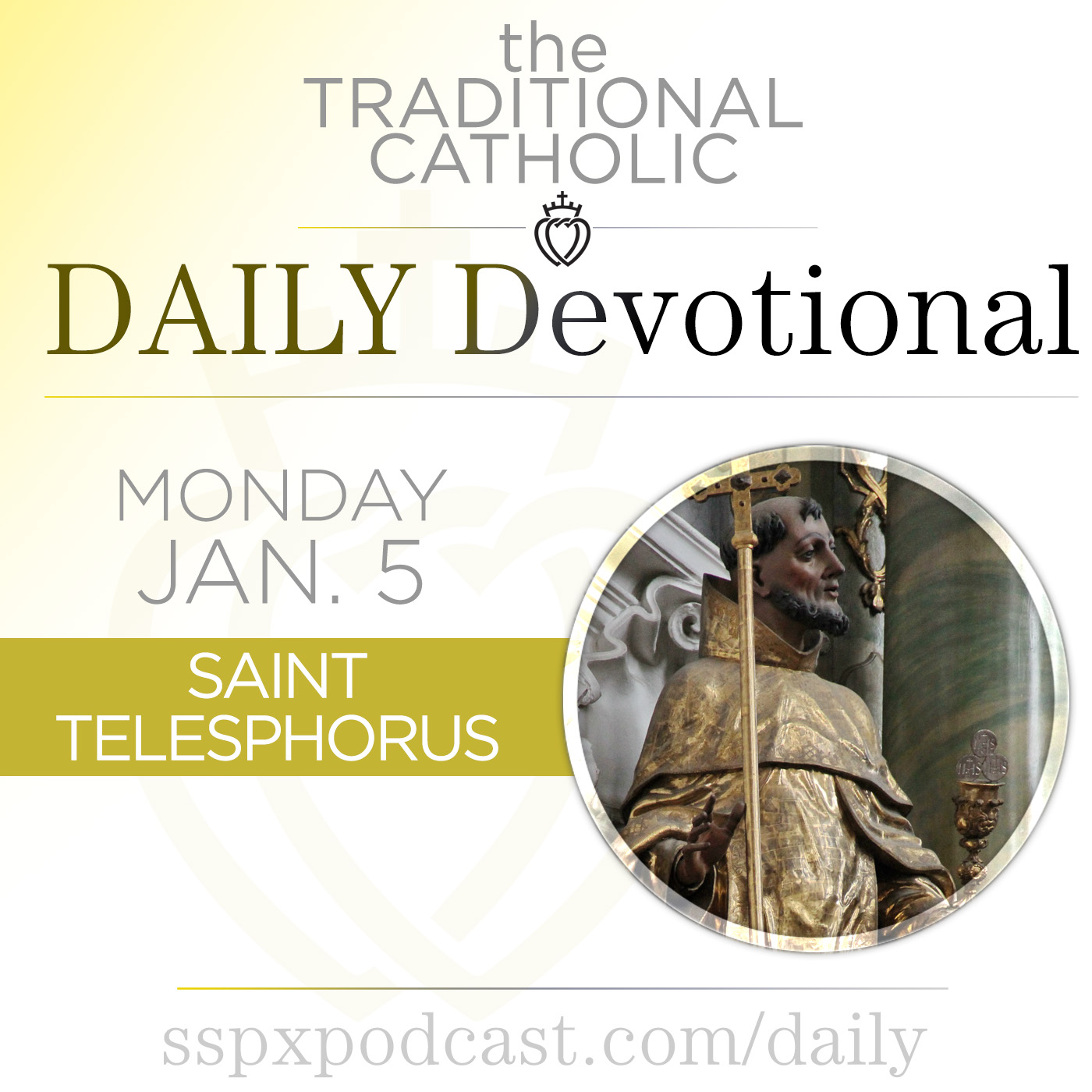
It’s the Feast of Feria, Comm S Telesphorus, 4th Class, with the color of White. In this episode: the meditation: “Little King of Grace”, today’s news from the Church: “The Fruits Without the Tree?”, a preview of the Sermon: “The Power of the Holy Name of Jesus”, and today’s thought from the Archbishop.
Have feedback or questions about the DD or our other shows? podcast@sspx.org
Sources Used Today:
- “Little King of Grace” – From Advent to Epiphany
- “The Fruits Without the Tree?” (FSSPX.news)
- “The Power of the Holy Name of Jesus” (SSPX Sermons)
- The Spiritual Life – Archbishop Lefebvre (Angelus Press)
Saint Telesphorus stands among the earliest shepherds of the Church, a pope whose holiness was forged in silence, discipline, and eventual martyrdom. He lived in the second century and is traditionally counted as the seventh successor of Saint Peter, governing the Church during a time when Christianity was still fragile and often misunderstood. Ancient sources describe him as a Greek by birth and a former hermit, a man shaped by ascetic prayer before being called to lead the Church of Rome. That monastic spirit never left him. Even as pope, he was remembered for simplicity of life and deep devotion to the mystery of Christ.
His pontificate unfolded during the reign of Emperor Hadrian, a period that alternated between tolerance and hostility. Christians were not hunted systematically, but accusations could still lead to death. Telesphorus guided the Church with quiet firmness, strengthening worship and discipline rather than engaging in public confrontation. Early tradition credits him with helping to shape the Church’s liturgical life, especially the observance of the fast before Easter and the celebration of the Nativity of Our Lord. While later centuries would develop these practices more fully, Telesphorus is remembered as one who helped root the Church’s calendar in prayer, penance, and joy centered on Christ.
What set him apart even among early popes was his end. Saint Irenaeus, writing within living memory of his time, lists Telesphorus explicitly as a martyr. This is rare testimony for such an early period. Though no details of his death survive, the Church remembered him as a shepherd who sealed his teaching with blood. His witness placed him among those leaders who did not merely organize the Church, but suffered for it.
Devotion to Saint Telesphorus remained largely tied to Rome and to the memory of the early martyrs. His feast on January 5 was observed as a reminder of the Church’s roots in sacrifice and perseverance. Because of his association with early fasting and liturgical order, he became an intercessor for those seeking fidelity in prayer and discipline in spiritual life, especially pastors guiding communities through uncertain times.
Saint Telesphorus shows us that the Church was built not only by great preaching and dramatic conversions, but by hidden holiness, steady prayer, and shepherds willing to give everything for Christ.
Saint Telesphorus, pope and martyr, pray for us!
- - - - - -
- - - - - -
Explore more:
What is the SSPX Podcast?
The SSPX Podcast is produced by Angelus Press, which has as its mission the fortification of traditional Catholics so that they can defend the Faith, and reaching out to those who have not yet found Tradition.
What is the SSPX?
The main goal of the Society of Saint Pius X is to preserve the Catholic Faith in its fullness and purity, to teach its truths, and to diffuse its virtues, especially through the Roman Catholic priesthood.
Authentic spiritual life, the sacraments, and the traditional liturgy are its primary means of bringing this life of grace to souls.
Although the traditional Latin Mass is the most visible and public expression of the work of the Society, we are committed to defending Catholic Tradition in its entirety: all of Catholic doctrine and morals as the Church has always defended them. What people need is the Catholic Faith, without compromise, with all the truth and beauty which accompanies it.
https://sspx.org