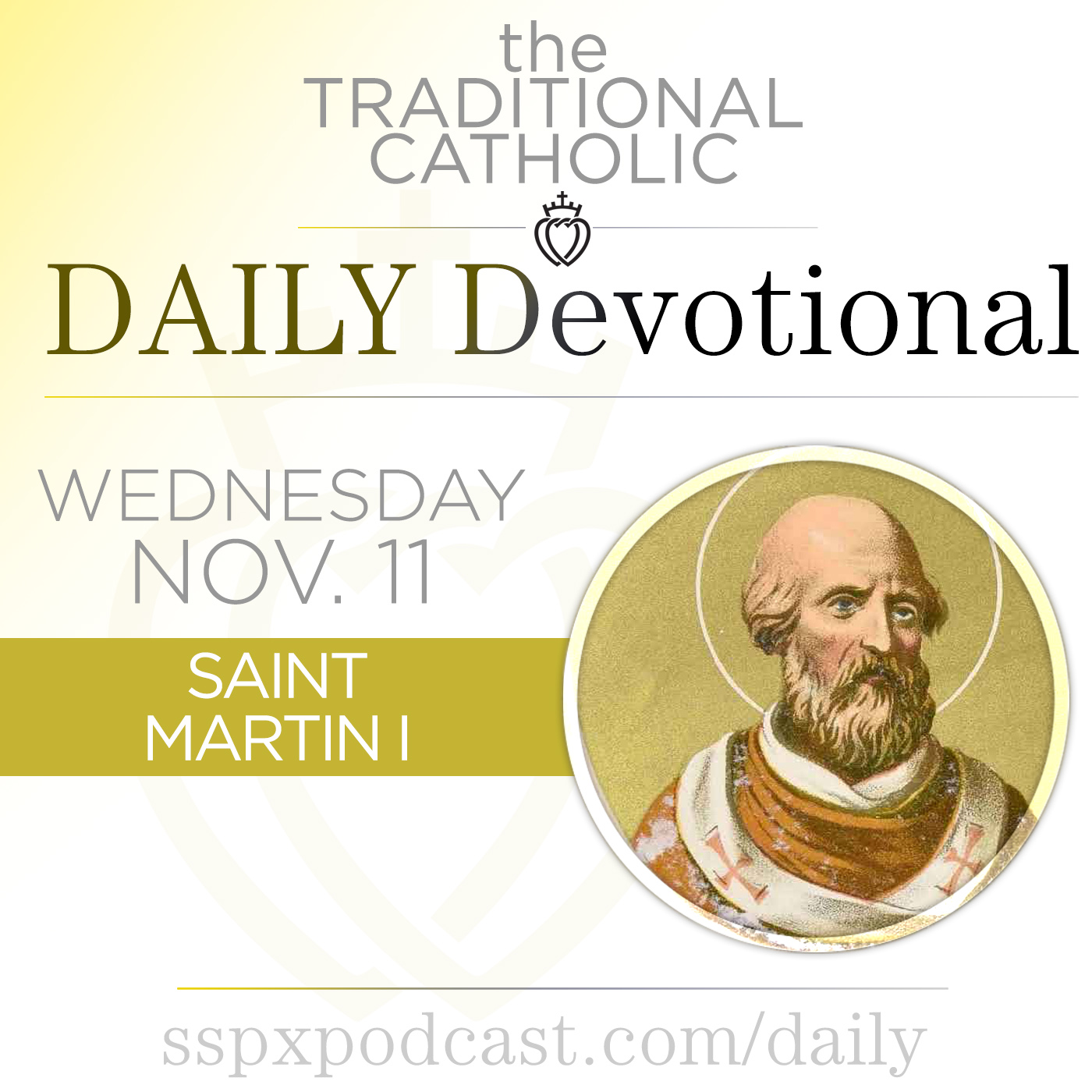
It’s the Feast of St Martin I, 3rd Class, with the color of Red. In this episode: the meditation: “Appropriating the Threefold Efficacy of the Mass”, today’s news from the Church: “Left-wing Parties Once More Fail to Seize Control of Cordoba Cathedral”, a preview of the Sermon: “A Crisis of Faith”, and today’s thought from the Archbishop.
Have feedback or questions about the DD or our other shows? podcast@sspx.org
Sources Used Today:
- “Appropriating the Threefold Efficacy of the Mass” – The Heart of the Mass
- “Left-wing Parties Once More Fail to Seize Control of Cordoba Cathedral” (FSSPX.news)
- “A Crisis of Faith” (SSPX Sermons)
- The Spiritual Life – Archbishop Lefebvre (Angelus Press)
Saint Martin I was a pope who paid dearly for his courage. Born in Umbria at the beginning of the seventh century, he rose through the ranks of the Church as a man of learning, purity, and integrity. Before his election to the papacy in 649, he had already served as papal ambassador to Constantinople, where he saw firsthand the growing tension between the Eastern and Western Churches. It was a time of deep confusion: emperors and patriarchs were promoting a doctrine called Monothelitism, which claimed that Christ had only one will, not both divine and human. For Martin, this was not a minor theological detail. It threatened the very truth of the Incarnation, that Christ is fully God and fully man.
Soon after becoming pope, Martin called the Lateran Council of 649, gathering bishops from across the Christian world to defend the faith. The council condemned Monothelitism and reaffirmed that Christ’s two natures act together in harmony. It was a clear stand for orthodoxy, but it enraged the Byzantine Emperor Constans II, who had hoped to impose peace by silencing both sides. The emperor sent an order for Martin’s arrest, branding him a traitor. For more than a year, the pope managed to evade capture, but in 653 imperial troops broke into the Lateran and dragged the frail pontiff from his bed.
He was taken to Constantinople, publicly humiliated, and condemned without a fair trial. Starved and beaten, he was eventually exiled to the Crimea, far from the Roman Church he loved. There he wrote letters to his flock, urging them not to lose heart. His words show no bitterness, only serenity and faith. “Pray for those who persecute us,” he wrote, “that they may receive the light of understanding.” He died in exile in 655, the last pope to be martyred for defending doctrine.
In the centuries that followed, his courage became a model for all who guard the integrity of the faith against political pressure. His feast on November 12 honors not a man of worldly triumph, but a shepherd who refused to bend the truth for the sake of comfort or compromise.
- - - - - -
- - - - - -
Explore more:
What is the SSPX Podcast?
The SSPX Podcast is produced by Angelus Press, which has as its mission the fortification of traditional Catholics so that they can defend the Faith, and reaching out to those who have not yet found Tradition.
What is the SSPX?
The main goal of the Society of Saint Pius X is to preserve the Catholic Faith in its fullness and purity, to teach its truths, and to diffuse its virtues, especially through the Roman Catholic priesthood.
Authentic spiritual life, the sacraments, and the traditional liturgy are its primary means of bringing this life of grace to souls.
Although the traditional Latin Mass is the most visible and public expression of the work of the Society, we are committed to defending Catholic Tradition in its entirety: all of Catholic doctrine and morals as the Church has always defended them. What people need is the Catholic Faith, without compromise, with all the truth and beauty which accompanies it.
https://sspx.org