It's the Feast of
Ember Wed in September,
2nd Class, with the color of
Violet. In this episode: the meditation: "Intimacy with God", today's news from the Church: "The Interior Renewal Effected by the Spiritual Exercises", and today's thought from the Archbishop Marcel Lefebvre.
Have feedback or questions about the DD or our other shows?
podcast@sspx.org
Sources Used Today:
- "Intimacy with God" — From the Assumption to Advent
- "The Interior Renewal Effected by the Spiritual Exercises" (FSSPX.news)
- The Spiritual Life — Archbishop Marcel Lefebvre (Angelus Press)
Please support our new project, the Archbishop Lefebvre Biography Audiobook:
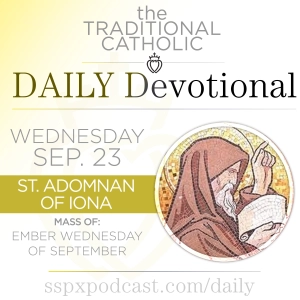
Saint Adomnán of Iona is one of those saints who becomes more interesting the more you dig into him. He was a monk and abbot, but also a historian, biographer, diplomat, traveler, and the driving force behind one of medieval Europe's earliest attempts to protect civilians during warfare.
He was born in Ireland around 624 and eventually entered the great monastery of Iona, the island community off the coast of Scotland founded by Columba.
About a century after Columba's birth, Adomnán became Iona's ninth abbot.
And fortunately for us, he liked to write.
His Life of Saint Columba is one of the most valuable works surviving from early medieval Britain and Ireland. Adomnán collected stories from older monks who had known people close to Columba himself. He recorded miracles, voyages, conversations, kings, monasteries, and little details of daily life that otherwise would have disappeared completely.
So a surprising amount of what we know about Saint Columba comes from Adomnán.
He also wrote a fascinating book about the Holy Land.
Adomnán had never been there.
Instead, a Frankish bishop named Arculf was apparently shipwrecked near Britain after making a pilgrimage to Jerusalem. He eventually reached Iona and described everything he had seen. Adomnán carefully interviewed him and turned those conversations into On the Holy Places, complete with descriptions of Jerusalem, Bethlehem, and other biblical sites.
But perhaps the most remarkable part of Adomnán's story came later.
According to Irish tradition, he encountered a woman who had been brutally injured during warfare. The experience deeply disturbed him.
Adomnán began pushing Irish kings and churchmen to agree that some people simply should not be legitimate targets in war.
In 697, a major gathering at Birr adopted what became known as the Law of Adomnán, or Cáin Adomnáin. It offered special legal protection to women, children, and clerics and established penalties for killing, assaulting, or abusing them.
For the seventh century, that's extraordinary.
It wasn't modern humanitarian law, of course, but it came from a strikingly familiar conviction: even warfare needs limits, and the vulnerable deserve protection.
Adomnán died in 704, leaving behind something unusual for an early medieval saint. We don't just have legends about him.
We have his books.
You can still visit Iona today and walk the island where he governed the monastery and gathered stories about Columba more than thirteen centuries ago.
Saint Adomnán reminds us that preserving history, protecting the vulnerable, and telling the stories of holy people can themselves become works of Christian charity.
Saint Adomnán of Iona, keeper of sacred memory and defender of the vulnerable, pray for us.
- - - - - -
Explore more:
What is the SSPX Podcast?
The SSPX Podcast is produced by Angelus Press, which has as its mission the fortification of traditional Catholics so that they can defend the Faith, and reaching out to those who have not yet found Tradition.
What is the SSPX?
The main goal of the Society of Saint Pius X is to preserve the Catholic Faith in its fullness and purity, to teach its truths, and to diffuse its virtues, especially through the Roman Catholic priesthood.
Authentic spiritual life, the sacraments, and the traditional liturgy are its primary means of bringing this life of grace to souls.
Although the traditional Latin Mass is the most visible and public expression of the work of the Society, we are committed to defending Catholic Tradition in its entirety: all of Catholic doctrine and morals as the Church has always defended them. What people need is the Catholic Faith, without compromise, with all the truth and beauty which accompanies it.
https://sspx.org