358E-389-Tiny Spacecraft

358E-389-Tiny Spacecraft

Author: Albert D. Grauer October 14, 2025 Duration: 2:01
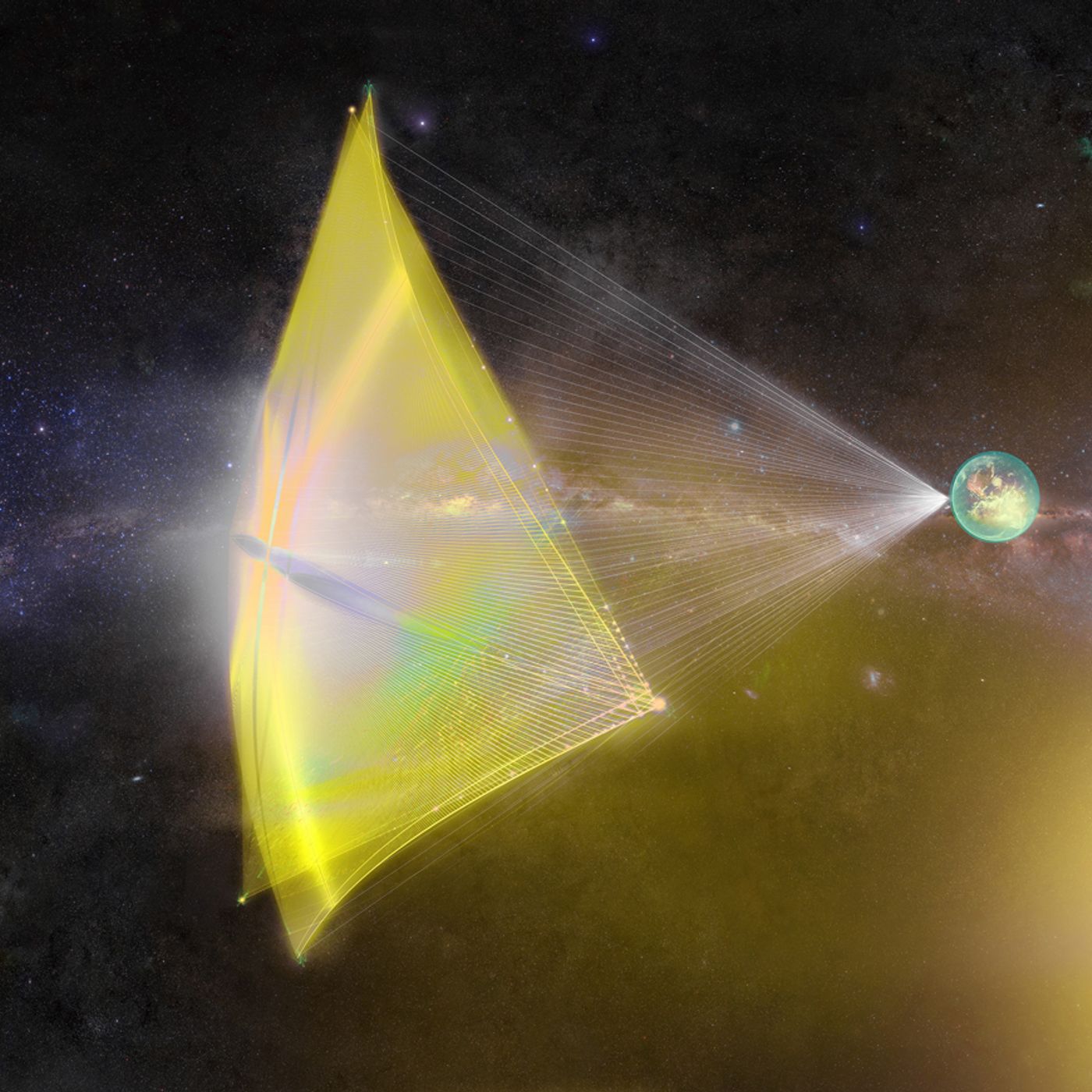
To reach the vicinity of the nearest star, 24 trillion miles away, in less than 20 years, an interstellar space probe would have to travel at a substantial fraction of the speed of light. Newton's laws of motion, published 300 years ago, predict that the greater the mass of an object the greater is the force required to increase it's velocity. In order to alleviate the need for the virtually unaffordable amount of energy required to accelerate a normal sized spacecraft to a speed of 20% of the speed of light, the Breakthrough Starshot program has funded the creation of 'Sprite' , the world's smallest spacecraft. About the size of a saltine cracker and having a mass of less than 2 dimes, the single-board Sprite spacecraft has all the essentials; solar panels, computing electronics, thermometers, gyroscopes, radio communication equipment and more. Working prototypes have been launched into Earth orbit by the Indian Space Research Organization attached to the Italian Max Valier and Latvian Ventra satellites. One of them has sent back signals which have been received by Cornell University's ground station. Dr. Zac Manchester who started the Sprite Spacecraft program while earning a PhD at Cornell University envisions using tiny spacecraft to explore near Earth Space as well as asteroids and moons in our solar system. In the future, fleets of the decedents of Sprite could be sent to explore intriguing planets in nearby alien solar systems. These tiny explorers will be propelled by high power Earth bound lasers directed at their solar sails and could reach and explore distant planets in a reasonable amount of time.

Each episode of Travelers In The Night feels like a quiet, personal conversation under a dark sky. Hosted by astronomer Dr. Albert D. Grauer, this podcast brings the distant cosmos into sharp, intimate focus. Dr. Grauer isn't just an observer; he's an active participant in the hunt, working with the Catalina Sky Survey team that has consistently discovered near-Earth asteroids for years. In these brief and engaging segments, you'll hear firsthand accounts of what it's like to track these ancient celestial travelers-the asteroids and comets that silently pass by our world. The discussions move beyond simple facts to explore the real-world implications of these discoveries, from planetary defense to the sheer wonder of our dynamic solar system. Accompanied by the contemplative music of John Lyell's "Eternity," each installment offers a moment of calm reflection on humanity's place in the universe. It’s a perfect blend of grounded science and cosmic curiosity, making complex astronomical concepts accessible and deeply fascinating. For anyone who has ever looked up and wondered what's out there moving in the dark, this podcast provides a direct line to the front lines of discovery.
Author: Language: English Episodes: 1000

Travelers In The Night
Podcast Episodes
312E-331-Space Salsa [not-audio_url] [/not-audio_url]

Duration: 2:01
If Lunar and Martian colonists are to have chips and salsa they will need grow their own tomatoes. To test methods to do this German Aerospace Center or DLR has developed the EU:CROPIS satellite which will be launched by…
824-Catalina Near Earth Comet [not-audio_url] [/not-audio_url]

Duration: 2:01
My Catalina Sky Survey teammate Kacper Wierzchos was asteroid hunting with our Schmidt telescope on Mt. Bigelow, Arizona when he discovered and reported a fuzzy looking unknown object in a set of his images. There is no…
311E-330-Comet Johnson [not-audio_url] [/not-audio_url]

Duration: 2:01
Comet C2/2015 V2 Johnson was discovered by my Catalina Sky Survey teammate Jess Johnson on November 3, 2015. It travels on a hyperbolic path around the Sun which is highly inclined to the plane where the planets and most…
823 Jacqui's Impactor [not-audio_url] [/not-audio_url]

Duration: 2:01
My Catalina Sky Survey teammate Jacqueline Fazekas was asteroid hunting in the constellation of Aquarius with our 60 inch telescope on Mt. Lemmon Arizona when she discovered a tiny asteroid which would impact the Earth i…
310E-329-Near Neighbor [not-audio_url] [/not-audio_url]

Duration: 2:01
My Catalina Sky Survey teammate Carson Fuls was using the new hundred million pixel camera on our team's Schmidt telescope located on Mt. Bigelow, Arizona, when he discovered 2017 AG13. It passes near the Earth's orbit t…
822-Dark Matter and Alien Beings [not-audio_url] [/not-audio_url]

Duration: 2:01
In a recent paper published in the International Journal of Astrobiology, a philosopher Dr. Vojin Rakić (voyin rack itch) reviews some 50 or so proposed solutions to Fermi’s paradox, including, that human life is so exce…
309E-328-The Heat is On [not-audio_url] [/not-audio_url]

Duration: 2:01
The National Oceanic and Atmospheric Administration has published an extensive data based review, analysis, and summary of the Earth's Climate. 2016 was hotter than 2015 which was hotter than 2014. 2016 is the warmest ye…
821-Dinosaur Killing Asteroid [not-audio_url] [/not-audio_url]

Duration: 2:01
Scientific results are consistent with the hypothesis that the dinosaur killing, K-T layer forming Chicxulub impactor came from well beyond Jupiter while the other 5 impactors in the past 541 million years as well as mos…
308E-327-Suddenly Bright [not-audio_url] [/not-audio_url]

Duration: 2:01
An example that a relatively large space rock can approach the Earth suddenly started with what appeared as a bright star moving across the images that I had just obtained with the Catalina Sky Survey's 60 inch telescope…
820-4015 Wilson-Harrington (1979 VA) [not-audio_url] [/not-audio_url]

Duration: 2:01
4015 Wilson-Harrington (1979 VA) was discovered as a comet by Wilson and Harrington in 1949, lost to astronomers for 30 years, and rediscovered in 1979 as an asteroid named 1979 VA. In 1992 with more data it was determin…