358E-389-Tiny Spacecraft

358E-389-Tiny Spacecraft

Author: Albert D. Grauer October 14, 2025 Duration: 2:01
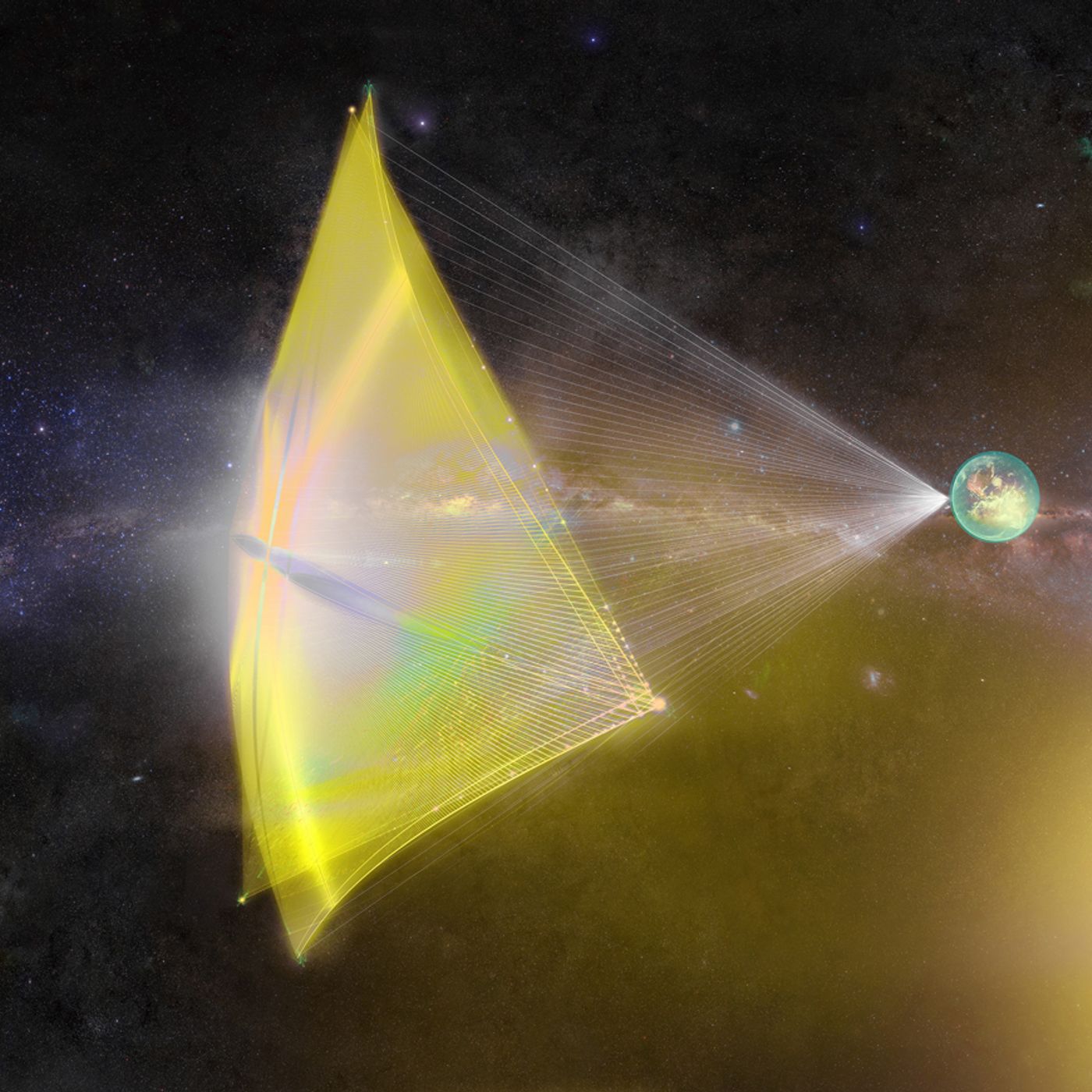
To reach the vicinity of the nearest star, 24 trillion miles away, in less than 20 years, an interstellar space probe would have to travel at a substantial fraction of the speed of light. Newton's laws of motion, published 300 years ago, predict that the greater the mass of an object the greater is the force required to increase it's velocity. In order to alleviate the need for the virtually unaffordable amount of energy required to accelerate a normal sized spacecraft to a speed of 20% of the speed of light, the Breakthrough Starshot program has funded the creation of 'Sprite' , the world's smallest spacecraft. About the size of a saltine cracker and having a mass of less than 2 dimes, the single-board Sprite spacecraft has all the essentials; solar panels, computing electronics, thermometers, gyroscopes, radio communication equipment and more. Working prototypes have been launched into Earth orbit by the Indian Space Research Organization attached to the Italian Max Valier and Latvian Ventra satellites. One of them has sent back signals which have been received by Cornell University's ground station. Dr. Zac Manchester who started the Sprite Spacecraft program while earning a PhD at Cornell University envisions using tiny spacecraft to explore near Earth Space as well as asteroids and moons in our solar system. In the future, fleets of the decedents of Sprite could be sent to explore intriguing planets in nearby alien solar systems. These tiny explorers will be propelled by high power Earth bound lasers directed at their solar sails and could reach and explore distant planets in a reasonable amount of time.

Each episode of Travelers In The Night feels like a quiet, personal conversation under a dark sky. Hosted by astronomer Dr. Albert D. Grauer, this podcast brings the distant cosmos into sharp, intimate focus. Dr. Grauer isn't just an observer; he's an active participant in the hunt, working with the Catalina Sky Survey team that has consistently discovered near-Earth asteroids for years. In these brief and engaging segments, you'll hear firsthand accounts of what it's like to track these ancient celestial travelers-the asteroids and comets that silently pass by our world. The discussions move beyond simple facts to explore the real-world implications of these discoveries, from planetary defense to the sheer wonder of our dynamic solar system. Accompanied by the contemplative music of John Lyell's "Eternity," each installment offers a moment of calm reflection on humanity's place in the universe. It’s a perfect blend of grounded science and cosmic curiosity, making complex astronomical concepts accessible and deeply fascinating. For anyone who has ever looked up and wondered what's out there moving in the dark, this podcast provides a direct line to the front lines of discovery.
Author: Language: English Episodes: 1000

Travelers In The Night
Podcast Episodes
97E-109-Eighteen Sleeps Later [not-audio_url] [/not-audio_url]

Duration: 2:01
The NASA, New Horizons spacecraft woke up from its 18th sleeping period in the last 9 years. Its long space naps have lasted an average 104 days each. It has traveled 9 years from Earth and has crossed the orbit of Neptu…
608-Triple Comet [not-audio_url] [/not-audio_url]

Duration: 2:01
Recently amateur astronomer, Worachate Boonplod discovered the 4049th comet recorded in the imaging data produced by SOHO, the ESA/NASA Solar and Heliospheric Observatory. To discover your very own comet visit the NASA S…
96E-108-How Close Will It Come To Us [not-audio_url] [/not-audio_url]

Duration: 2:01
The goal of the NASA Near Earth Object Program is to provide an early warning should an asteroid be found to be on a path bringing it close to planet Earth. Look at the Near Earth Object websites and you will know about…
607-Good Night [not-audio_url] [/not-audio_url]

Duration: 2:01
Nearly every day during the monsoon rainy season in the American southwest, afternoon thunderstorms require putting mountain top telescopes and cameras into a lightning safe mode. Through holes in the clouds asteroid hun…
95E-107-Mining Asteroids [not-audio_url] [/not-audio_url]

Duration: 2:01
Science fiction writers have long imagined human space colonies which use the resources they find.It will take major, risky investments over many years to develop the capability to use asteroids to enable humans to explo…
606-Falling Stones [not-audio_url] [/not-audio_url]

Duration: 2:01
Approximately 100 million metric tons of mostly sand grained sized space dust enters the Earth's atmosphere every day. Occasionally, larger pieces become fireball meteors which can even be seen in the daytime as they str…
94E-106-Your Reality Fueled Spacecraft [not-audio_url] [/not-audio_url]

Duration: 2:01
Computers are extremely efficient at processing numbers while humans excel at visualization. NASA and JPL have developed a computer environment, based on game software architecture, which allows you explore the solar sys…
605-Monsoon Nights [not-audio_url] [/not-audio_url]

Duration: 2:01
Every year the Monsoon summer rains come to the American southwest in July and August. After the threat of wild fires has been rained out, monsoon time continues to be difficult for asteroid hunters. Even so this season…
93E-105-A New Chapter In The Human Exploration Of Space [not-audio_url] [/not-audio_url]

Duration: 2:01
The first unmanned test flight of the new NASA Orion Spacecraft went perfectly. It made two orbits of the Earth traveling as far as 3600 miles above the surface of our planet. Its path took it nearly 15 times higher than…
604-Comet Rankin [not-audio_url] [/not-audio_url]

Duration: 2:01
There may be as many as a trillion small icy objects in the Oort cloud near the outer edge of our solar system. Very rarely one of these frozen ice balls is jostled by the gravity of a nearby star causing its distant pat…