362E-394-Tiny Beasts

362E-394-Tiny Beasts

Author: Albert D. Grauer November 11, 2025 Duration: 2:01
Humans have a long history of partnerships with a variety of micro organisms. Although the proportions vary widely with individuals, recent scientific estimates suggest that a typical human being has approximately the same number of bacteria and other microbes as they do actual human cells. Now it appears that a partnership with yeast and algae will enable spacefaring humans to use their waste products to produce food and plastics during long duration space flights. Dr. Mark Blenner of Clemson University leads a research group developing strains of yeast which obtain their nitrogen from untreated urine and their carbon dioxide from exhaled breath or the Martian atmosphere which has been converted into yeast food by algae. One of Blenner's yeast strains produces omega-3 fatty acids which are essential for heart, eye, and brain health while another strain of yeast has been engineered to produce polyester polymers which could be used by 3D printers to produce plastic tools and other useful devices. In the future research Blenner's team will focus on increasing the output of these tiny beasts to the point that they will generate useful amounts of nutrients and plastics from astronaut's waste products. This new research when added to the fact that on the International Space Station space travelers now routinely drink recycled water from their urine, sweat, and showers moves us closer to the day when space travelers literally use and reuse every atom that they lift from the Earth's surface enabling journeys that may last for years. The flip side of our partnership with microorganisms is that it is extremely difficult to protect the worlds we explore from a microorganism invasion which would threaten their home grown biology.

Each episode of Travelers In The Night feels like a quiet, personal conversation under a dark sky. Hosted by astronomer Dr. Albert D. Grauer, this podcast brings the distant cosmos into sharp, intimate focus. Dr. Grauer isn't just an observer; he's an active participant in the hunt, working with the Catalina Sky Survey team that has consistently discovered near-Earth asteroids for years. In these brief and engaging segments, you'll hear firsthand accounts of what it's like to track these ancient celestial travelers-the asteroids and comets that silently pass by our world. The discussions move beyond simple facts to explore the real-world implications of these discoveries, from planetary defense to the sheer wonder of our dynamic solar system. Accompanied by the contemplative music of John Lyell's "Eternity," each installment offers a moment of calm reflection on humanity's place in the universe. It’s a perfect blend of grounded science and cosmic curiosity, making complex astronomical concepts accessible and deeply fascinating. For anyone who has ever looked up and wondered what's out there moving in the dark, this podcast provides a direct line to the front lines of discovery.
Author: Language: English Episodes: 1000

Travelers In The Night
Podcast Episodes
22E-34-Number 5000 [not-audio_url] [/not-audio_url]

Duration: 2:01
The 5000th Earth approaching asteroid discovered by the University of Arizona's NASA funded Catalina Sky Survey is approximately 3 times the size of the one which injured 1491 people in Russia in February of 2013. It was…
533-100 Moons [not-audio_url] [/not-audio_url]

Duration: 2:01
A small telescope makes a substantial contribution to our knowledge of the celestial visitors to our neighborhood.
21E-33-A Busy Month In The Earth's Neighborhood [not-audio_url] [/not-audio_url]

Duration: 2:01
For us who look for Earth approaching objects, March of 2014 was a busy month. Six asteroids which pass closer than our Moon were discovered and tracked. The smallest of them is the size of an SUV and the largest would f…
532-Teddy's Debut [not-audio_url] [/not-audio_url]

Duration: 2:01
On a recent training night with Teddy Pruyne at the controls of our 60 inch telescope on Mt. Lemmon, Arizona, this duo discovered six new Earth Approaching Objects, an inner main belt asteroid, and rediscovered an inner…
20E-32-A Peanut Shaped Asteroid with a Moon [not-audio_url] [/not-audio_url]

Duration: 2:01
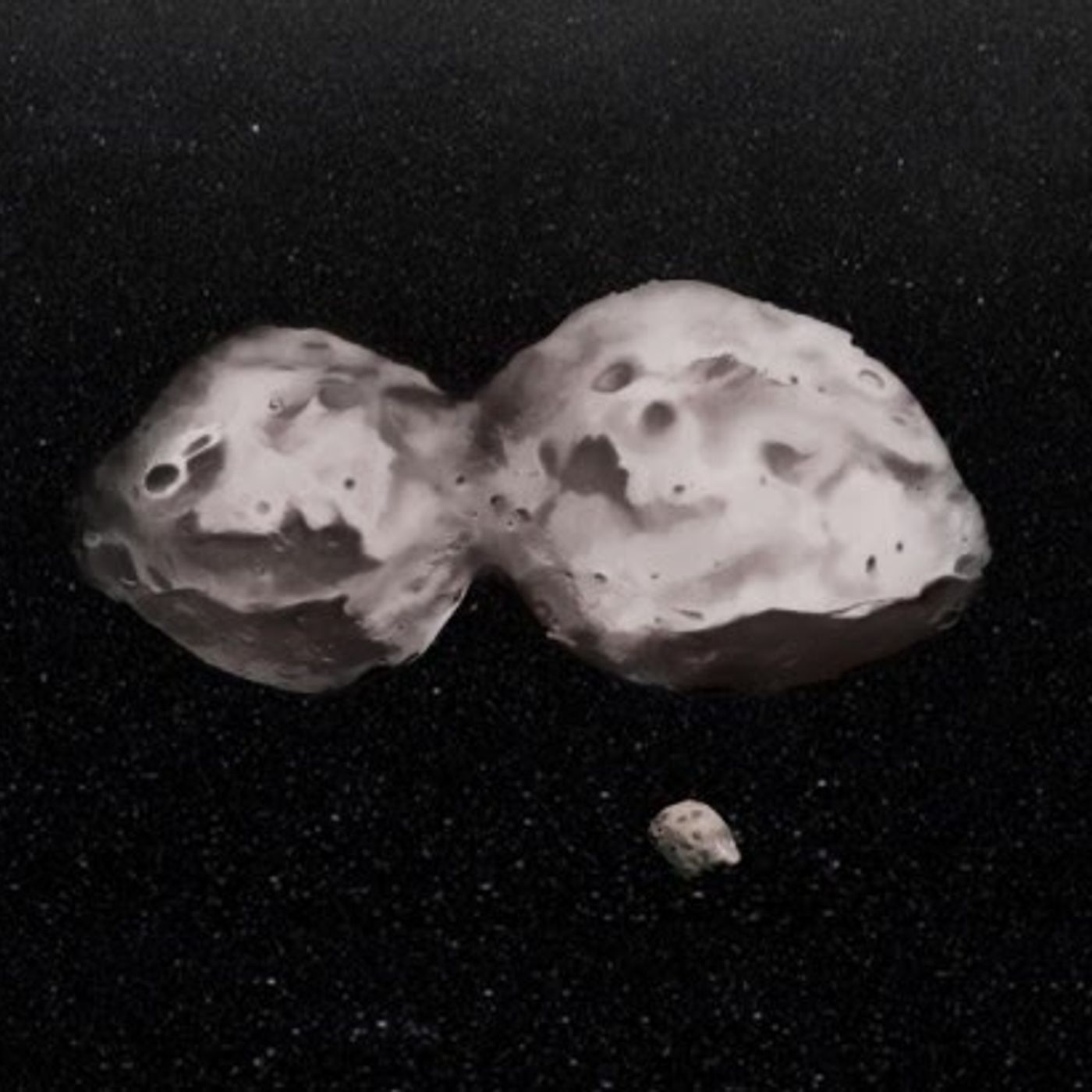
It appears that Hektor and its moon were created by a collision between two icy asteroids early in the 4.5 billion year history of our solar system when things were more chaotic. They happened to land in a gravitational…
531-Alex's Catch [not-audio_url] [/not-audio_url]

Duration: 2:01
On a cold windy night, with clouds frustrating his search, my Catalina Sky Survey teammate Alex Gibbs discovered 8 new celestial visitors while observing with our 60 inch telescope on Mt. Lemmon, Arizona.
19E-31-A Gentle Breakup Of An Asteroid [not-audio_url] [/not-audio_url]

Duration: 2:01
An asteroid spins up and comes apart. When the Earth runs into its trail we will be treated to a meteor shower.
530-Cuban Meteorites [not-audio_url] [/not-audio_url]

Duration: 2:01
A large fireball meteor which exploded over Cuba produced a number of interesting results.
18E-30-Asteroids On An Inside Track [not-audio_url] [/not-audio_url]

Duration: 2:01
Only 13 out of the more than 10,000 Earth approaching objects have their orbit completely within that of the Earth.
529-Africano 4 [not-audio_url] [/not-audio_url]

Duration: 2:01
My Catalina Sky Survey Teammate Brian Africano discovered his 4th comet while asteroid hunting in the constellation of Ursa Major with our Schmidt telescope on Mt. Bigelow, Arizona. Observers with small telescopes equipp…