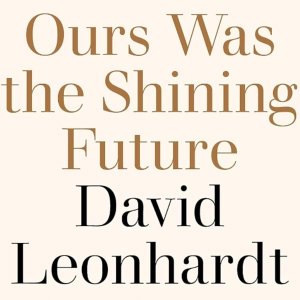
What happened to the ‘American dream’?

What happened to the ‘American dream’?

Author: The Watson School April 3, 2024 Duration: 32:24

Here’s a depressing fact: it takes longer to travel from Boston to Los Angeles today than it did 50 years ago. Getting to the airport, getting through the airport, the flight itself — just about every part of the process takes longer than it once did.  

According to New York Times senior writer David Leonhardt, this is just one example of the stagnation defining so many aspects of America’s society and economy today. From life expectancy to education outcomes to rates of income inequality, by so many measures, American society simply isn’t improving for as many Americans as rapidly as it once did. By some measures, it’s not improving at all.

In other words: the American dream is increasingly out of reach. 

Leonhardt’s newest book, “Ours Was the Shining Future: The Story of the American Dream,” explores the data and the history behind this dimming of the American dream. This spring, he came to the Watson Institute to discuss the book with Jeff Colgan, director of the Watson Institute’s Climate Solutions Lab. In this episode of Trending Globally, Colgan talks with Leonhardt about the cultural and political shifts that have contributed to this change, and about what needs to be done to make widespread prosperity attainable in the decades to come. 

Learn more about and purchase “Ours Was the Shining Future: The Story of the American Dream

Subscribe to “The Morning”, a newsletter from The New York Times

Learn more about the Watson Institute’s other podcasts


From the Watson School at Brown University, Trending Globally: Politics and Policy brings the insights of leading scholars and practitioners directly into your ears. This award-winning podcast digs into the complex forces shaping our world, moving beyond headlines to understand the deeper political and policy decisions behind them. Each conversation is designed to unpack a pressing issue-whether it's international trade tensions, public health crises, or social movements-with clarity and depth. You'll hear experts from the Watson Institute and beyond explain not just what's happening, but why it matters and how different policies might change the course of events. The discussions are grounded in rigorous research yet remain accessible, turning daunting global topics into understandable and engaging dialogue. For anyone curious about the mechanics of power, governance, and societal change, this series offers a vital resource. It’s a direct line to some of the sharpest minds in international and public affairs, all within a format that fits into your daily routine. Find Trending Globally: Politics and Policy and add it to your listening rotation for a consistently informative perspective on the stories that define our time.
Author: Language: English Episodes: 100

Trending Globally: Politics and Policy
Podcast Episodes
From pandemics to misinformation: rethinking security today [not-audio_url] [/not-audio_url]

Duration: 39:34
From a once-in-a-century global pandemic, to wars in Europe and the Middle East, to the unchecked rise of AI and social media technologies, we are living in an age of threats against humanity that are profound, fast-movi…
A brief history of US interventionism in Iran and beyond [not-audio_url] [/not-audio_url]

Duration: 38:52
On this episode, Dan Richards spoke with Watson School Senior Fellow Stephen Kinzer about the history of U.S. foreign intervention and how it can help us to understand today’s conflict in Iran.Stephen is an award-winning…
How US economic policy is interacting with the global economy today [not-audio_url] [/not-audio_url]

Duration: 42:03
On this episode, Watson School Dean and economist John Friedman talks with economist Sebnem Kalemli Ozcan about how U.S. economic policy in the last year has changed the American economy, how those changes have rippled t…
Are human brains wired for war? [not-audio_url] [/not-audio_url]

Duration: 38:48
Violent, organized conflict is a near constant in human history.But why?Often, large-scale conflicts and wars are explained in material or political terms: humans engaging in conflict over land, resources, or ideologies.…
Challenging the U.S. foreign policy consensus on Taiwan [not-audio_url] [/not-audio_url]

Duration: 42:45
In October, President Trump and President Xi Jinping met for the first time in Trump’s new presidential term. The meeting ended with commitments from both countries designed to lower trade tensions —– something many obse…
The future of the green transition and the climate movement [not-audio_url] [/not-audio_url]

Duration: 47:51
In August 2022 — just over three years ago — the Inflation Reduction Act was signed into law. It represented the largest federal investment in renewable energy and climate action in U.S. history. The bill was a historic…
Inequality and democracy in India, the US, and beyond [not-audio_url] [/not-audio_url]

Duration: 47:42
In 2014, Narendra Modi became India’s Prime Minister, marking the beginning of what many experts and international watchgroups identify as a period of democratic erosion in the country. Since then, a number of other demo…
