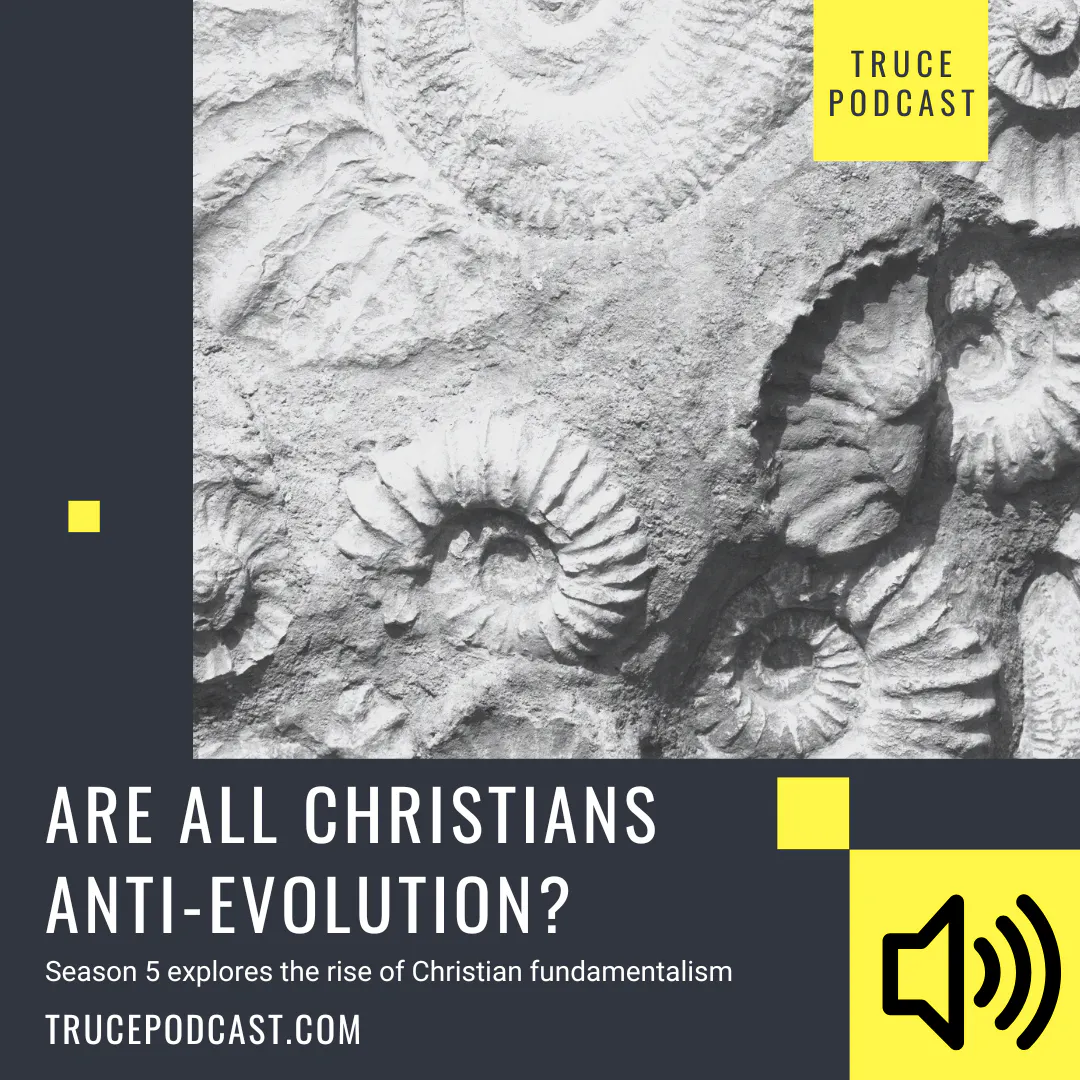
Are All Christians Anti-Evolution? | Christian Fundamentalism Series

Are All Christians Anti-Evolution? | Christian Fundamentalism Series

Author: Chris Staron February 7, 2023 Duration: 41:12
Give to help Truce! Donate here. In the 1600s, an Irish Archbishop named James Ussher did a bunch of math. The Bible is full of numbers and genealogies. He sat down and calculated that, in his opinion, the Bible dated creation at 4004 BC. According to Ussher, that is when God created man. That number has really stuck around! I gathered my small group together to explore the Adams Synchronological Chart. It is a 23-foot-long timeline of human history, beginning in 4004 BC and ending in 1900. There it was! The 4004 BC number! Which brings up an interesting question, right? What did Christians really believe about evolution just before it became a linchpin battle for fundamentalists? I turned to Edward Larson for answers. He's a professor at Pepperdine University and the author of the Pulitzer Prize-winning book "Summer for the Gods". The book chronicles the Scopes "Monkey" trial that we'll be covering in the next two episodes. But it also gives us a great introductory look at what Christians believed about evolution in the build-up to the trial. It turns out that evangelical Christians and even fundamentalists were all over the place when it came to ideas of evolution. Many Christians, like William Jennings Bryan, believed in an old earth and even some forms of evolution. But they thought that it was God who caused that evolution. Charles Darwin, though, said that evolution was a matter of chance adaptations, thus cutting God out of the equation. Fundamentalists like Bryan were determined to stop the spread of Darwinian evolution for that very reason. They believed that if young people were taught that they were the result of grand mistakes then what reason did they have to treat each other with respect? To be good citizens? Helpful Sources "Summer for the Gods" by Edward Larson "A Godly Hero" by Michael Kazin "The Birth of a Nation" on YouTube Article about James Ussher and his burial in Westminster Abbey Helpful article about Lamarck "The Evangelicals" by Francis Fitzgerald More about Henry Ford's Anti-Semitism An interesting article about "The Birth of a Nation" Discussion Questions: How did Cuvier and Lamarck differ in their ideas about evolution? Do you believe in a young or old earth? Do you believe in some evolution, macro-evolution, or no evolution at all? What is the best way to oppose an idea? When should we propose laws to combat ideas we don't like and when should we allow others to believe what they like? Do you think the fundamentalists were right to combat teaching evolution in schools? Now that you know about Bryan's failure to call out the KKK, what do you think of him? "Birth of a Nation" shaped American views about black people. Are there more modern films and series that have shaped society in similar ways? Or changed public opinion in other ways? Learn more about your ad choices. Visit podcastchoices.com/adchoices
Hosted by Chris Staron, Truce-History of the Christian Church is a deep, journalistic look into the forces that have shaped American evangelicalism. This isn't a simple timeline of events; it's an investigation into the surprising intersections of faith, culture, and power. Staron digs into movements from fundamentalism's roots to modern political campaigns, and even examines connections to phenomena like pyramid schemes, revealing a complex history many listeners may never have encountered. Each episode is built on thorough research and thoughtful interviews, aiming to understand not just how the church arrived at its current moment, but how that story might inform a better path forward. The current season focuses specifically on the rise of the Religious Right, meticulously tracing the evolving alliance between evangelicals and the Republican Party. To tell this story, the podcast features conversations with notable guests like historians Rick Perlstein and Frances Fitzgerald, or journalist Jesse Eisinger, who bring their expertise to this nuanced narrative. Listening to this podcast feels like joining a rigorous yet accessible conversation, one that respects the subject's gravity while pursuing clarity and truth. For anyone curious about the real stories behind today's headlines concerning faith and society, this series offers essential context.
Author: Language: English Episodes: 100

Truce - History of the Christian Church
Podcast Episodes
Republicans and Evangelicals I Women's Roundtable Book Discussion [not-audio_url] [/not-audio_url]

Duration: 50:19
Give to help Chris continue making Truce Betty Friedan's The Feminine Mystique kicked off second-wave feminism in the United States. The book was published in 1963 and addressed what she called "the problem that has no n…
Compelled - KKK Terrorist Finds Christ [not-audio_url] [/not-audio_url]

Duration: 33:07
Donate to help Chris make Truce In the 1960s, Tom Tarrants was a young man on a mission - to save America from Communism, Marxism, and desegregation. He was prepared to do anything, including joining the Ku Klux Klan, dr…
Chris Quits Driving A School Bus [not-audio_url] [/not-audio_url]

Duration: 3:55
Give to help Chris make Truce Paypal Venmo Patreon Help via check at: Chris Staron PO Box 3434 Jackson, WY 83001 Learn more about your ad choices. Visit podcastchoices.com/adchoices
Republicans and Evangelicals I Kanawha County Textbook War [not-audio_url] [/not-audio_url]

Duration: 34:35
Give to help Chris make Truce In 1974, Alice Moore was a member of the school board in Kanawha County, West Virginia. The board met to hear the recommendations of the textbook committee and approve them. But Alice protes…
Republicans and Evangelicals I The New Deal [not-audio_url] [/not-audio_url]

Duration: 36:14
Partner with us by donating at: www.trucepodcast.com/donate Something had to be done. The Great Depression meant the loss of a vast number of jobs and left families waiting on bread lines. Economists like John Meynard Ke…
