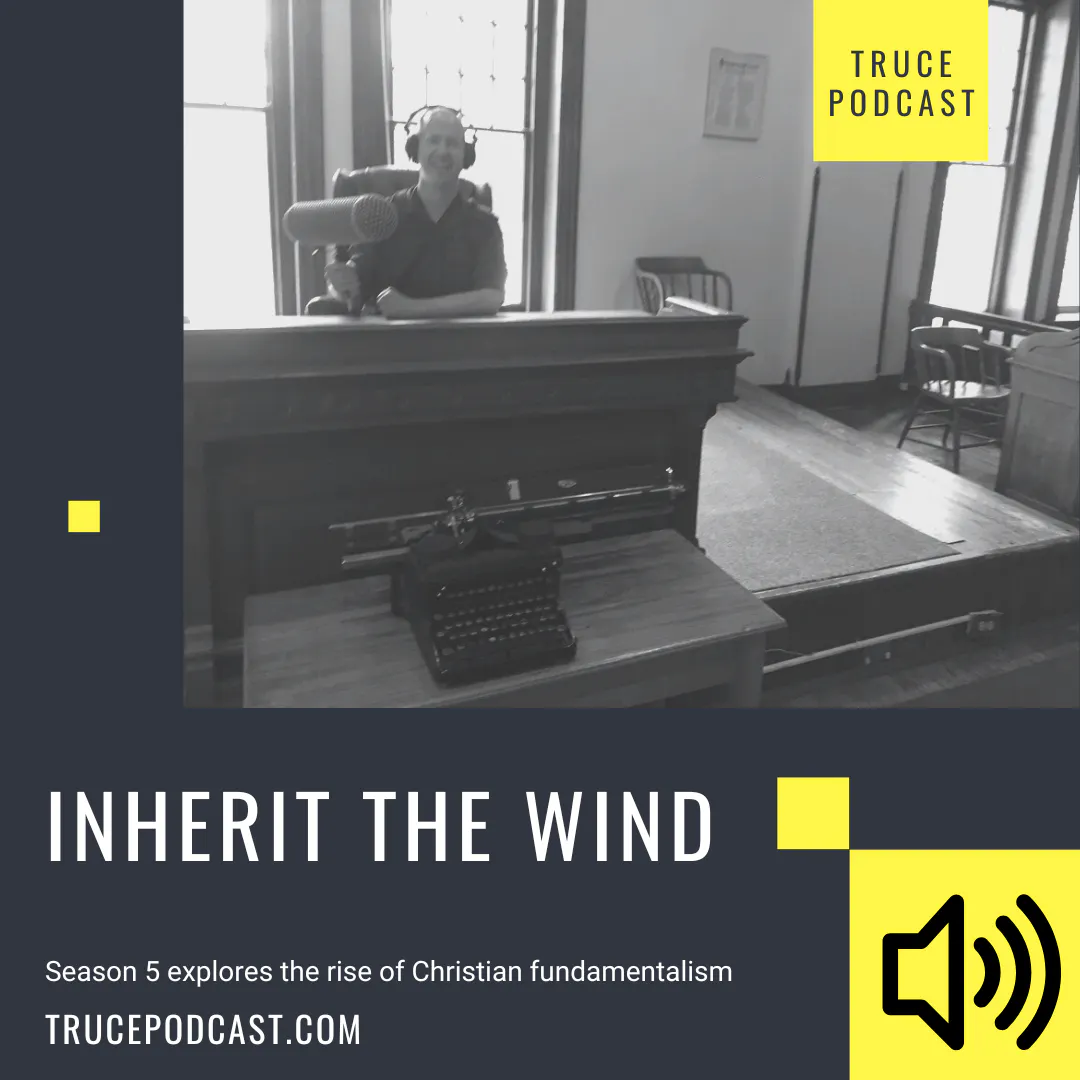
Inherit the Wind | Christian Fundamentalism Series
Author: Chris Staron
March 21, 2023
Duration: 44:01
US Senator Joseph McCarthy unleashed an era of suspicion on the American people as he went looking for communists. His trials, both public and behind closed doors, focused on the government as well as Hollywood and the Army. He claimed that he had lists of communists, but failed to produce that list. It wasn't until the Army-McCarthy hearings in the spring and summer of 1954 that his unfounded hearings were put to rest.
One year later the play Inherit the Wind opened. It was supposed to be a critique of the McCarthy era set inside of a re-telling of the Scopes "monkey" trial. In doing so, it got many of the facts wrong. John Scopes never spent any time in jail. He didn't have a girlfriend, and that girlfriend was not berated on the stand. The townspeople of Dayton, TN were welcoming to both Bryan and Darrow.
To explore this work of art and revisionist history I spoke with the hosts of the Seeing and Believing podcast Kevin McLenithan and Sarah Welch-Larson.
Select differences between the Scopes trial and Inherit the Wind
John Scopes was arrested but never spent time in jail.
He was "arrested" in a soda fountain where the test trial was conceived and not in school.
Scopes later claimed he never taught evolution, which is why he never took the stand in real life.
The entire case was set up as a publicity stunt to bring attention to the town of Dayton, TN. They got the idea when they saw an ad placed by the ACLU.
The character of Rachel did not exist in real life.
The people of Dayton were welcoming to both Darrow and Bryan and Scopes was loved by many. He even spent time swimming with the prosecution between trial sessions.
The moment when Bryan was on trial was held outdoors.
H.L. Mencken was not some loveable curmudgeon. He was an anti-semite and a racist.
Dayton largely did not vote for Bryan when he ran for president.
Bryan died a few days after the trial, not while in the courtroom.
Darrow did not carry a copy of the Bible and Darwin out of the courtroom.
The textbook in question during the trial was clearly pro-eugenics, was sold in the soda fountain, and had been approved by the state textbook committee.
The preachers of the town were kind. The odd sermon given the night of the trial never happened and the script adds a lot of strange things that are not in the Bible.
Bryan wished the law to have no penalty, unlike his stand-in in the movie who hoped for a harsher punishment.
Sources
Inherit the Wind (1960 version) starring Spencer Tracy
Summer for the Gods by Edward Larson
Chris' own visit to the Dayton museum dedicated to the trial
Helpful video about the Napoleon painting
Discussion Questions:
Where is the line between art and propaganda?
Does art have an obligation to the truth?
Do you see McCarthyism in Inherit the Wind?
Is Inherit the Wind a fair way of discussing the Scopes trial, or a work of revisionist history? Why does it matter?
What would it mean for a group that feels maligned and misunderstood to have a film misrepresent them?
Learn more about your ad choices. Visit podcastchoices.com/adchoices