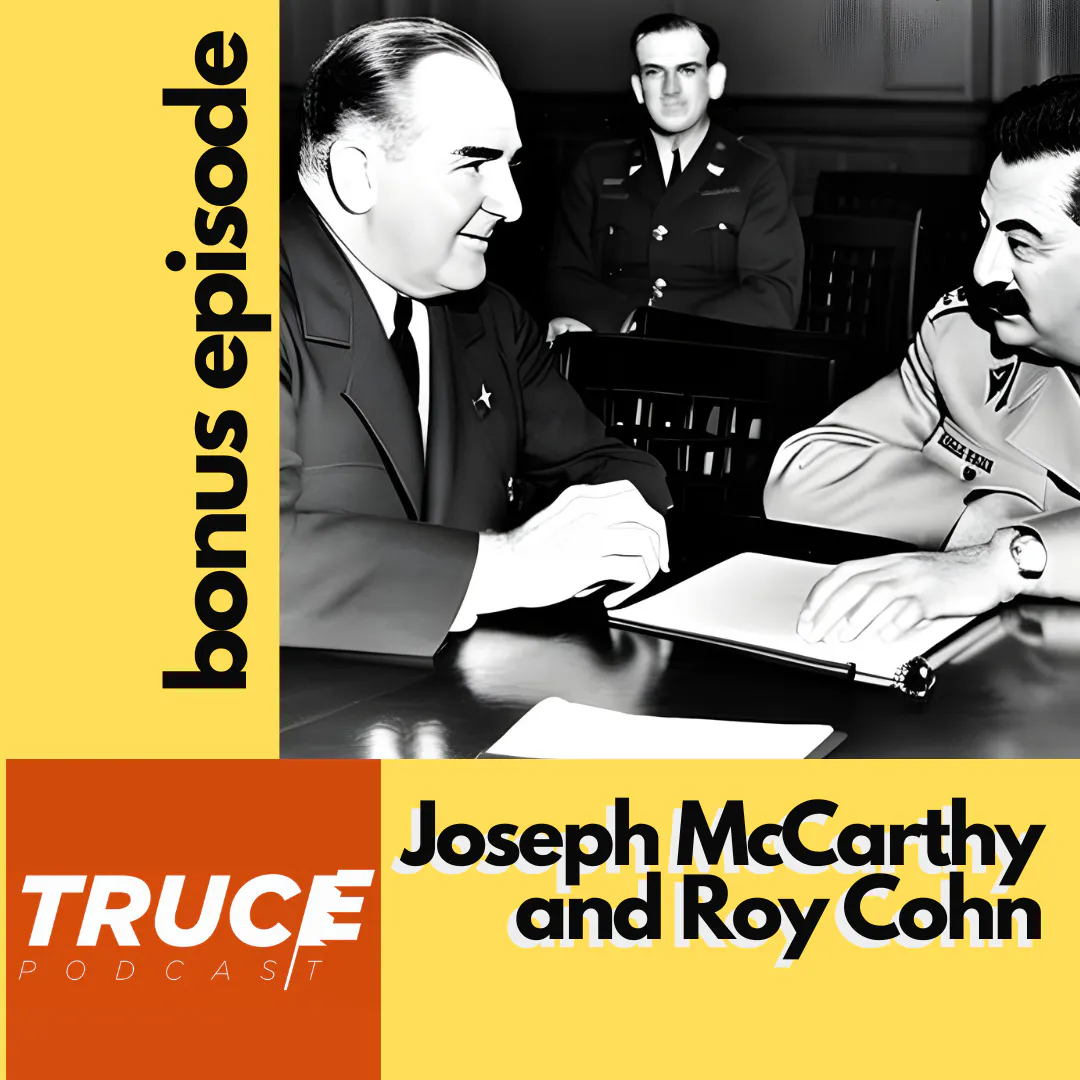
Joseph McCarthy and Roy Cohn (featuring Larry Tye, author of Demagogue)

Joseph McCarthy and Roy Cohn (featuring Larry Tye, author of Demagogue)

Author: Chris Staron September 12, 2023 Duration: 46:50
Give to help Chris make Truce! Joseph McCarthy was an unexceptional junior congressman from Wisconsin. He grew up brawling in the streets, playing cards, and embellishing his stories. Then, during a Lincoln Day address in 1950, Joseph McCarthy told an audience that he had a list of 205 communists working in the government. Within days, he was a household name. McCarthy started "investigating" suspected communists in the American government, focusing on the US State Department. Along the way, he brought in a young lawyer named Roy Cohn. Cohn was already known for his work sending Julius and Ethel Rosenberg to the electric chair. Now, he and McCarthy bullied and cajoled during private hearings. Being labeled a communist, or even a suspected communist could ruin a person's career. People committed suicide rather than face their scrutiny. Their reign lasted four years, ending in the televised broadcasts of the Army-McCarthy hearings in which a lawyer asked if McCarthy had any decency. That was pretty much it for McCarthy. But Roy Cohn went on to have a well-connected career, providing legal services for the mob and Rupert Murdoch, owner of Fox News. He also became a mentor to a young real estate mogul named Donald Trump. Famous people like Andy Warhol attended his birthday party at Studio 54. Cohn died of AIDS, something that was killing gay men rapidly in the 1980s, though he denied he ever had it. This is the story of two men allowed to prey on the fears of the American people for their own gain. One fell hard, the other found himself fighting against his own people. In this episode, Chris interviews Larry Tye, author of the book "Demagogue". He's also the author of "Satchel: The Life and Times of an American Legend" and "Bobby Kennedy: The Making of a Liberal Icon". Sources: "Demagogue" by Larry Tye Helpful article about the Rosenbergs Article about Klaus Fuchs McCarthy's speech in Wheeling, WV New York Times, February 23, 1954. Pages 16-17 “Transcript of General Zwicker's Testimony Before the McCarthy Senate Subcommittee” Video from Army-McCarthy hearings (forward to the last 20 minutes if you want to jump to the stuff I used) The guest list for Roy Cohn's birthday at Studio 54 Discussion Questions: Why do we love demagogues? Who are other demagogues in American history? The threat of communists in the government in the 1950s is sometimes downplayed. Do you think it was a real concern? McCarthy ran for Congress in an illegal way while still in the Marines. How do you feel about that? Roy Cohn sometimes went against his own people, claiming that gay people did not deserve equal rights. What might have been his motivation? Do you see any crossover between McCarthy, Cohn, and Donald Trump? Cohn died of AIDs in the 1980s when the disease was at its peak. Why might he have wanted to keep his illness a secret? Learn more about your ad choices. Visit podcastchoices.com/adchoices
Hosted by Chris Staron, Truce-History of the Christian Church is a deep, journalistic look into the forces that have shaped American evangelicalism. This isn't a simple timeline of events; it's an investigation into the surprising intersections of faith, culture, and power. Staron digs into movements from fundamentalism's roots to modern political campaigns, and even examines connections to phenomena like pyramid schemes, revealing a complex history many listeners may never have encountered. Each episode is built on thorough research and thoughtful interviews, aiming to understand not just how the church arrived at its current moment, but how that story might inform a better path forward. The current season focuses specifically on the rise of the Religious Right, meticulously tracing the evolving alliance between evangelicals and the Republican Party. To tell this story, the podcast features conversations with notable guests like historians Rick Perlstein and Frances Fitzgerald, or journalist Jesse Eisinger, who bring their expertise to this nuanced narrative. Listening to this podcast feels like joining a rigorous yet accessible conversation, one that respects the subject's gravity while pursuing clarity and truth. For anyone curious about the real stories behind today's headlines concerning faith and society, this series offers essential context.
Author: Language: English Episodes: 100

Truce - History of the Christian Church
Podcast Episodes
Populism | Christian Fundamentalism Series [not-audio_url] [/not-audio_url]

Duration: 40:04
Give to help Truce. www,trucepodcast.com/donate Populism is a tricky subject. We use it these days as a slur, but populism can be a useful phenomenon. History professor and author Michael Kazin says that populism is an i…
The Gold Standard and the Great Depression [not-audio_url] [/not-audio_url]

Duration: 14:19
The Great Depression. Some say that it was caused by a failure of the stock market. Well... that's not all. Jacob Goldstein, host of NPR's Planet Money podcast and author of "Money: the Truce Story of a Made-Up Thing" jo…
The Gold Standard | Christian Fundamentalism Series [not-audio_url] [/not-audio_url]

Duration: 33:15
There was a time not so long ago when the value of an ounce of gold cost $20.67. That was true not just in one moment or one year. It was true in the 1880s, 1890s, 1900s, 1920s... This was the gold standard. A person cou…
The Liberals | Christian Fundamentalism Series [not-audio_url] [/not-audio_url]

Duration: 39:13
George Marsden characterized Christian fundamentalism as "militantly anti-modernist protestant evangelicalism". Right there you see that fundamentalism is a reaction against something. And that something is modernist the…
The End of Reconstruction | Christian Fundamentalism Series [not-audio_url] [/not-audio_url]

Duration: 27:06
The 1800s were a time of milking cows and going to the county fair. Sure... but what else? We tend to think of this century as a quiet, pastoral era when people were friendly and life was simple. But the 1800s were a cra…

«1...678910