Republicans and Evangelicals | George Wallace

Republicans and Evangelicals | George Wallace

Author: Chris Staron September 9, 2025 Duration: 1:04:06
Give to help Chris continue to make Truce George Wallace was, as historian Dan Carter put it, "the most influential loser in American history". He was the governor of Alabama and lost multiple bids for president of the United States. In the process, he spread his racist views throughout the country. Wallace is a vitally important figure in American history. His success in pulling in votes from racists attracted the attention of establishment politicians. He showed men like Richard Nixon that there was a significant voting bloc out there willing to vote based just on their fears about race. In this episode, Chris speaks with historian and author Dan T. Carter about his book The Politics of Rage. Wallace Bio (AI Generated) George Corley Wallace Jr., born on August 25, 1919, in Clio, Alabama, rose to prominence as a controversial figure in American politics. A graduate of the University of Alabama School of Law in 1942, he served in the U.S. Army Air Forces during World War II. After the war, Wallace embarked on a political career, serving in the Alabama House of Representatives from 1947 to 1953 and as a circuit court judge until 1959. His early political endeavors were marked by a moderate stance on racial issues. However, his political trajectory shifted dramatically in the early 1960s. In 1962, Wallace was elected governor of Alabama, campaigning on a platform of staunch segregationism. His infamous declaration, "Segregation now, segregation tomorrow, segregation forever," during his inaugural address in 1963, epitomized his commitment to maintaining racial segregation. That same year, he attempted to block the enrollment of African American students, Vivian Malone and James Hood, at the University of Alabama, an event that became known as the "Stand in the Schoolhouse Door." This act of defiance against federal desegregation efforts brought national attention to Wallace and solidified his reputation as a symbol of resistance to civil rights advancements. Wallace's political influence extended beyond state politics. In 1968, he ran for president as the candidate of the American Independent Party, advocating for states' rights and appealing to disaffected white voters. He carried five Southern states and secured 13.5% of the national vote, demonstrating significant support for his segregationist views on a national scale. Despite his presidential aspirations, Wallace's influence remained strongest in Alabama, where he served multiple non-consecutive terms as governor. A pivotal moment in Wallace's life occurred in 1972 during his campaign for the Democratic presidential nomination. While campaigning in Laurel, Maryland, he was shot by Arthur Bremer, leaving him permanently paralyzed from the waist down. Despite this setback, Wallace returned to Alabama politics, winning the gubernatorial election in 1974. His later years in office were characterized by a shift in his political ideology, as he sought to distance himself from his earlier segregationist positions. Sources: The Politics of Rage by Dan T. Carter National Park Service article about the 16th Street Baptist Church Curtis LeMary's announcement speech History.com article about George Wallace being shot Nixon Library audio tapes collection Nixon talking about Wallace on tape Rolling Stone magazine, October 24, 1974, “The Ministry of George Wallace” by Joe Klein. Questions: Had you heard of George Wallace before? Why was Wallace important? How did Wallace's moderate successes change politics in his era? One prominent person speaking negatively about another race can significantly impact public opinion. How could his bloviating give permission to white people in the north to be openly racist? Learn more about your ad choices. Visit podcastchoices.com/adchoices

Hosted by Chris Staron, Truce-History of the Christian Church is a deep, journalistic look into the forces that have shaped American evangelicalism. This isn't a simple timeline of events; it's an investigation into the surprising intersections of faith, culture, and power. Staron digs into movements from fundamentalism's roots to modern political campaigns, and even examines connections to phenomena like pyramid schemes, revealing a complex history many listeners may never have encountered. Each episode is built on thorough research and thoughtful interviews, aiming to understand not just how the church arrived at its current moment, but how that story might inform a better path forward. The current season focuses specifically on the rise of the Religious Right, meticulously tracing the evolving alliance between evangelicals and the Republican Party. To tell this story, the podcast features conversations with notable guests like historians Rick Perlstein and Frances Fitzgerald, or journalist Jesse Eisinger, who bring their expertise to this nuanced narrative. Listening to this podcast feels like joining a rigorous yet accessible conversation, one that respects the subject's gravity while pursuing clarity and truth. For anyone curious about the real stories behind today's headlines concerning faith and society, this series offers essential context.
Author: Language: English Episodes: 100

Truce - History of the Christian Church
Podcast Episodes
Season 6 Update [not-audio_url] [/not-audio_url]

Duration: 3:10
Season 5 of the Truce Podcast was a blast! I'm hard at work on season 6, which will discuss how American evangelicals got tied to the Republican Party. It is already coming together so well! I can't wait to share it with…
Takeaway #5 - The Only Thing We Have to Fear [not-audio_url] [/not-audio_url]

Duration: 15:45
Give to support the Truce Podcast On March 4, 1933, FDR delivered his inaugural address. In it, he used the phrase "the only thing we have to fear is fear itself". I did a little searching and this phrase is used a LOT i…
Takeaway #4 - We Are A People of the Means [not-audio_url] [/not-audio_url]

Duration: 37:14
Love Truce? Give a little to help support the show! "The ends justify the means" is a phrase we hear occasionally. Often it is used to justify bad behavior, so long as it creates a profitable outcome. But we Christians k…
Takeaway #3 - The Great Divorce [not-audio_url] [/not-audio_url]

Duration: 14:43
Give a little to help Chris continue to make Truce! In 1945, C.S. Lewis published his excellent book "The Great Divorce". It happens to be one of my favorite books. It has many themes, the biggest of which is that there…
Takeaway #2 - Extremes Lead to Extremes [not-audio_url] [/not-audio_url]

Duration: 12:39
In the fall of 1814, the powers of Europe gathered together to discuss what to do with the continent after the Napoleonic Wars. Napoleon had changed a lot in his time in power! He cowed the Roman Catholic Church, ended s…
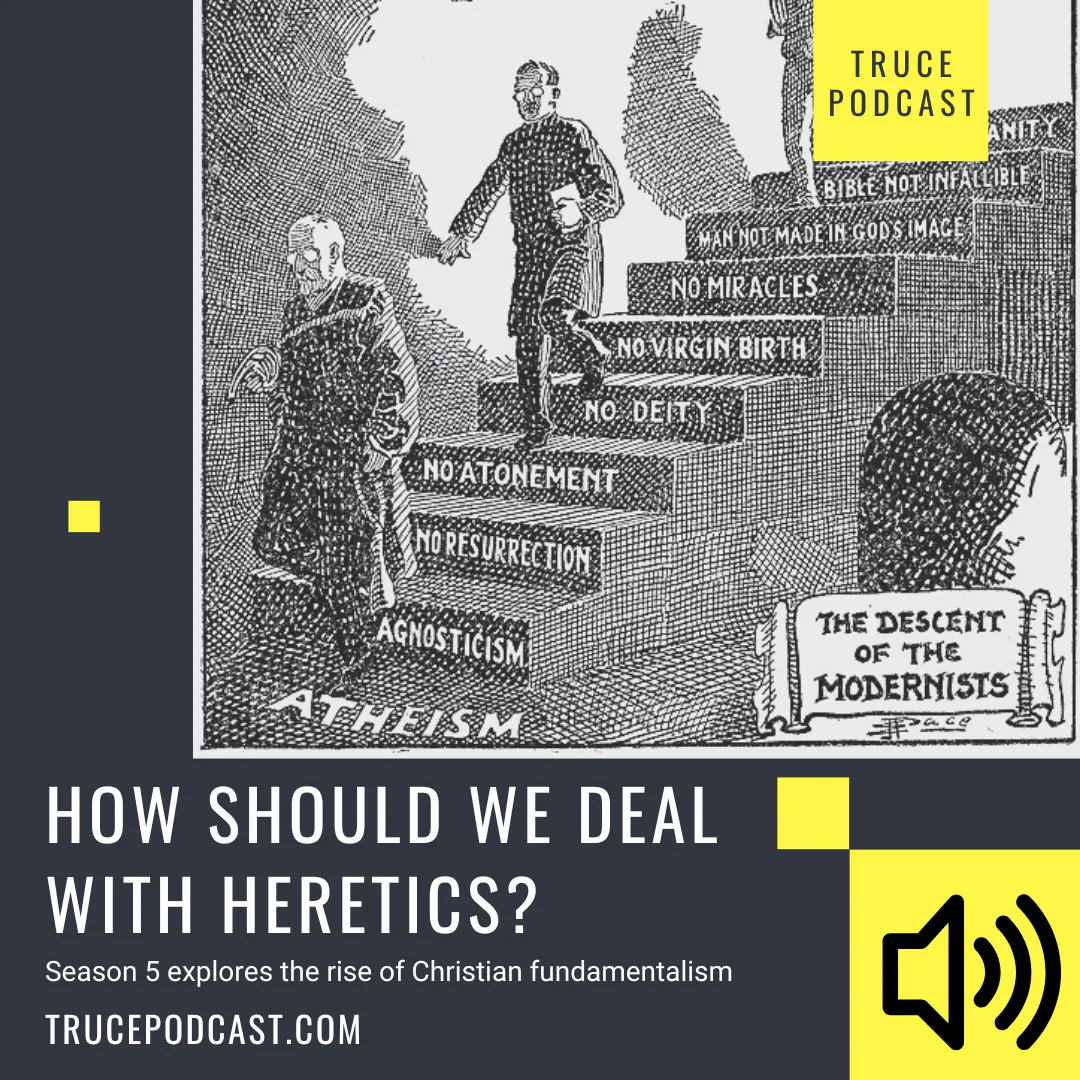
Takeaway #1 - How Should We Deal With Heretics? [not-audio_url] [/not-audio_url]

Duration: 19:58
Donate to help Chris make Truce! The first-century Christian Church had a lot going on. Their Savior died and was resurrected, sending the Holy Spirit and leaving them with the command to take this new message to all tri…
Inherit the Wind | Christian Fundamentalism Series [not-audio_url] [/not-audio_url]

Duration: 44:01
US Senator Joseph McCarthy unleashed an era of suspicion on the American people as he went looking for communists. His trials, both public and behind closed doors, focused on the government as well as Hollywood and the A…
The Scopes "Monkey" Trial Part Two | Christian Fundamentalism Series [not-audio_url] [/not-audio_url]

Duration: 38:24
Love Truce?? Donate to keep the show going! The trial was basically over. The prosecution won. John Scopes was moments away from being convicted of teaching evolution in Dayton, Tennessee. The ACLU and the prosecution ha…
The Scopes "Monkey" Trial Part One | Christian Fundamentalism Series [not-audio_url] [/not-audio_url]

Duration: 36:38
Give to help Chris do Truce full time! Tennessee was the first state in the United States to crack down hard on the teaching of evolution in public schools. Others had dabbled, but Tennessee went all the way. The ACLU wa…
Are All Christians Anti-Evolution? | Christian Fundamentalism Series [not-audio_url] [/not-audio_url]

Duration: 41:12
Give to help Truce! Donate here. In the 1600s, an Irish Archbishop named James Ussher did a bunch of math. The Bible is full of numbers and genealogies. He sat down and calculated that, in his opinion, the Bible dated cr…