Republicans and Evangelicals I Jerry Falwell (part 1)
Author: Chris Staron
November 18, 2025
Duration: 40:08
Give to help Chris make Truce
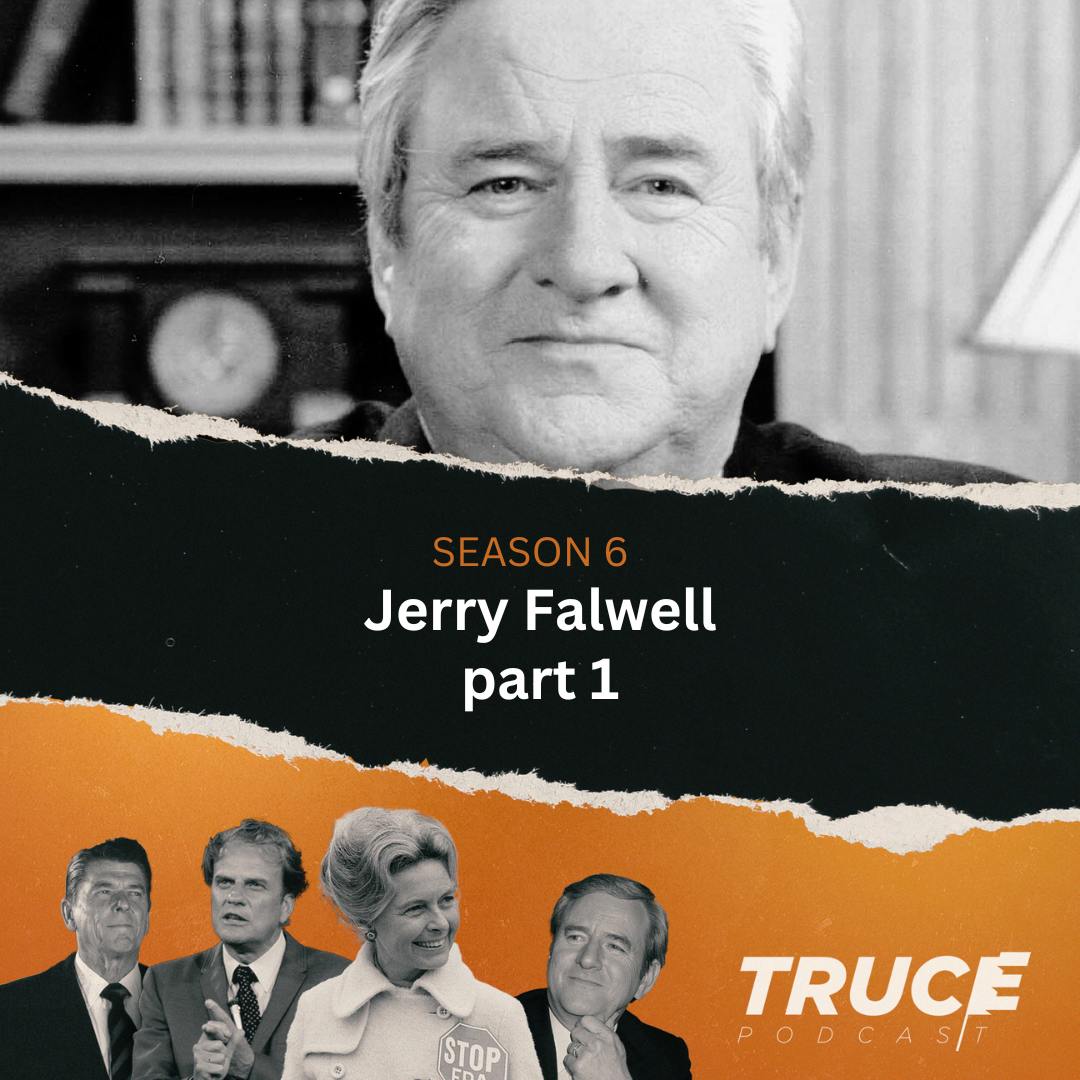
Jerry Falwell was a prominent American pastor, televangelist, and conservative political activist whose life and ministry had a significant impact on American evangelicalism and politics. Born on August 11, 1933, in Lynchburg, Virginia, Falwell grew up in a family that was not particularly religious. However, after becoming a Christian during his college years, he dedicated his life to ministry. He attended Baptist Bible College in Missouri, where he developed the theological convictions that would shape his future work. In 1956, at the age of 22, he returned to his hometown to found the Thomas Road Baptist Church, beginning his long journey as a spiritual and cultural leader.
Falwell’s ministry expanded rapidly through the use of media. He launched the “Old-Time Gospel Hour” television program, which gained national attention and allowed him to reach millions of viewers. His style combined traditional evangelical preaching with a strong emphasis on conservative values. The success of his broadcast ministry helped him establish a broad base of support and financial backing, enabling the growth of both his church and other initiatives. By the 1970s, Falwell had become one of the most recognizable faces of American evangelicalism.
In 1971, Falwell founded Liberty University in Lynchburg.
Perhaps Falwell’s most politically influential move came in 1979 with the founding of the Moral Majority, an organization that mobilized conservative Christians to become involved in American politics. Through the Moral Majority, Falwell encouraged evangelicals to support Republican candidates who aligned with their views on issues like abortion, school prayer, and family values. The group played a crucial role in the election of Ronald Reagan in 1980, signaling a new era of religious involvement in American political life. Falwell's efforts helped to solidify the alliance between evangelical Christians and the Republican Party that persists to this day.
Falwell’s outspoken views often sparked controversy. He was a staunch opponent of abortion, LGBTQ rights, and the feminist movement, and he frequently spoke out against what he saw as the moral decline of American society. Critics accused him of promoting intolerance and mixing religion with politics in divisive ways. Nevertheless, his supporters praised him for standing up for biblical principles and being unafraid to speak his mind in a secularizing culture. Falwell saw himself as a defender of traditional American and Christian values, even as the country grew increasingly polarized.
Jerry Falwell died on May 15, 2007.
My guest for this episode is Daniel K Williams, author of God's Own Party.
Sources:
God's Own Party by Daniel K Williams
American Sermons: The Pilgrims to Martin Luther King Jr. (for the Danforth sermon)
I first heard the Danforth sermon mentioned on the Now and Then podcast
The Evangelicals by Frances Fitzgerald
Falwell: An Autobiography by Jerry Falwell
Falwell's "Ministers and Marchers" sermon
Discussion Questions
What do you think of Danforth's sermon? Why is it important to understand that preachers have been concerned about the US since before it became a country?
Why is it valuable to understand Falwell's early opposition to integration?
We know that much of the season is related to education. Why is it significant that Falwell was an educator?
How should we as a society adapt when a leader repents of their racism?
What role did Frances Schaeffer play in shaping Falwell?
Learn more about your ad choices. Visit podcastchoices.com/adchoices