Republicans and Evangelicals I William F. Buckley Jr. and National Review

Republicans and Evangelicals I William F. Buckley Jr. and National Review

Author: Chris Staron March 4, 2025 Duration: 43:01
Give to help Chris continue the Truce Podcast. Senator Robert Taft couldn't get the nomination. He tried to be the GOP's nominee for president three different times but could not get elected. Conservative Republicans' failure to get nominated by their own party was a source of much frustration. What could they do? Concerns of conspiracy spread through people like Phyllis Schlafly whose book A Choice Not an Echo claimed that "elites" were steering the party. It was into this world that a bright young man with an untraceable accent found his appeal. William F. Buckley Jr. was born into a wealthy family that was deeply Catholic and driven by concern over the New Deal. They were libertarians and wanted a small government. Buckley lived a childhood of privilege, riding horses, playing piano, and mostly private education. His first book, God and Man at Yale, was a sharp critique of his alma mater, stating that they should have done a better job promoting laissez-faire economics and religion. The book was a smash hit, in part, because Yale fought its charges in the press. Buckley followed it with a rousing defense of Senator Joseph McCarthy's tactics in the early 1950s, but the book was published just as the senator was revealed to be the demagogue he was. So Buckley decided to shift his effort to creating a journal of opinion that would appeal to conservatives. National Review became the "it" publication for conservatism in the US, and the most successful journal of opinion in the country. Its greatest impact was giving conservatism an intellectual voice in an era when the "liberal consensus" dominated. Buckley then went on to start in the PBS television show Firing Line, a funny thing for a libertarian because the show was sponsored, in part, through government funding. Buckley succeeded in giving conservatism an intellectual voice. In the process, he won his greatest victory: convincing Ronald Reagan to become a conservative. Sources Buckley: William F Buckley Jr. and the Rise of American Conservatism by Cart T. Bogus. The Rise and Fall of Modern American Conservatism by David Farber Burning Down the House by Andrew Koppelman https://www.youtube.com/watch?v=BYgv7ur8ipg&t=3018s Firing Line Episode 113, September 3 1968 Before the Storm: Barry Goldwater and the Unmaking of the American Consensus by Rick Perlstein God and Man at Yale by William F. Buckley Jr Heather Cox Richardson's YouTube series on the history of the GOP National Review. 1st edition, November 19, 1955. Page 6 (gives a helpful breakdown of what the magazine stands for) Hoover Institution article on the impact of Buckley and Firing Line Reaganland by Rick Perlstein The Incomparable Mr. Buckley documentary Discussion Questions Do you have any personal connection with Buckley? Did you see his shows or read his writings? Why did conservatism need an intellectual voice? How did conservatism change between Bob Taft and Buckley? Buckley believed in a limited government, one that incorporated Christianity. Would you like his version of the American government? Buckley claimed that he wasn't racist, but believed that black people were incapable of governing themselves. That they should earn the right to vote in the South. Is this racism? National Review welcomed segregationists to write in the journal. Would you read a publication like this? Buckley advocated for a smaller government but also stared in a TV show on public television. Does this strike you as hypocrisy? Learn more about your ad choices. Visit podcastchoices.com/adchoices

Hosted by Chris Staron, Truce-History of the Christian Church is a deep, journalistic look into the forces that have shaped American evangelicalism. This isn't a simple timeline of events; it's an investigation into the surprising intersections of faith, culture, and power. Staron digs into movements from fundamentalism's roots to modern political campaigns, and even examines connections to phenomena like pyramid schemes, revealing a complex history many listeners may never have encountered. Each episode is built on thorough research and thoughtful interviews, aiming to understand not just how the church arrived at its current moment, but how that story might inform a better path forward. The current season focuses specifically on the rise of the Religious Right, meticulously tracing the evolving alliance between evangelicals and the Republican Party. To tell this story, the podcast features conversations with notable guests like historians Rick Perlstein and Frances Fitzgerald, or journalist Jesse Eisinger, who bring their expertise to this nuanced narrative. Listening to this podcast feels like joining a rigorous yet accessible conversation, one that respects the subject's gravity while pursuing clarity and truth. For anyone curious about the real stories behind today's headlines concerning faith and society, this series offers essential context.
Author: Language: English Episodes: 100

Truce - History of the Christian Church
Podcast Episodes
Season 6 Update [not-audio_url] [/not-audio_url]

Duration: 3:10
Season 5 of the Truce Podcast was a blast! I'm hard at work on season 6, which will discuss how American evangelicals got tied to the Republican Party. It is already coming together so well! I can't wait to share it with…
Takeaway #5 - The Only Thing We Have to Fear [not-audio_url] [/not-audio_url]

Duration: 15:45
Give to support the Truce Podcast On March 4, 1933, FDR delivered his inaugural address. In it, he used the phrase "the only thing we have to fear is fear itself". I did a little searching and this phrase is used a LOT i…
Takeaway #4 - We Are A People of the Means [not-audio_url] [/not-audio_url]

Duration: 37:14
Love Truce? Give a little to help support the show! "The ends justify the means" is a phrase we hear occasionally. Often it is used to justify bad behavior, so long as it creates a profitable outcome. But we Christians k…
Takeaway #3 - The Great Divorce [not-audio_url] [/not-audio_url]

Duration: 14:43
Give a little to help Chris continue to make Truce! In 1945, C.S. Lewis published his excellent book "The Great Divorce". It happens to be one of my favorite books. It has many themes, the biggest of which is that there…
Takeaway #2 - Extremes Lead to Extremes [not-audio_url] [/not-audio_url]

Duration: 12:39
In the fall of 1814, the powers of Europe gathered together to discuss what to do with the continent after the Napoleonic Wars. Napoleon had changed a lot in his time in power! He cowed the Roman Catholic Church, ended s…
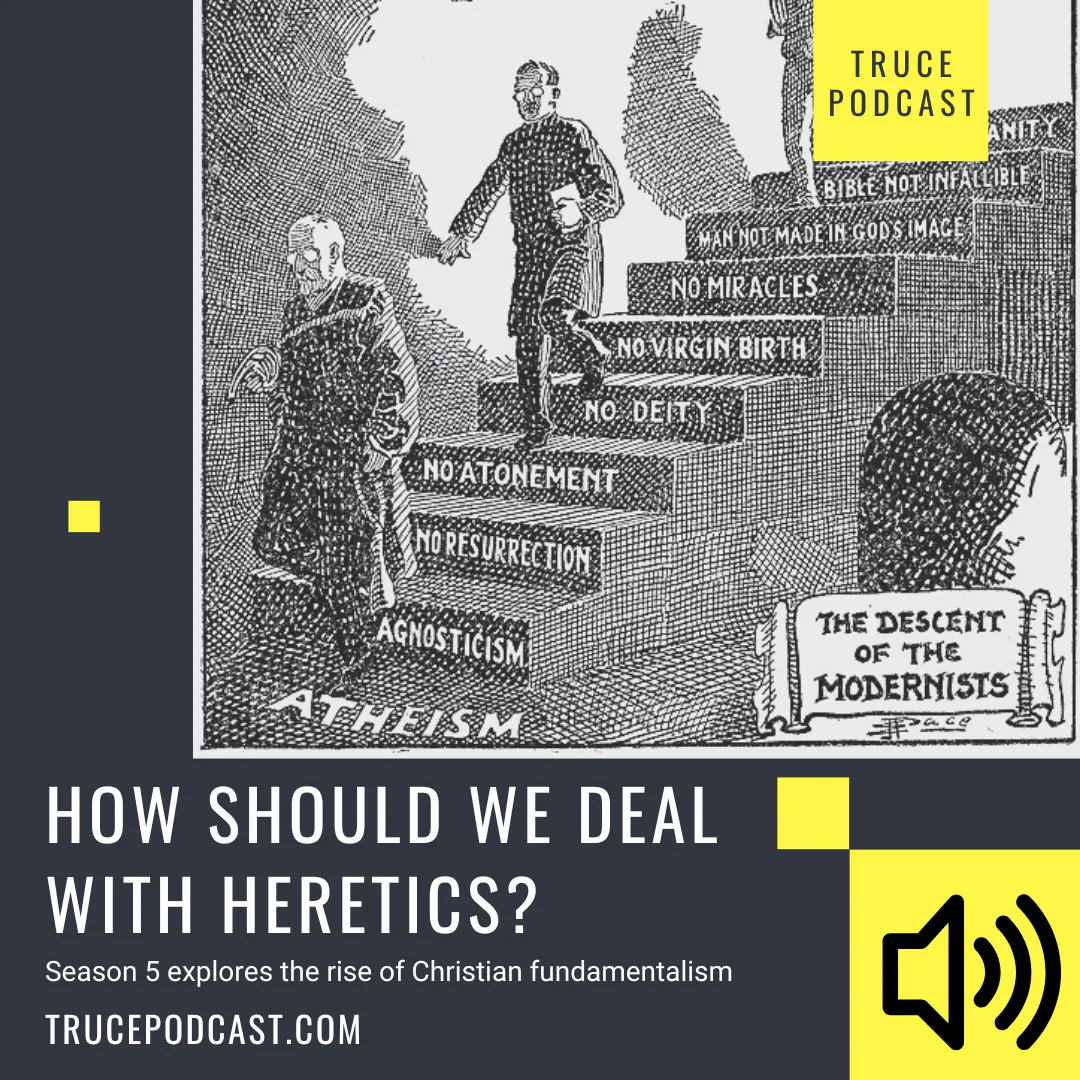
Takeaway #1 - How Should We Deal With Heretics? [not-audio_url] [/not-audio_url]

Duration: 19:58
Donate to help Chris make Truce! The first-century Christian Church had a lot going on. Their Savior died and was resurrected, sending the Holy Spirit and leaving them with the command to take this new message to all tri…
Inherit the Wind | Christian Fundamentalism Series [not-audio_url] [/not-audio_url]

Duration: 44:01
US Senator Joseph McCarthy unleashed an era of suspicion on the American people as he went looking for communists. His trials, both public and behind closed doors, focused on the government as well as Hollywood and the A…
The Scopes "Monkey" Trial Part Two | Christian Fundamentalism Series [not-audio_url] [/not-audio_url]

Duration: 38:24
Love Truce?? Donate to keep the show going! The trial was basically over. The prosecution won. John Scopes was moments away from being convicted of teaching evolution in Dayton, Tennessee. The ACLU and the prosecution ha…
The Scopes "Monkey" Trial Part One | Christian Fundamentalism Series [not-audio_url] [/not-audio_url]

Duration: 36:38
Give to help Chris do Truce full time! Tennessee was the first state in the United States to crack down hard on the teaching of evolution in public schools. Others had dabbled, but Tennessee went all the way. The ACLU wa…
Are All Christians Anti-Evolution? | Christian Fundamentalism Series [not-audio_url] [/not-audio_url]

Duration: 41:12
Give to help Truce! Donate here. In the 1600s, an Irish Archbishop named James Ussher did a bunch of math. The Bible is full of numbers and genealogies. He sat down and calculated that, in his opinion, the Bible dated cr…