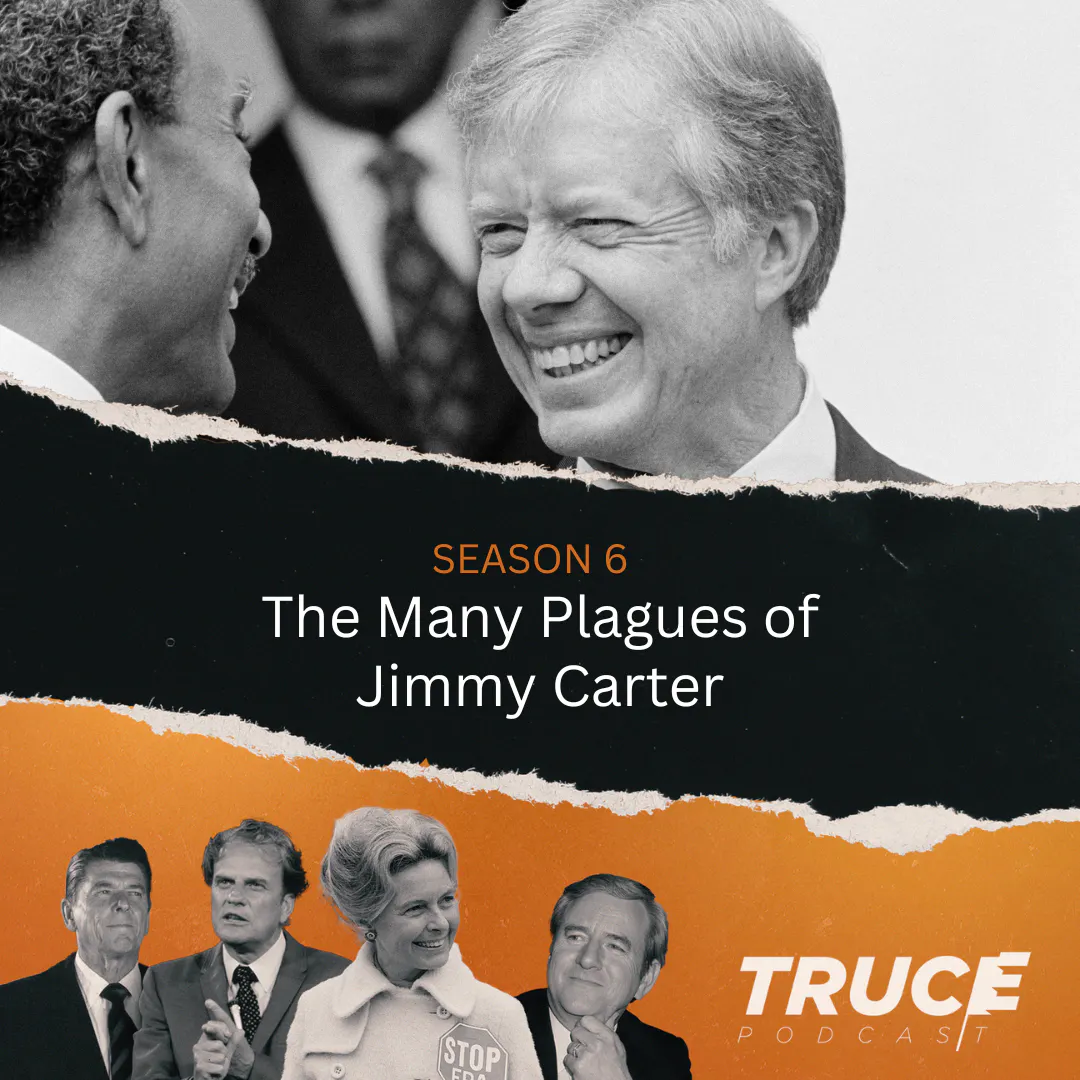
Republicans and Evangelicals | The Many Plagues of Jimmy Carter

Republicans and Evangelicals | The Many Plagues of Jimmy Carter

Author: Chris Staron March 10, 2026 Duration: 43:48
Give to help Chris make Truce President Jimmy Carter's presidency (1977–1981) faced several major challenges, both domestically and internationally. One of the biggest domestic issues was the struggling U.S. economy. Carter inherited high inflation and unemployment, problems that worsened during his term. The country experienced "stagflation" — a combination of stagnant economic growth and high inflation. The energy crisis, marked by oil shortages and skyrocketing gas prices, further fueled economic instability. Though Carter promoted energy conservation and alternative energy development, many Americans viewed his efforts as inadequate or overly pessimistic. Internationally, Carter faced major challenges in foreign policy. One of the most significant was the Iran Hostage Crisis, which began in November 1979 when 52 American diplomats and citizens were taken hostage at the U.S. Embassy in Tehran. The crisis lasted 444 days and was a major blow to Carter’s administration, especially after a failed rescue attempt. It deeply affected U.S. relations with Iran and damaged public confidence in Carter’s leadership. Though Carter did achieve a major diplomatic success with the Camp David Accords — a peace agreement between Egypt and Israel — the Iran Hostage Crisis ultimately overshadowed much of his foreign policy work. Another major issue during Carter’s presidency was a perceived lack of effective leadership. Carter, known for his integrity and moral outlook, struggled to build strong relationships with Congress and the media. He often took a technocratic, detail-oriented approach to governing, which alienated many political allies. Critics saw his administration as indecisive and overly focused on long-term goals rather than immediate results. These perceptions contributed to a loss of public confidence and were a key factor in his defeat by Ronald Reagan in the 1980 presidential election. The special guest for this episode is historian and author Rick Perlstein. Sources: Phyllis Schlafly's debate with Buckley Reaganland by Rick Perlstein Slate story on Chisholm Video showing Carter's opposition to integrated busing Reagan by Bob Spitz The Invisible Bridge by Rick Perlstein These Truths by Jill Lepore Crash Course by Paul Ingrassia C-SPAN clip of Carter's malaise speech Who is Government? by Michael Lewis Discussion Questions: What do you find appealing about Carter? How do voters sometimes use issues that are beyond a politician's control to judge them? Why would Carter and his predecessors choose to give the Panama Canal to Panama? How would an event like the hostage crisis impact an election? Learn more about your ad choices. Visit podcastchoices.com/adchoices

Hosted by Chris Staron, Truce-History of the Christian Church is a deep, journalistic look into the forces that have shaped American evangelicalism. This isn't a simple timeline of events; it's an investigation into the surprising intersections of faith, culture, and power. Staron digs into movements from fundamentalism's roots to modern political campaigns, and even examines connections to phenomena like pyramid schemes, revealing a complex history many listeners may never have encountered. Each episode is built on thorough research and thoughtful interviews, aiming to understand not just how the church arrived at its current moment, but how that story might inform a better path forward. The current season focuses specifically on the rise of the Religious Right, meticulously tracing the evolving alliance between evangelicals and the Republican Party. To tell this story, the podcast features conversations with notable guests like historians Rick Perlstein and Frances Fitzgerald, or journalist Jesse Eisinger, who bring their expertise to this nuanced narrative. Listening to this podcast feels like joining a rigorous yet accessible conversation, one that respects the subject's gravity while pursuing clarity and truth. For anyone curious about the real stories behind today's headlines concerning faith and society, this series offers essential context.
Author: Language: English Episodes: 100

Truce - History of the Christian Church
Podcast Episodes
Populism | Christian Fundamentalism Series [not-audio_url] [/not-audio_url]

Duration: 40:04
Give to help Truce. www,trucepodcast.com/donate Populism is a tricky subject. We use it these days as a slur, but populism can be a useful phenomenon. History professor and author Michael Kazin says that populism is an i…
The Gold Standard and the Great Depression [not-audio_url] [/not-audio_url]

Duration: 14:19
The Great Depression. Some say that it was caused by a failure of the stock market. Well... that's not all. Jacob Goldstein, host of NPR's Planet Money podcast and author of "Money: the Truce Story of a Made-Up Thing" jo…
The Gold Standard | Christian Fundamentalism Series [not-audio_url] [/not-audio_url]

Duration: 33:15
There was a time not so long ago when the value of an ounce of gold cost $20.67. That was true not just in one moment or one year. It was true in the 1880s, 1890s, 1900s, 1920s... This was the gold standard. A person cou…
The Liberals | Christian Fundamentalism Series [not-audio_url] [/not-audio_url]

Duration: 39:13
George Marsden characterized Christian fundamentalism as "militantly anti-modernist protestant evangelicalism". Right there you see that fundamentalism is a reaction against something. And that something is modernist the…
The End of Reconstruction | Christian Fundamentalism Series [not-audio_url] [/not-audio_url]

Duration: 27:06
The 1800s were a time of milking cows and going to the county fair. Sure... but what else? We tend to think of this century as a quiet, pastoral era when people were friendly and life was simple. But the 1800s were a cra…

«1...678910