Takeaway #5 - The Only Thing We Have to Fear

Takeaway #5 - The Only Thing We Have to Fear

Author: Chris Staron June 13, 2023 Duration: 15:45
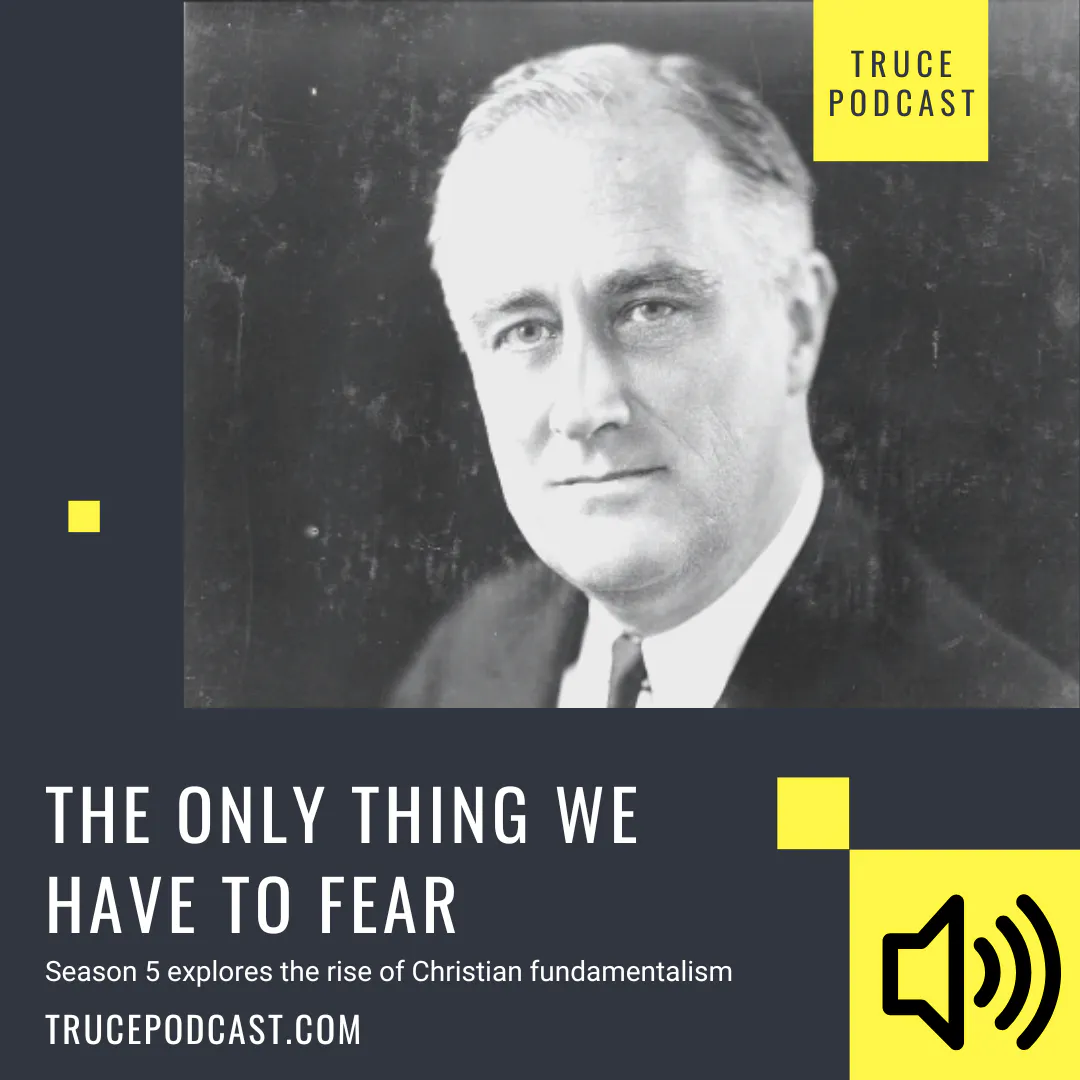
Give to support the Truce Podcast On March 4, 1933, FDR delivered his inaugural address. In it, he used the phrase "the only thing we have to fear is fear itself". I did a little searching and this phrase is used a LOT in Christian books. So often. But it almost always refers to the fear one person has in their heart. In reality, it is a comment on collective fear. The Great Depression started in 1929 and was exacerbated by a bank run in which Americans lost faith in the value of our currency and the banking systems. That is an important distinction. FDR's speech is about collective fear. As I've contemplated the modernist/fundamentalist debate this season, I keep returning to the idea of fear, not in the US economy but in God's economy. He commands us to love the Lord, keep His commands, love our neighbors, turn the other cheek, and give to those who ask of us. Why do we forget to do this important work? Could it be because we've lost faith in God's economy? This episode features a clip from my discussion with Jacob Goldstein, former host of NPR's Planet Money podcast and the current host of Pushkin's What's Your Problem? podcast. His book is Money: The True Story of a Made-up Thing. Select Sources FDR's Inaugural Address Jacob Goldstein's Money: The True Story of a Made-Up Thing Movie: It's a Wonderful Life Discussion Questions: Why does it matter that FDR's quote "...the only thing we have to fear is fear itself" is a collective statement and not one about individual fear? What are some identifying features of God's economy? Do you trust in the way that God tells us to do things? When was the last time you prayed for someone who you don't like? Do you believe in turning the other cheek? Learn more about your ad choices. Visit podcastchoices.com/adchoices

Hosted by Chris Staron, Truce-History of the Christian Church is a deep, journalistic look into the forces that have shaped American evangelicalism. This isn't a simple timeline of events; it's an investigation into the surprising intersections of faith, culture, and power. Staron digs into movements from fundamentalism's roots to modern political campaigns, and even examines connections to phenomena like pyramid schemes, revealing a complex history many listeners may never have encountered. Each episode is built on thorough research and thoughtful interviews, aiming to understand not just how the church arrived at its current moment, but how that story might inform a better path forward. The current season focuses specifically on the rise of the Religious Right, meticulously tracing the evolving alliance between evangelicals and the Republican Party. To tell this story, the podcast features conversations with notable guests like historians Rick Perlstein and Frances Fitzgerald, or journalist Jesse Eisinger, who bring their expertise to this nuanced narrative. Listening to this podcast feels like joining a rigorous yet accessible conversation, one that respects the subject's gravity while pursuing clarity and truth. For anyone curious about the real stories behind today's headlines concerning faith and society, this series offers essential context.
Author: Language: English Episodes: 100

Truce - History of the Christian Church
Podcast Episodes
Looking Backward | Christian Fundamentalism Series [not-audio_url] [/not-audio_url]

Duration: 12:46
Now that we've read In His Steps together and discussed it, let's talk about another work of fiction. Looking Backward was written by Edward Bellamy. That name may sound familiar! We talked about his cousin Frances Bella…
In His Steps Discussion [not-audio_url] [/not-audio_url]

Duration: 45:16
Support the Truce Podcast via Patreon or through the website you can do Paypal, check, or Venmo! We've been reading the book "In His Steps" together for the last few weeks. It was written by Charles Sheldon, a man whose…
In His Steps (part 3) [not-audio_url] [/not-audio_url]

Duration: 2:40:42
This is part 3 of an audiobook presented on Truce. Please start at part 1! Become a patron of the show to keep more content like this coming your way! In His Steps by Charles Sheldon is a classic of Christian fiction. It…
In His Steps (part 2) [not-audio_url] [/not-audio_url]

Duration: 2:20:43
This is the second part of the series. Please start with part 1. In His Steps by Charles Sheldon is a classic of Christian fiction. It is also one of the top-selling Christian books of all time. We've been running throug…
Bonus Episode - In His Steps [not-audio_url] [/not-audio_url]

Duration: 1:36
Want more Truce? Give a little bit each month and you'll gain access to a patrons-only Zoom event! We'll be getting together to discuss "In His Steps" and answer listener questions. This event is open to anyone who gives…
In His Steps (part 1) [not-audio_url] [/not-audio_url]

Duration: 3:00:41
In His Steps by Charles Sheldon is a classic of Christian fiction. It is also one of the top-selling Christian books of all time. We've been running through the history of Christian fundamentalism this season. It's worth…
The Holiness Movement | Christian Fundamentalism Series [not-audio_url] [/not-audio_url]

Duration: 21:29
Can a Christian be holy? Can we go a week, a day, or an hour without sinning? These are questions that modern Christians struggle with. They have their origin in John Wesley, a hymn writer, preacher, and one of the found…
Moody's Lieutenants | Christian Fundamentalism Series [not-audio_url] [/not-audio_url]

Duration: 21:31
After the evangelist D.L. Moody died at the end of the 1800s, he left behind a series of lieutenants, guys who carried on the work of sharing the gospel and shaping culture. It was these men who went on to set the founda…
D.L. Moody | Christian Fundamentalism Series [not-audio_url] [/not-audio_url]

Duration: 36:58
DL Moody. The name may be familiar. There is a Moody Publishers, a Moody Bible Institute, Moody Radio. His name is all over evangelicalism. His remarkable life story is something worth noting. Though Moody was not a fund…