154: The American Championship Belt – 1879

154: The American Championship Belt – 1879

Author: Davy Crockett March 18, 2024 Duration: 26:15
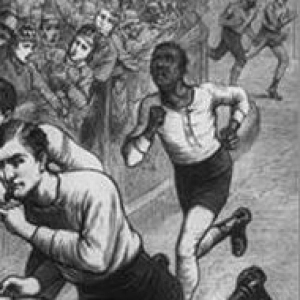
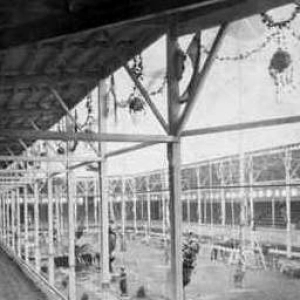
The six-day American Championship Belt race was billed as a contest to produce the best man to be sponsored to compete in the 4th Astley Belt race to be scheduled in June 1879, in England. For this qualifying race, $1,000 and a championship belt would be awarded to the winner. The race was open only to residents of America and would be under the direction of the New York Athletic Club.

Belts, not belt-buckles, had become the six-day championship award for the winner of these races. The belt was described as “38 inches long, five inches wide, made of seven heavy plates of gold and silver and bearing the inscription: ‘Champion Pedestrian Belt of the United States.’” Figures of runners were inscribed on two plates of the belt, some with wings or wheels for feet. The central plate featured large figures of the statue of Liberty and a native American.

The organizers planned for 40 starters, which would by far be the largest six-day race ever held up to that point. This race was significant, because it was the first major race where the field was composed mostly of amateurs. The entries’ fee for this race was not as expensive compared to the previous six-day races, and thus a new crop of 36 six-day “greenhorns” entered the race. Only four others had six-day race experience. With all this inexperience, they risked causing a disaster.

Davy Crockett hosts Ultrarunning History, a deep and often surprising exploration of how runners began pushing themselves beyond the standard marathon distance. While many assume the sport started with the boom of the 1980s, its roots are far older, stretching back into the late 19th century. This podcast digs into those early decades, uncovering the personalities, races, and cultural forces that shaped ultrarunning long before it had a name. Each episode functions as an audio archive, piecing together narratives from a time when running 50 kilometers or more was considered an almost unimaginable feat. You’ll hear about forgotten competitions, pioneering athletes whose stories have faded, and the gradual evolution of training and ethos that defined the community. The focus is primarily on the era before the year 2000, offering a foundational understanding of how modern ultra events came to be. It’s for anyone who loves running and wonders about its past, or for history buffs curious about a niche sport’s enduring human drama. The storytelling in this podcast aims to connect today’s trails and roads to a much longer, dustier path.

Author: Language: en-us Episodes: 50

Ultrarunning History
Podcast Episodes
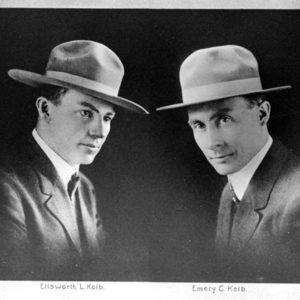
137: Grand Canyon Rim-to-Rim History – Part 8: Kolb Brothers [not-audio_url] [/not-audio_url]

Duration: 27:00
No Grand Canyon Rim to Rim History can be complete without mentioning the Kolb brothers, who maintained a photo gallery on the South Rim for decades. The two were among the very first to accomplish double crossings of th…
136: Grand Canyon Rim-to-Rim History – Part 7: Prof Cureton [not-audio_url] [/not-audio_url]

Duration: 26:55
“Prof” Thomas Henry Cureton (1875-1957) of Williams, Arizona, was a significant Grand Canyon rim-to-rim contributor. Through his selfless service in the 1920s, he passed on the love of the inner Grand Canyon to a generat…
135: Grand Canyon Rim-to-Rim History – Part 6: Early Guides [not-audio_url] [/not-audio_url]

Duration: 25:27
Running the Grand Canyon rim-to-rim and back is one of the ultimate experiences for ultrarunners. Before the Grand Canyon National Park was established in 1919, there were several individuals who helped to bring attentio…
134: Frank Hart – Part 6: Final Years [not-audio_url] [/not-audio_url]

Duration: 24:43
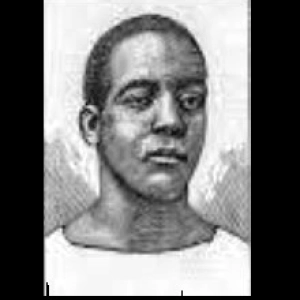
By late 1892, many of the original six-day professional pedestrians had left the sport, using their winnings to establish other careers, some of them pursuing illegal activities. Frank Hart had another terrible health sc…
133: Frank Hart – Part 5: Declining Running Career [not-audio_url] [/not-audio_url]

Duration: 27:26
By 1888, Hart had competed in about 30 six-day races in nine years. He had reached 100 miles or more in about 40 races and had so far won at least 30 ultras. Perhaps because of his color, he had not been given enough cre…
132: Frank Hart Part 4 – Former Champion [not-audio_url] [/not-audio_url]

Duration: 28:16
Frank Hart’s life in 1883 was at a low point. He had squandered his riches and damaged his reputation as a professional pedestrian. He was viewed as being hot-headed, undisciplined, and a womanizer. His wife and children…
131: Tom Osler – The Serious Runner [not-audio_url] [/not-audio_url]

Duration: 27:05
Thomas Joseph Osler (1940-2023) of Camden, New Jersey, was a mathematician, former national champion distance runner, and author. His published running training theories have made a deep impact on distance running for mu…
130: The 2023 Barkley Marathons [not-audio_url] [/not-audio_url]

Duration: 24:48
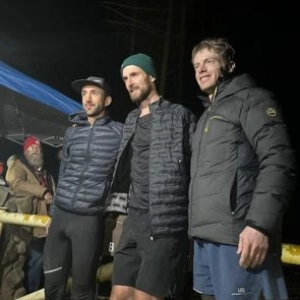
The Barkley Marathons course (thought to be roughly 130 miles and about 63,000 feet of elevation gain) at Frozen Head State Park in Tennessee was conquered for the first time in six years. Laz (Gary Cantrell) blew the co…
129: Encore – Birth of the Barkley Marathons [not-audio_url] [/not-audio_url]

Duration: 37:07
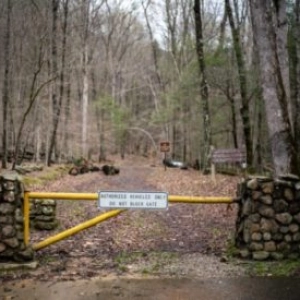
This is an encore episode. The Barkley Marathons, with its historic low finish rate (only 15 runners in 30 years), is perhaps the most difficult ultramarathon trail race in the world. It is held in and near Frozen Head S…